Use the ordinary real inner product on the domain of functions obeying the two separated boundary conditions. Integration by parts gives the Lagrange identity for a Sturm-Liouville operatorAt , the two boundary-value vectors and satisfy the same homogeneous linear relation. If , both function values vanish; if , their derivatives are the same constant multiple of their values. Either way . The same argument applies at . HenceThis proves symmetry, and the regular separated Sturm-Liouville problem has the same adjoint domain, so is self-adjoint. To see the domain point, require the boundary form to vanish against every admissible : the independently variable endpoint data force an adjoint-domain function to obey those same endpoint relations.
As usual, each endpoint pair and must be nonzero, and the coefficients must have the regularity needed for these operations. An identically zero pair would impose no condition at that endpoint and would not give the claimed self-adjoint operator. The related operator is self-adjoint in the weighted inner product .
Multiply the eigenvalue equation of the Sturm-Liouville problem by and integrate. Integration by parts givesSince is a nonzero eigenfunction and , the denominator is strictly positive. Thus the Rayleigh quotient isThe endpoint term must be retained for a general Robin boundary condition; it vanishes for homogeneous Dirichlet boundary conditions but need not vanish in the present general problem.
The left boundary condition is , while the right one is . Hence . The Rayleigh quotient becomesEvery term on the right is nonnegative. If the whole expression were zero, in particular , so would be constant. Its zero value at the left endpoint would force , contrary to its being an eigenfunction. ThereforeThis is the positivity mechanism for Dirichlet-Robin eigenvalues on a finite interval. The sign of the boundary contribution is positive for the convention with .
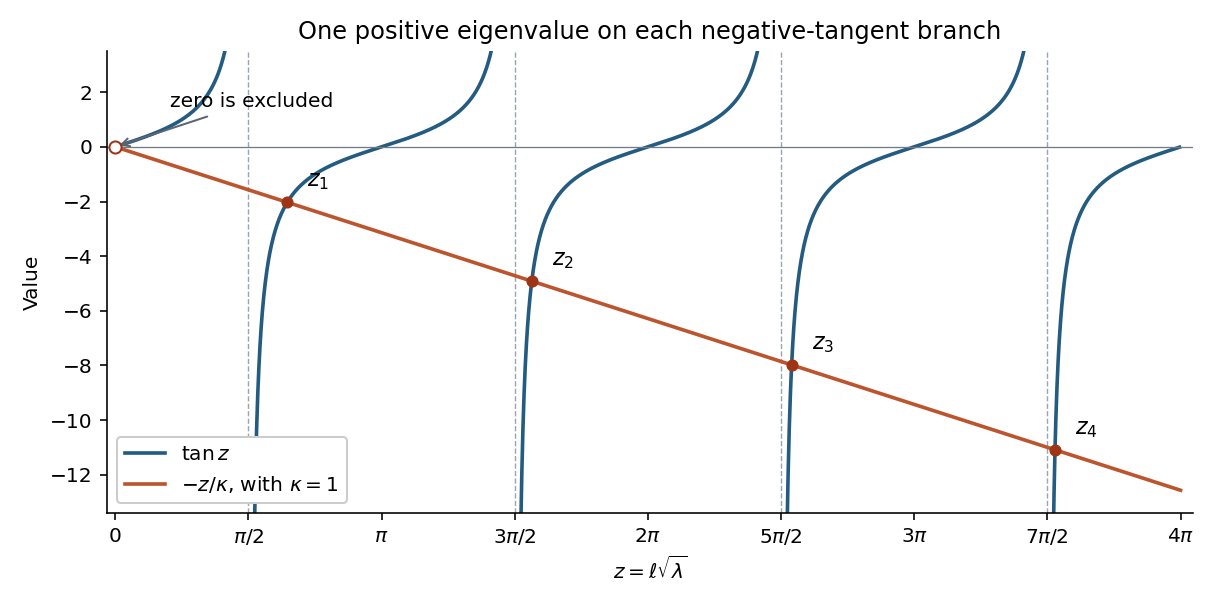
By part (c), write with . The equation is , and the left Dirichlet boundary condition eliminates the cosine term. Thus , with . The right Robin boundary condition becomesPut and . A root cannot have , so this is equivalent to .
On each interval , , the function rises from to a positive value and has derivative . The intermediate value theorem and strict monotonicity therefore give exactly one root there. On the intervening positive-tangent intervals both terms are positive, so there are no further positive roots. ConsequentlyThese intervals establish and an infinite sequence of eigenvalues. The apparent algebraic root of the sine equation is excluded: it gives a zero sine function, and the direct zero-eigenvalue solution would require .

For vector normalization to unit norm, the Dirichlet-Robin eigenvalues on a finite interval giveThe eigenfunctions can otherwise be scaled by any nonzero real constant.
For fixed and , the line becomes increasingly negative, so each intersection approaches its branch’s left-hand vertical asymptote. Write , where and . The eigenvalue equation givesSince , it follows that . ThusThe half-integer phase identifies the sharper high-frequency behaviour of these Dirichlet-Robin eigenvalues on a finite interval. The expansion holds with the Robin coefficient fixed; it is not a uniform expansion in .
Articles by others on the same topic
There are currently no matching articles.