For a continuously differentiable vector field on a bounded volume with piecewise smooth closed boundary , the divergence theorem stateswhere is the outward unit normal vector. Thus total outward flux through a closed surface equals the integral of the local divergence inside it. A nonclosed surface first needs a suitable closure, with the added surface's flux accounted for separately.
In cylindrical coordinates, the surface has radius . It is the lateral surface of a right circular cone, with vertex at the origin and axis along positive . Its height is and the limiting upper rim has radius ; the horizontal disk at that rim is absent. The half-angle from the vertical satisfiesThe upper rim is excluded by , which does not affect any convergent surface integral. The vertex likewise contributes no area.
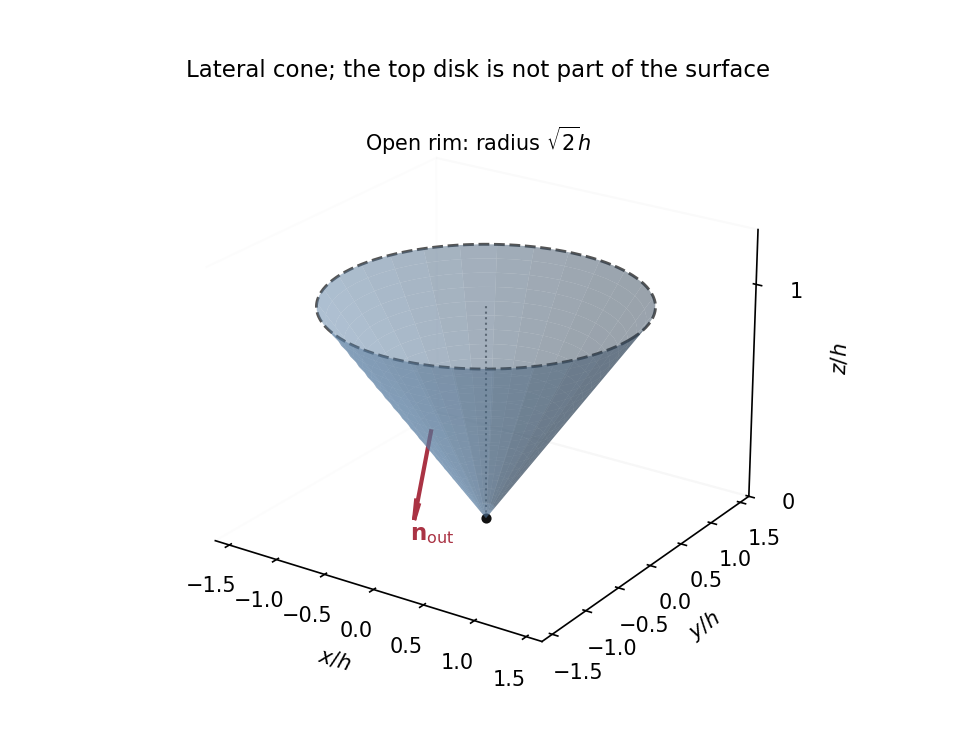
The open lateral cone and its auxiliary closing cap
. Original sketch in units of . The dashed upper rim bounds an auxiliary disk used only to apply the divergence theorem. The arrow shows the outward lateral normal, which has a downward component. Details.
Close the cone with the horizontal disk at height , and let be the enclosed solid. The divergence isThe term integrates to zero by reflection symmetry of each circular cross-section. Using the divergence theorem and cylindrical coordinates, the closed-surface flux isThe outward normal on is , so its flux is its area times :Subtracting this cap contribution gives the required lateral flux:This is conical flux by closing with a cap. The normal convention matters: on the lateral cone the outward normal points radially outwards and partly downwards, so the contribution to the lateral flux is negative. To justify applying the theorem at the vertex, truncate a small tip and take its size to zero; the extra flux vanishes because is regular there.
Articles by others on the same topic
There are currently no matching articles.