Take nonzero real trial functions with square-integrable and sufficient decay for integration by parts. For a compactly supported variation , the first variations areThe quotient rule for the functional then yieldsBy the fundamental lemma of the calculus of variations, stationarity for all such is equivalent toConversely, multiplying a decaying eigenfunction equation by and using integration by parts gives , so its Rayleigh quotient equals and its first variation vanishes. Thus the stationary values of the functional are the energy eigenvalues. The word "extrema" in the question includes stationary points here: higher eigenfunctions can be saddle points of the unrestricted Rayleigh quotient.
The Rayleigh-Ritz variational principle givesChoose an admissible trial family, calculate its Rayleigh quotient, and minimize over its parameters to obtain the best upper bound within that family. Equality holds for the exact ground state; a restricted family generally gives only an upper bound.
For the trial function, . The required Gaussian integrals areThe second formula follows by differentiating the first with respect to . Thereforeand division by gives the Gaussian variational bound for an attractive Gaussian well:This is a good trial family because it consists of smooth, positive, square-integrable functions decaying at both infinities. Each is an even function, matching the symmetry of the lowest bound state in this even potential, and the parameter varies its width. It also permits exact Gaussian integrals. Its Gaussian tail need not equal the exact exponential tail of a negative-energy bound state for the Rayleigh-Ritz variational principle to give a valid bound.
Differentiating the Gaussian variational bound for an attractive Gaussian well givesThus an interior stationary point obeysThe left side of the first equation increases strictly from zero to infinity, so there is exactly one such point. More explicitly,so is a strictly convex function on and is its global minimum. At that minimum the stationarity equation givesThere is a continuous limiting zero at , although at exactly is not a square-integrable function and hence is not an admissible trial. For a positive zero, division by and squaring gives , sois the unique positive zero. The other quadratic root is negative and inadmissible. Near zero,so the graph leaves the origin with slope , falls to its unique negative minimum, rises through , and grows as at infinity.
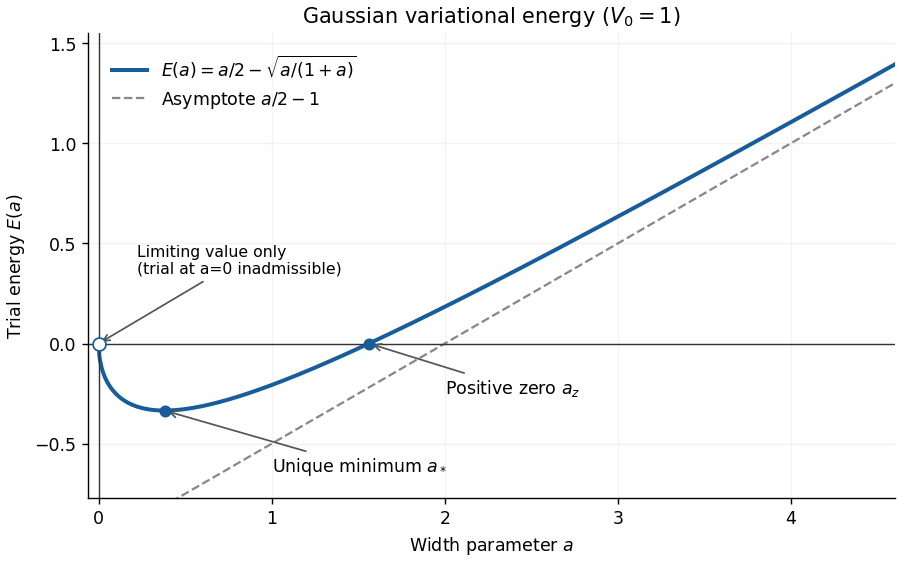
The Gaussian variational bound for an attractive Gaussian well at , showing its negative minimum and positive zero
. Details. 
By the Rayleigh-Ritz variational principle,Thus the attractive well supports a negative-energy bound state for every .
It is enough to choose an admissible parameter, without solving the minimizing equation. Take in the Gaussian variational bound for an attractive Gaussian well. The Rayleigh-Ritz variational principle giveswhere an explicit remainder isThe denominator tends to as , proving in Big O notation. More precisely the binomial series givesand thereforeThis is an upper bound on the exact ground state energy, rather than an assertion that the leading coefficient of its exact weak-potential expansion is .
Articles by others on the same topic
There are currently no matching articles.