The three contacts in the strip. Work with the external-contact arrangement drawn in the original diagram: both disks lie between the two parallel lines and touch opposite boundaries. A rigid motion puts those boundaries at and , with , and makes . Write , and let the positive radii be . Because a tangent to a circle is perpendicular to the corresponding radius, the centres areAt the external tangency, the two radial segments form the segment , with and . Hence the internal division formula givesThusThe coefficient is strictly between zero and one, so lies on the actual line segment . This proves collinearity for tangent circles between parallel lines. We will also use the fact that and are chords of the respective circles; the entire line segment therefore lies in the union of their closed disks.
The four contacts. Label the successive contact points , with belonging to and . The original diagram has four positive-radius circles with disjoint interiors, successive external tangencies, and distinct contact points. Set and apply the reciprocal Möbius transformationBy part (b), the two circles through become straight lines . These straight lines cannot meet at a finite point, since their inverse images would give a second intersection of . They are therefore distinct parallel lines. The other two circles avoid , so their images are ordinary circles missing zero.
The three remaining contacts retain their tangencies. Indeed, away from the map and its inverse are holomorphic functions with nonzero derivatives, hence are local conformal maps. In particular they preserve a shared tangent line. Equivalently, bijectivity preserves the unique intersection of two generalized circles, which characterizes their tangency here.
The finite closed disks bounded by lie between , have external tangency to each other, and touch opposite boundaries at the images of and . To track the sides as well as the boundaries, a closed disk avoiding maps to the bounded closed disk of its image circle, while each disk with on its boundary maps to a closed half-plane. The two latter half-planes have disjoint interiors, so their complement is the strip containing zero. Disjointness of the original interiors puts inside that strip. Neither image closed disk contains zero, since the reciprocal Möbius transformation sends only infinity to zero.
The first part now makes the three finite transformed contact points collinear, on a straight line . It is essential that misses zero. If it passed through zero, its segment between and would contain zero, since zero lies strictly within the strip. But the first part shows that this whole line segment is covered by the two image closed disks, neither of which contains zero. This contradiction proves .
The inverse image of a straight line missing zero is a genuine circle through , by the same coefficient transformation in part (b), or by applying the involution in reverse and translating back. This circle contains , while is the inverse image of the point at infinity on . ThereforeThis is the four contact points of a circle chain result; the four contacts form a cyclic quadrilateral.
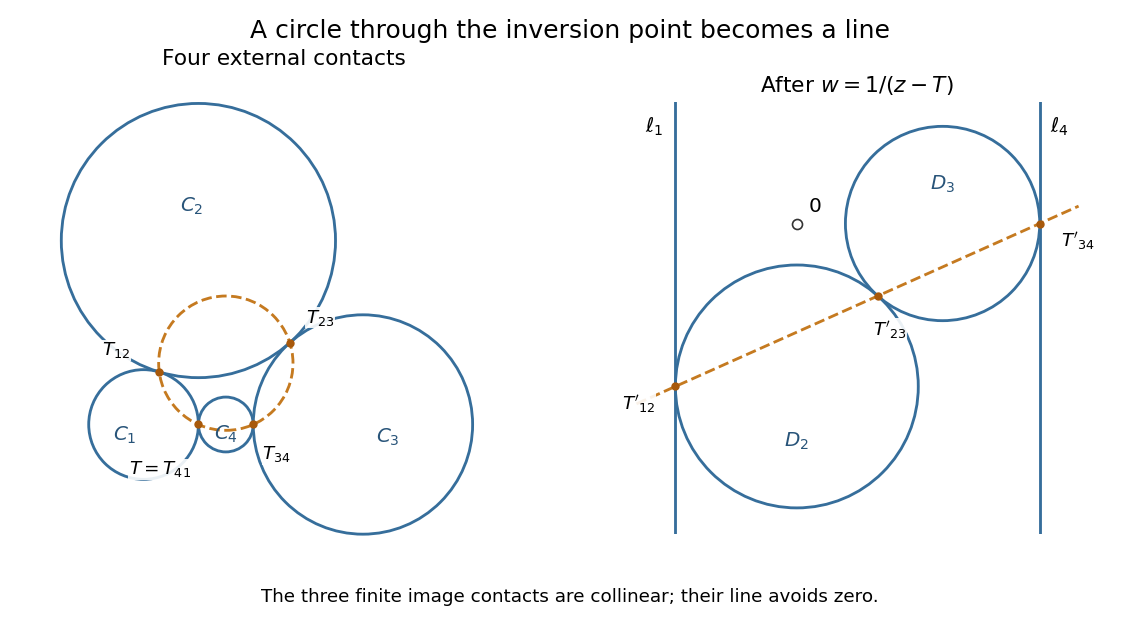
The reciprocal transformation of a generalized circle turns the chain into two tangent circles between parallel lines
. An original exact construction illustrates the arrangement. The orange circle through all four contacts becomes the orange straight line through the three finite transformed contacts. The hollow point at zero lies between the parallel lines and outside the two image disks. Details.
The pictured arrangement matters. Arbitrary mixtures of internal tangency and external tangency can instead give four distinct collinear contacts: take four circles whose diameter endpoints on the real axis are respectively , , , and . Their successive contacts are , so no ordinary circle contains all four. The proof above establishes the requested genuine-circle conclusion for the external-contact arrangement actually drawn, rather than silently treating every generalized circle as an ordinary circle.
Articles by others on the same topic
There are currently no matching articles.