Original sitting: Friday 19 June 2015, 9.30am to 12.30pm. The recovered original cover establishes this date despite the enclosing archive's directory label. [ref]
https://www.whatdotheyknow.com/request/ba_computer_science_past_papers/response/2577745/attach/2/202402%20183%20CS%20Papers.zip?cookie_passthrough=1. Original source archive, member 2014/T/a13754w1.pdf; recovered cover headed Trinity Term 2015
The complete five-page replacement is in the Mathematics Part A FOI release, member
FOI-20210708-1 - Data/a13754w1 (3).pdf. Its intact printed page 2 supplies Questions 1–3; the readable original Questions 4–6 and all twelve existing answers are retained unchanged. The original archive link above is preserved for provenance.The Heine-Borel theorem says that a subset of finite-dimensional Euclidean space is compact exactly when it is both closed and bounded:Here compactness refers to the subspace topology induced by the usual Euclidean metric, and closedness and boundedness are measured in the ambient Euclidean space. This characterization does not hold for arbitrary metric spaces.
The empty set is bounded. Otherwise choose in the compact metric space . The open balls , , form an open cover. A finite subcover exists by compactness; because the balls are nested, the largest one already covers . Hence for some .
For , the triangle inequality gives . ThusThe proof uses only compactness and the metric, not a coordinate system.
The sequence is unbounded. Every compact metric space is bounded, by part (b), so this subspace is not compact.
Take an irrational number . The density of the rational numbers provides a sequence in converging to , which is outside that subset. Thus the subset is not closed in . By the Heine-Borel theorem, it is not compact, despite being bounded.
The unit circle is the inverse image of the closed set under the continuous map , so it is closed. It is also bounded, since every point has Euclidean norm one. The Heine-Borel theorem gives compactness.
The open unit disk is bounded but not closed: lies in it for and converges to the omitted point . By the Heine-Borel theorem, it is not compact.
The points belong to the indicated subset for every positive integer . They form an unbounded sequence, so this metric space is not bounded. Therefore it is not compact. Shrinking the vertical width does not bound its horizontal extent.
By the Heine-Borel theorem, a noncompact subset is either unbounded or not closed. If is unbounded, the restriction is a continuous function with unbounded range.
Otherwise is bounded and not closed. Choose , and defineIts denominator is nonzero on , so it is continuous. Since is in the closure, for every there is with . Hence , proving that this continuous function is unbounded. These two cases establish unbounded continuous witnesses to noncompactness of a real subspace.
We can arrange that neither the supremum nor the infimum is attained. By part (d), choose a continuous function on with unbounded range, and put . Choose so that increases strictly to infinity. Construct a continuous function withkeep it constant up to and interpolate linearly on each . Since , the joining points have no finite accumulation, so this defines a continuous function everywhere on its domain.
Now setBy function composition, is continuous, and for every . Along the even and odd chosen points,Thus and , and neither is a value of . This proves the bounded continuous witness with neither extremum attained construction, including for subsets that are bounded but not closed.
A metric space is connected when it has no separation of a topological space: it cannot be written as the union of two disjoint nonempty open subsets. Equivalently, the only subsets that are both open and closed are the empty set and the whole space.The open sets here are those of the metric topology.
A metric space is path-connected if every pair can be joined by a path: a continuous map with and .The path must remain in , including at its endpoints.
Suppose a path-connected space had a separation . Choose , , and a path from to . The inverse images and are disjoint open sets in the subspace topology of , cover it, and are nonempty because they contain its opposite endpoints. This contradicts the connectedness of an interval.
Therefore every path-connected space is connected. Notice that it is the subspace topology on that is used in the inverse-image argument.
The two open balls are disjoint: a common point would have distances to their centres summing to less than two, contradicting the triangle inequality. Both are nonempty and relatively open, and they cover the union. They therefore give a separation, so the union is neither connected nor path-connected.
Each closed ball is a convex set and contains the origin. Join any point to zero by a line segment inside its ball, then join zero to the other point. Concatenating the two segments gives a path in the union. It is therefore path-connected and connected.
Only the right-hand ball is closed, but the union is still path-connected and connected. Its right-hand closed ball contains zero, and every point of the left-hand open ball can be joined to zero by .
To check the endpoint carefully, write . For , convexity and the triangle inequality giveAt , the path reaches zero in the other, closed ball. Points in that ball also join zero by line segments, completing the construction.
Each vertical line segment over a rational coordinate meets the horizontal line at height one. A point on such a segment can move vertically to the top, then horizontally along that line; points already at height one use only the horizontal motion. Concatenating these motions joins any two points.
Thus the rational comb with a deleted attachment point construction, before deletion, is path-connected and hence connected. The infinitely many vertical pieces cause no difficulty because each individual path uses only finitely many segments.
Let be this union of rational-coordinate horizontal and vertical lines. A point has either rational , in which case it moves vertically to then horizontally to , or rational , in which case it moves horizontally to then vertically to . Every segment remains on a line with a rational fixed coordinate.
Write and . Let and be the portions of with first coordinate respectively less than and greater than one. Each is path-connected: move along a rational tooth to its corresponding open half of the top line, then horizontally there. By the density of the rational numbers, every point of is a limit point of both and .
Use the elementary fact that adjoining any collection of limit points to a connected set preserves connectedness. Indeed, in a proposed separation, the connected subset lies on one side; relative openness would prevent any point on the other side from being a limit point of it. Therefore and are connected. They intersect in , so their union is connected.
There is, however, no path from to . If were one, let be the first time at which . Such a first time exists by continuity and compactness of , and . For , membership in the comb forces . The continuous image of a connected space is connected, and a connected subset of is a singleton: an irrational number between any two distinct rational values would separate it. Hence for . By continuity, , which was deleted.
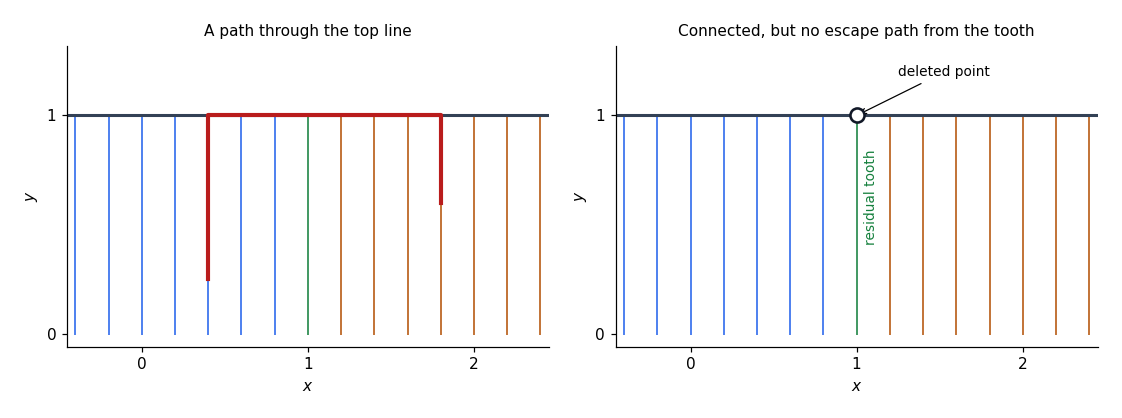
Deleting one attachment point destroys paths but preserves connectedness
. Finite samples of rational vertical teeth illustrate the full rational comb. The right panel marks the deleted point with an open circle; the residual vertical tooth is still approached from both sides. Details.
Define on the sphere. It is continuous and satisfies . If at a chosen point, we are done. Otherwise choose a unit vector perpendicular to and follow the half great circleThe Pythagorean theorem shows that lies on the sphere, and its endpoints are . The continuous function has opposite signs at the endpoints. The Intermediate value theorem therefore gives a zero , soThis is a scalar equal-value assertion for an antipodal pair; it uses only a path and the Intermediate value theorem.
One standard form of the Cauchy integral formula is this: if is holomorphic on an open set containing a contour that is a simple closed curve and its interior, and has positive orientation of a contour, then for every point inside it,The hypothesis includes the contour itself; singularities on the contour are excluded. In particular, the formula applies on a circle whose closed disk is contained in the domain of holomorphy.
Put and choose . For , the triangle inequality givesThe reverse triangle inequality therefore yieldsIf had no root, the function would be an entire function. The bound just proved makes as . On the remaining closed disk, continuity and the extreme value theorem make bounded. Thus is a bounded entire function, so Liouville's theorem makes it constant. Its limit at infinity forces that constant to be zero, impossible for a reciprocal.
Consequently has a root in . This proves the existence part of the fundamental theorem of algebra. The invoked Liouville theorem follows from the Cauchy integral formula: the Cauchy estimate on arbitrarily large circles gives when is bounded by .
List the roots with their multiplicities. By the factor theorem, with . The product rule, followed by division where , gives its logarithmic derivative:Let . If too, then is already one of the roots, so either desired location conclusion follows immediately. Otherwise the displayed sum vanishes at . If all roots have positive imaginary parts but , thenfor every . Their sum cannot be zero. Thus .
For the unit disk conclusion, the same sum gives an especially transparent convex combination. Taking complex conjugates and setting givesTherefore, if every ,The strict inequality follows because this is a finite weighted average of numbers strictly below one. This also proves the Gauss-Lucas theorem: every critical point of a nonconstant polynomial lies in the convex hull of its roots. The common-root case, handled before division, is essential when multiplicities occur.
Choose and traverse the circle counterclockwise, so it has positive orientation of a contour. The Cauchy coefficient formula gives, for every nonnegative integer ,The smaller radius matters: the holomorphic function is only known on , so its values on need not exist. To see directly why this contour integral selects , the power series converges uniformly on , allowing uniform convergence and contour integration to justify integrating term by term. The contour integral of is zero for and for . Thus all other terms disappear.
Use the generalized binomial theorem with exponent , choosing the analytic branch of a square root that equals at . For ,The signs cancel in each binomial coefficient. For ,The same expression equals for , using the empty-product convention. Consequently the power series isIts coefficients are the normalized central binomial coefficients. As a convergence check, the ratio of successive absolute terms tends to , so the ratio test gives absolute convergence inside the unit disc. Applying the Cauchy coefficient formula to the holomorphic function now immediately yieldsThis value is independent of the chosen radius because the contour integral extracts the same coefficient on every such circle.
For , the number avoids the nonpositive real axis. Define the branch of the complex logarithm byHere the principal argument is selected as a continuous map on that slit domain, so this is a holomorphic function, with derivative and . For example, locally writing gives , verifying the complex derivative. The normalization also makes this branch of the complex logarithm unique: any two continuous choices differ by a constant integer multiple of on the connected slit domain, and their values at agree.
To evaluate the corresponding analytic branch of a square root on the unit circle, factorFor , we have and . Thus this factorization already uses the selected principal argument, with no hidden change by . It follows thatHalving this expression and applying the exponential function givesSince , the desired branch value isFor instance, gives , a quick check that the sign agrees with the normalization.
Write . The given limiting identity and the Cauchy coefficient formula from part (a) give the boundary contour integralThe contour passes through , so its value here is an improper integral using the one-sided branch values. Parametrize its open arc by , . Substitution of the analytic branch of a square root calculated in part (b) givesThe factor comes from cancelling in against ; the extra comes from the chosen branch. Keeping both phases prevents a change in the half-integer frequency.
Now put . ThenDividing by givesTaking the real part therefore provesAll these improper integrals converge absolutely: the numerators are bounded, while is of order at zero and at . Hence the substitutions and passage to the real part are legitimate. The imaginary part also shows that the corresponding sine integral has the same positive value, which checks the phase calculation.
One standard form of Cauchy's residue theorem is the following. Let be a positively oriented contour that is a simple closed curve, and let be a holomorphic function on an open set containing and its interior except for finitely many interior isolated singularities . There are no singularities on . ThenThe residue is the coefficient of in the Laurent series at . Each interior isolated singularity contributes once because the winding number of this positively oriented contour about each such point is one. Reversing the orientation of a contour reverses the sign. This form of Cauchy's residue theorem applies to the rectangle below.
Start with the exponential function definition of the hyperbolic sine and use Euler's formula:Identifying the hyperbolic sine and hyperbolic cosine in the final line gives
The two terms in the preceding formula are the real part and imaginary part. Their squared sum is the squared complex modulus:Here follows directly from the exponential function definitions. The hyperbolic sine modulus identity therefore yieldsEquality holds exactly when , that is, when is an integer multiple of . The lower bound is uniform in , which will control whole vertical sides of the contour rather than just their endpoints.
The equation requires . Write , with real . Comparing real parts and imaginary parts using part (b)(i) givesIf , the second equality would require , impossible because . Thus , forcing andNow , so . The hyperbolic cosine is even and is a strictly increasing function on , hence . Conversely, substituting these values gives , so every value found does satisfy the original equation. Therefore the complete set is
Put and . Traverse the rectangle with positive orientation of a contour, taking . Part (i) shows that the only enclosed poles of areThey are simple poles becauseThe residue formula for a quotient at a simple denominator zero givesTheir imaginary terms cancel and their residues sum to . Thus Cauchy's residue theorem gives
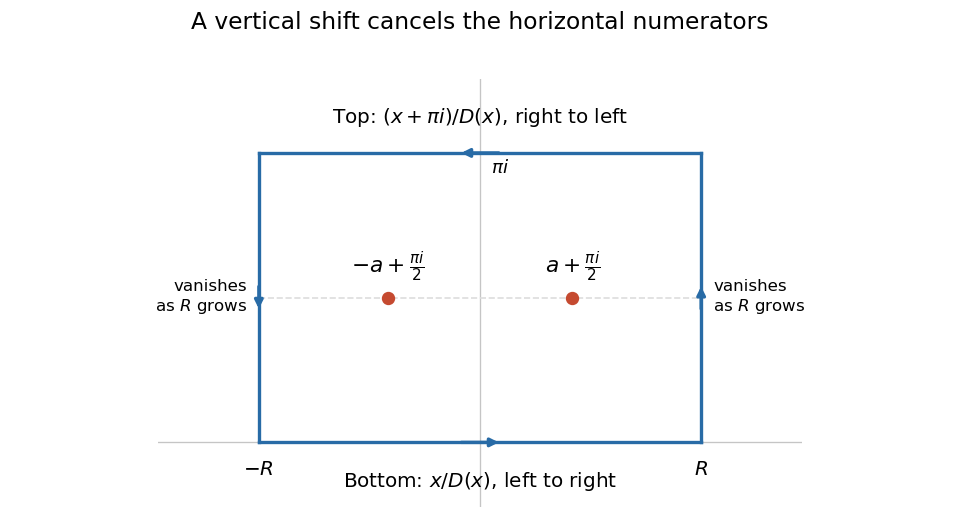

The choice of numerator makes the horizontal sides useful. The hyperbolic sine satisfies , so . Consequently the lower and upper contour integrals, with their actual orientations, add toIt remains to justify discarding both vertical sides. On either side , , the reverse triangle inequality and part (b)(ii) implyThis lower bound is positive for sufficiently large . Also and each vertical side has length . The estimation lemma bounds the absolute value of the sum of the vertical contributions byThe real improper integral converges absolutely, since its integrand is continuous on the real axis and decays like at infinity. Combining all four sides and taking givesThereforeAn independent real-variable check uses the hyperbolic tangent substitution : the integral becomes . Its antiderivative uses the inverse hyperbolic tangent, giving . As , this tends to , agreeing with and checking the factor of two.
Use and . When , completing the square givesThus, with ,If , this is a circle with centre and radius . If , it is the single point , sometimes called a degenerate circle of radius zero. If , it is the empty set, because a squared complex modulus cannot be negative.
When and , write and . The remaining equation iswhich is a straight line with normal vector . It passes through zero exactly when . Finally, when , the equation has no solutions if and every complex number is a solution if .
The complete classification of a real complex-circle equation therefore includes two degeneracies in addition to ordinary circles, straight lines and the empty set:For the three advertised alternatives to be exhaustive, one must exclude the identically zero equation and either exclude or explicitly allow radius-zero circles. This is a qualification of the unrestricted coefficients, not a reason to discard the genuine circle and straight line cases used next.
Put , so and . Substitute into the equation in part (a) and multiply by :This is the reciprocal transformation of a generalized circle. In the original coefficient convention the new triple is : the linear coefficient is conjugated, which reflects the distinction between and inversion in a circle .
A circle through zero. Here , , and nondegeneracy forces . Its image satisfiesThis is a straight line, and does not satisfy it because . Conversely every point of this straight line has a nonzero reciprocal on the original circle. Thus the original circle with zero omitted maps onto the full finite straight line.
A circle missing zero. Now , and . Applying part (a) to the transformed coefficients gives centre and radius , so the image is again a genuine circle. It misses zero, because the transformed equation has nonzero constant . The inverse proves that the whole of this circle is attained.
A straight line through zero. Here and . The transformed equation is , another straight line through zero. Precisely, the finite map takes the punctured original straight line onto the punctured image straight line, since neither the domain nor the image of contains zero.
In the Riemann sphere convention , all three become exact statements about whole generalized circles:Finite straight lines acquire their point at infinity in this convention. Stating it avoids accidentally adding merely because it satisfies a multiplied equation.
The three contacts in the strip. Work with the external-contact arrangement drawn in the original diagram: both disks lie between the two parallel lines and touch opposite boundaries. A rigid motion puts those boundaries at and , with , and makes . Write , and let the positive radii be . Because a tangent to a circle is perpendicular to the corresponding radius, the centres areAt the external tangency, the two radial segments form the segment , with and . Hence the internal division formula givesThusThe coefficient is strictly between zero and one, so lies on the actual line segment . This proves collinearity for tangent circles between parallel lines. We will also use the fact that and are chords of the respective circles; the entire line segment therefore lies in the union of their closed disks.
The four contacts. Label the successive contact points , with belonging to and . The original diagram has four positive-radius circles with disjoint interiors, successive external tangencies, and distinct contact points. Set and apply the reciprocal Möbius transformationBy part (b), the two circles through become straight lines . These straight lines cannot meet at a finite point, since their inverse images would give a second intersection of . They are therefore distinct parallel lines. The other two circles avoid , so their images are ordinary circles missing zero.
The three remaining contacts retain their tangencies. Indeed, away from the map and its inverse are holomorphic functions with nonzero derivatives, hence are local conformal maps. In particular they preserve a shared tangent line. Equivalently, bijectivity preserves the unique intersection of two generalized circles, which characterizes their tangency here.
The finite closed disks bounded by lie between , have external tangency to each other, and touch opposite boundaries at the images of and . To track the sides as well as the boundaries, a closed disk avoiding maps to the bounded closed disk of its image circle, while each disk with on its boundary maps to a closed half-plane. The two latter half-planes have disjoint interiors, so their complement is the strip containing zero. Disjointness of the original interiors puts inside that strip. Neither image closed disk contains zero, since the reciprocal Möbius transformation sends only infinity to zero.
The first part now makes the three finite transformed contact points collinear, on a straight line . It is essential that misses zero. If it passed through zero, its segment between and would contain zero, since zero lies strictly within the strip. But the first part shows that this whole line segment is covered by the two image closed disks, neither of which contains zero. This contradiction proves .
The inverse image of a straight line missing zero is a genuine circle through , by the same coefficient transformation in part (b), or by applying the involution in reverse and translating back. This circle contains , while is the inverse image of the point at infinity on . ThereforeThis is the four contact points of a circle chain result; the four contacts form a cyclic quadrilateral.
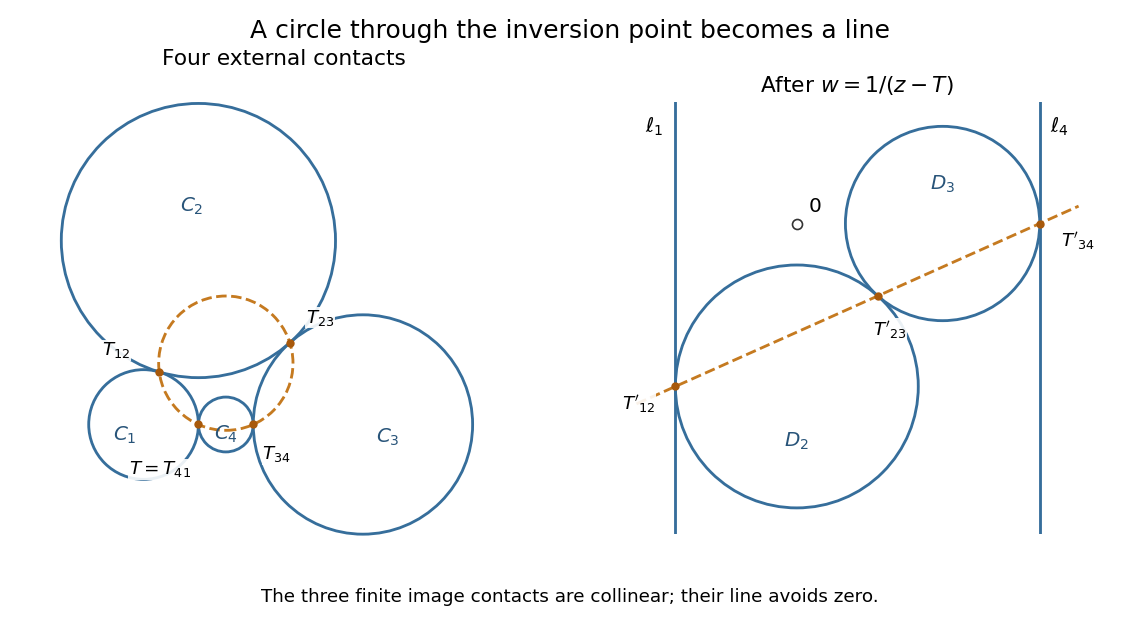
The reciprocal transformation of a generalized circle turns the chain into two tangent circles between parallel lines
. An original exact construction illustrates the arrangement. The orange circle through all four contacts becomes the orange straight line through the three finite transformed contacts. The hollow point at zero lies between the parallel lines and outside the two image disks. Details.
The pictured arrangement matters. Arbitrary mixtures of internal tangency and external tangency can instead give four distinct collinear contacts: take four circles whose diameter endpoints on the real axis are respectively , , , and . Their successive contacts are , so no ordinary circle contains all four. The proof above establishes the requested genuine-circle conclusion for the external-contact arrangement actually drawn, rather than silently treating every generalized circle as an ordinary circle.
Articles by others on the same topic
There are currently no matching articles.