Use a self-assembled monolayer of an alkanethiol with a polar terminal group, such as . Sulfur anchors to gold while the exposed hydroxyl groups interact favorably with water. A methyl-terminated monolayer would instead present a low-polarity outer surface and usually retain hydrophobic character.
Prepare a clean gold surface, allow adsorption from a compatible clean solution, and rinse away unbound material. Dense coverage and molecular ordering help make the terminal chemistry reproducible. Mixed chain lengths or incomplete coverage can change the wetting response, so the presence of an OH group in the bottle alone is not sufficient. An original experiment demonstrated hydrophilic hydroxyl-terminated films and showed that mixing chain lengths changed surface order and wettability.[ref]
Molecular-Level Control over Surface Order in Self-Assembled Monolayer Films of Thiols on Gold by Colin D. Bain and George M. Whitesides. Science240, pp.62–63, abstract: sulfur anchoring, exposed hydroxyl groups and effects of mixed chain lengths
This specifies the resulting interface rather than treating every freshly prepared gold surface as intrinsically identical: contamination, preparation and adsorbates influence the starting contact angle.
A useful net bookkeeping reaction for thiol adsorption iswith removal or reaction of the hydrogen depending on environment. Equivalently, a simplified overall balance can combine two hydrogen atoms into . These balances identify sulfur anchoring; they are not a claim that one elementary adsorption step universally releases hydrogen gas.
Molecules arrive at the interface, adsorb through sulfur, and reorganize laterally as coverage grows. Interactions between the chains favor packing and order, with the hydroxyl end groups facing outward. Gold surface structure, defects and adsorption conditions affect the final film.
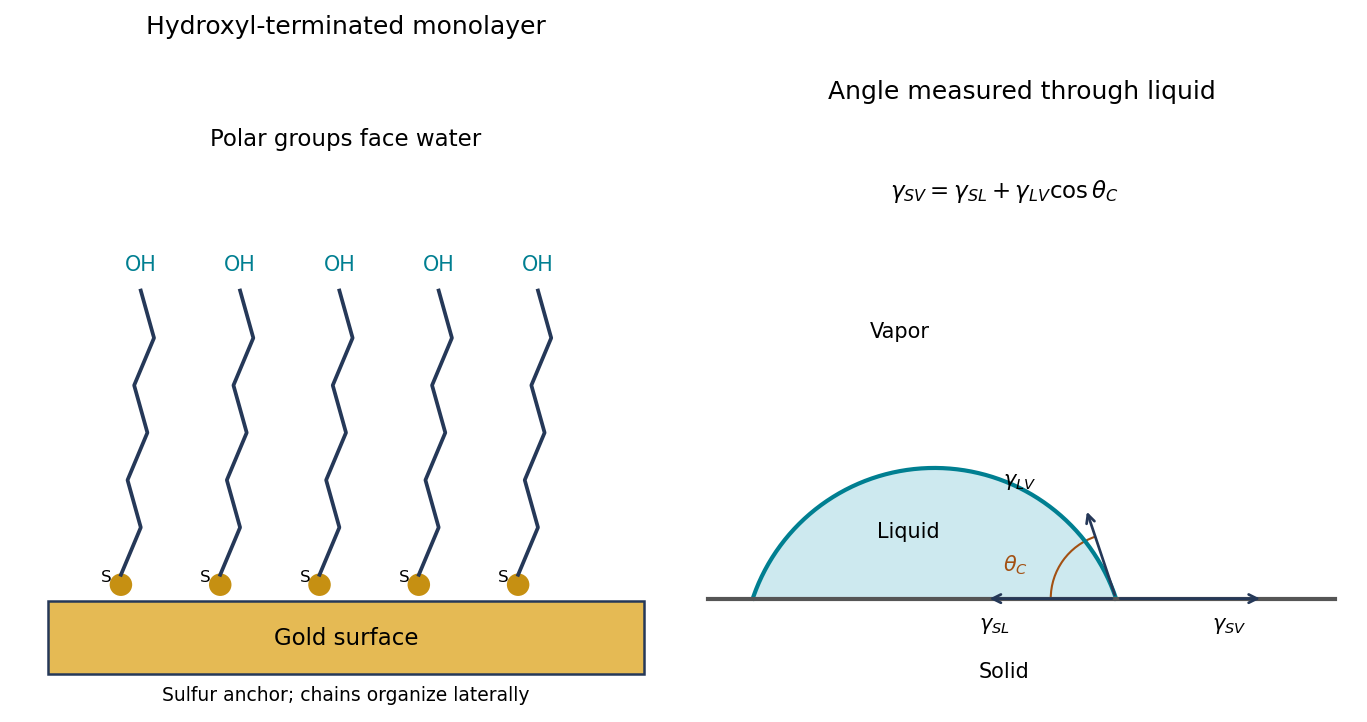
Original schematic of hydroxyl-terminated molecules anchored to gold and the through-liquid contact angle with interfacial-tension balance
. Details. 
Articles by others on the same topic
There are currently no matching articles.