Use a self-assembled monolayer of an alkanethiol with a polar terminal group, such as . Sulfur anchors to gold while the exposed hydroxyl groups interact favorably with water. A methyl-terminated monolayer would instead present a low-polarity outer surface and usually retain hydrophobic character.
Prepare a clean gold surface, allow adsorption from a compatible clean solution, and rinse away unbound material. Dense coverage and molecular ordering help make the terminal chemistry reproducible. Mixed chain lengths or incomplete coverage can change the wetting response, so the presence of an OH group in the bottle alone is not sufficient. An original experiment demonstrated hydrophilic hydroxyl-terminated films and showed that mixing chain lengths changed surface order and wettability.[ref]
Molecular-Level Control over Surface Order in Self-Assembled Monolayer Films of Thiols on Gold by Colin D. Bain and George M. Whitesides. Science240, pp.62–63, abstract: sulfur anchoring, exposed hydroxyl groups and effects of mixed chain lengths
This specifies the resulting interface rather than treating every freshly prepared gold surface as intrinsically identical: contamination, preparation and adsorbates influence the starting contact angle.
A useful net bookkeeping reaction for thiol adsorption iswith removal or reaction of the hydrogen depending on environment. Equivalently, a simplified overall balance can combine two hydrogen atoms into . These balances identify sulfur anchoring; they are not a claim that one elementary adsorption step universally releases hydrogen gas.
Molecules arrive at the interface, adsorb through sulfur, and reorganize laterally as coverage grows. Interactions between the chains favor packing and order, with the hydroxyl end groups facing outward. Gold surface structure, defects and adsorption conditions affect the final film.
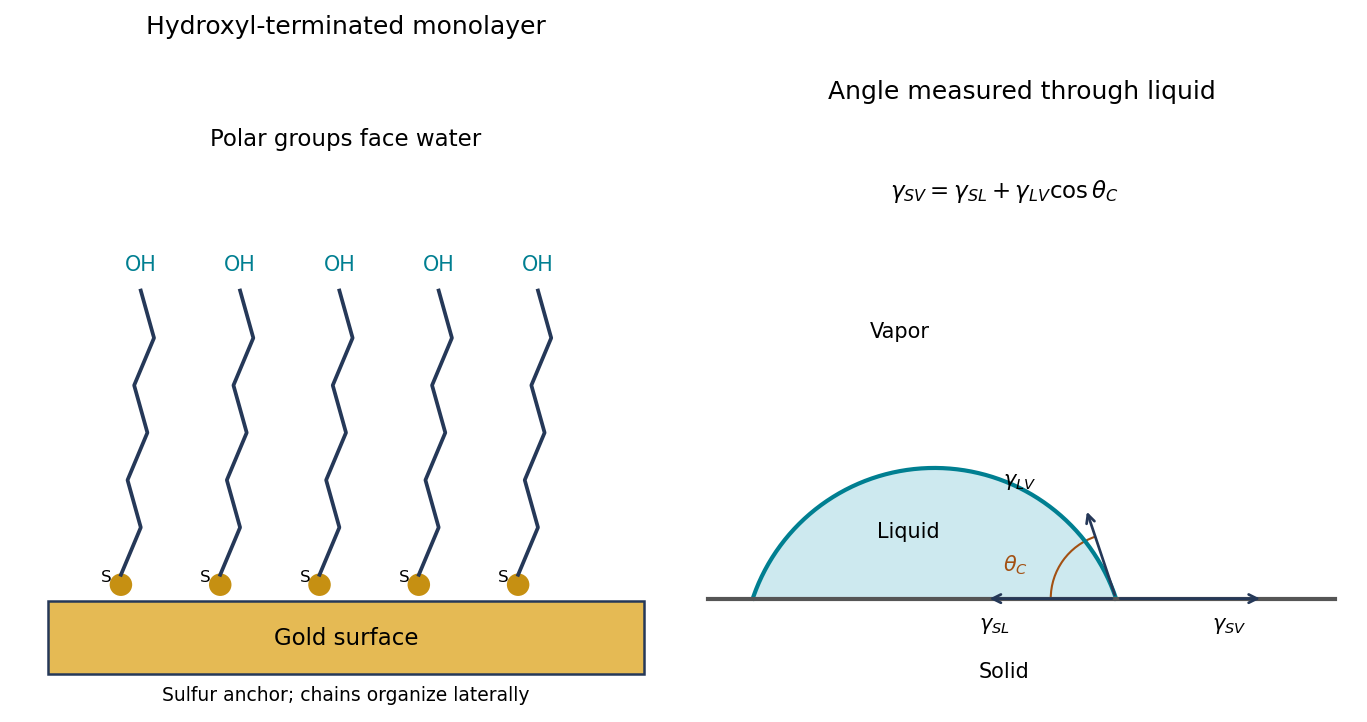
Original schematic of hydroxyl-terminated molecules anchored to gold and the through-liquid contact angle with interfacial-tension balance
. Details. 
The contact angle is measured through the liquid between the solid surface and the tangent to the liquid–vapor interface at the contact line. The right panel of the wetting diagram labels that angle and the three interfacial tensions.
At , the ideal macroscopic limit is complete wetting: a film spreads rather than remaining a finite-angle cap. Angles between and are conventionally called hydrophilic for water; the drop wets the surface relatively well. At the tangent is vertical. Between and the water drop is conventionally hydrophobic, with increasingly weak wetting. The exact limit represents vanishing macroscopic contact in an ideal model, not a routine finite-area sessile drop on a real solid.
The categories describe water under specified conditions. Roughness, contamination and contact-line pinning can make advancing and receding angles differ from each other and from the ideal equilibrium angle.
Use unambiguous symbols for solid–vapor, solid–liquid and liquid–vapor interfacial energies. The printed description repeats an interface subscript, so it cannot be used literally for two different interfaces.
For a smooth homogeneous equilibrium surface, take a horizontal displacement of the contact line. The substrate-parallel force balance isThus the contact-angle relation is Young's equation:The same result follows by varying interfacial free energy at fixed liquid volume. It assumes equilibrium, no contact-line pinning, and negligible line-tension and roughness corrections. If the inferred cosine lies outside , the finite-angle equilibrium construction fails and a wetting limit must be considered.
The name in the question should be distinguished from the Young–Laplace equation, which relates a pressure jump to interface curvature. The horizontal interfacial balance derived here is Young's equation; it does not require introducing a pressure-curvature formula.
This is the first printed “(vi)”, concerning adhesion. The reversible work per unit area to separate the solid–liquid interface into solid–vapor and liquid–vapor interfaces isSubstitute from Young's equation:This is the Young-Dupré equation. It has units , equivalent to . The liquid–vapor tension is the multiplier; the abbreviated printed subscript does not denote a new interface. Within this equilibrium model, smaller water contact angle means larger reversible work of adhesion for fixed liquid–vapor tension.
At the theta temperature, use the long-chain ideal-coil relationsThe two stated molar masses have ratio . ThereforeThe input is an end-to-end root-mean-square distance, not a radius of gyration: omitting would give the wrong result. The apparent missing superscript in the printed masses does not affect the factor-five ratio used here. The estimate assumes the same chain architecture and unperturbed segment statistics, and uses the long-chain rather than finite-link correction.
This is the second printed “(vi)”, concerning solvent temperature. The coil is expected to expand, so its radius of gyration increases. For the usual upper-critical-solution-temperature behavior of polystyrene in cyclohexane, heating above the stated theta condition improves solvent quality. Effective repulsion between segments favors more expanded conformations than the ideal coil.
In a Flory–Huggins solution theory description, the theta condition corresponds approximately to interaction parameter , whereas a good solvent has a positive effective excluded volume. The asymptotic size dependence crosses toward with near for a flexible chain in three dimensions. These scaling ideas establish the expected direction, not a numerical expansion factor for a ten-degree temperature change. Its value would require measured solvent-interaction data or a calibrated crossover model.
Taking the printed reference to part(iii) literally, measure an equilibrium water contact angle with a calibrated sessile-drop goniometer on a smooth homogeneous surface. With independently constrained interfacial tensions, test . Advancing and receding measurements reveal pinning and hysteresis; contact angle alone cannot independently determine both unknown solid-interface energies.
If the intended reference was instead the polymer-size prediction in the preceding part, use static light scattering or small-angle neutron scattering at both temperatures on appropriately dilute solutions. At small scattering wave number , the Guinier approximationgives from the slope of against . Control concentration, aggregation and scattering contrast, and compare the extracted radii. Dynamic light scattering normally measures a hydrodynamic size rather than directly the same radius of gyration. Answering both readings avoids silently correcting the printed cross-reference.
Articles by others on the same topic
There are currently no matching articles.