A zero-dimensional example is buckminsterfullerene, : a closed cage with 60 vertices, 90 edges, 12 pentagons and 20 hexagons. Euler's relation is . Each carbon has three neighbors in a curved, approximately -bonded network; bonds are not all equivalent. Its cage diameter is of order .
Confinement in all directions gives discrete molecular orbitals, unlike the extended dispersion of graphene. It is an electron acceptor with characteristic electronic and vibrational spectra. Its pentagons supply the positive curvature needed to close the carbon network. A molecular solid of cages is held together predominantly by intermolecular forces, so its mechanical and electrical properties differ from those of an individual strongly bonded cage. Undoped fullerene is not a high-conductivity graphene sheet; doping, packing and charge transfer can strongly change transport.
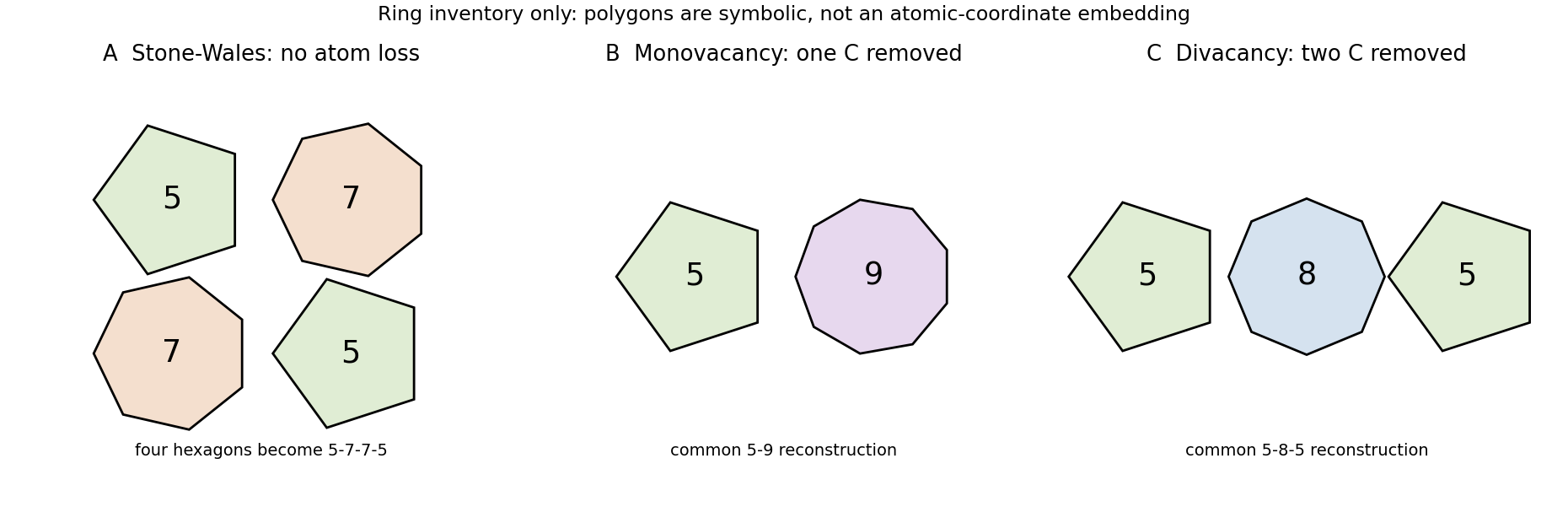
Three point-defect structures are a Stone-Wales defect, a reconstructed graphene monovacancy and a reconstructed graphene divacancy. The original sketch gives ring inventories rather than fitted atomic coordinates.
A Stone-Wales defect rotates one C–C bond, converting four hexagons into a 5–7–7–5 group without changing the number of atoms. A graphene monovacancy removes one carbon; a common reconstruction gives a 5–9 group with residual under-coordination. A graphene divacancy removes two adjacent carbons; a 5–8–5 reconstruction can eliminate dangling bonds. Other divacancy reconstructions exist, so atom loss does not uniquely select one topology.
Irradiation, energetic processing, etching and incomplete growth can create vacancies; thermally or beam-activated bond rearrangement can change their structures. Electron microscopy itself can create defects, so compare exposures before attributing a time sequence to unperturbed material.
Pentagons favor positive curvature and heptagons negative curvature. Such defects can bend tubes, help form caps or junctions, or change a local wrapping relationship. They scatter carriers and alter the local density of states; vacancies can add localized states and chemical reactivity. Whether a clean band gap appears depends on defect identity, concentration and arrangement, not merely on the presence of a defect.

Separated graphene sheets offer high accessible surface area, short lithium-transport distances and a conducting network. Edges and exposed sheet faces can supply additional storage sites; mechanical flexibility can help preserve contact during cycling. These advantages can improve rate capability when electrolyte access and electronic continuity are retained.
The graphite reference composition giveswhere the host-carbon mass is used. An idealized inventory doubles this figure, but two accessible faces do not prove a reversible electrode. Binding energies, aggregation, defects and electrolyte stability determine actual storage.
Large area increases electrolyte decomposition and solid electrolyte interphase formation, consuming lithium in early cycles. Restacking reduces accessible area, low packing density reduces volumetric capacity, and residual oxygen, defects or binder can lower conductivity and active mass fraction. A broad storage-voltage profile may lower full-cell energy efficiency. Compare electrodes at matched areal loading and practical current density, reporting first-cycle efficiency, retention, voltage profile and volumetric as well as gravimetric capacity.
I would choose liquid-phase exfoliation of graphite into few-layer graphene, followed by controlled electrode formation. It uses bulk feedstock and preserves much of the framework; a battery electrode does not require a wafer-sized perfect monolayer.
Disperse graphite in a compatible liquid, apply shear or sonication, and classify the dispersion to separate thin flakes from unexfoliated material. Recover and wash the selected fraction, remove contaminants and dispersants, then coat a Cu current collector with a suitably bound, porous and electrically connected film. Drying and consolidation should establish contacts without collapsing every transport pore. Characterize thickness and size distributions, residual impurities and conductivity after processing.
The advantages are solution compatibility, accessible feedstock and less basal-plane chemical disruption than oxidation–reduction routes. Limitations include a distribution of layer numbers, limited single-pass yield, flake fragmentation, solvent recovery and drying-induced restacking. Solvent toxicity and retained surfactants matter for manufacturing. In the original exfoliation study, microscopy and spectroscopy distinguished thin flakes from graphite and checked structural preservation; those controls precede any performance claim.[ref]
High-yield production of graphene by liquid-phase exfoliation of graphite by Yenny Hernandez and others. 2008, pp. 563–568, preparation and microscopy/spectroscopy characterization
Oxidation–exfoliation–reduction is another scalable route, but irreversible lattice damage and residual oxygen make conductivity and first-cycle losses separate concerns.
Yes: carbon nanotubes can store lithium and form a porous, conducting anode network. Their external surfaces, defects and intertube spaces provide possible storage sites. Open ends and suitable defects may make internal surfaces accessible; a closed pristine tube should not be credited with its full internal area.
Axial conduction and an entangled mechanical scaffold can support either active storage or a composite electrode. Limitations include tube–tube contact resistance, low packing density, catalyst residues and large-area solid electrolyte interphase formation. Opening or functionalizing tubes may improve ion access while increasing defects and irreversible reactions. Compare reversible capacity, first-cycle efficiency, retention and full-cell lithium inventory under matched loading and voltage-window conditions. A high first-cycle capacity alone is insufficient evidence of a superior anode.
Articles by others on the same topic
There are currently no matching articles.