Take the ArF wavelength as and assume an on-axis coherent illuminator. A grating of period has diffraction orders with transverse spatial frequencies . To reproduce amplitude modulation, the pupil must pass the zero order and at least the first spatial-frequency components. For symmetric on-axis illumination this requires .
For equal lines and spaces, the printed feature width is the half-pitch . The ideal limiting values are thereforeThese are limiting values approached from within the pupil, with adequate mask contrast and a suitable resist; a weakly modulated mask need not supply sufficient image contrast. They are not the Rayleigh separation of two incoherent point objects. Off-axis coherent illumination can shift the admitted orders and changes this particular geometry.
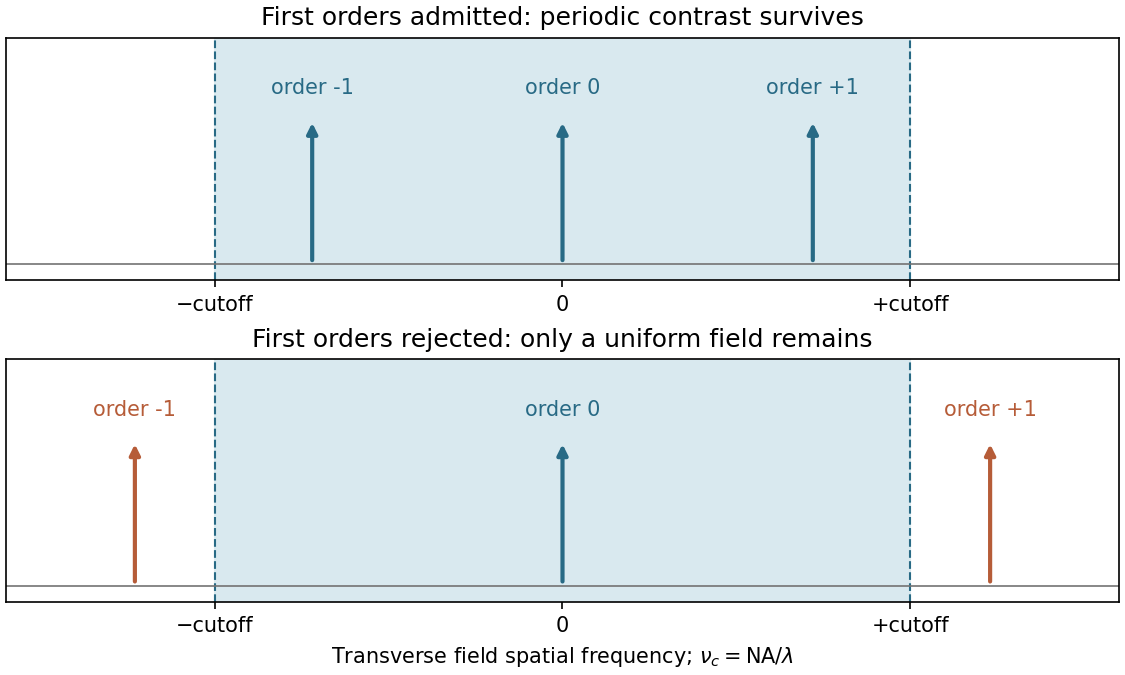
The projection lens maps the mask's angular spectrum into its back focal plane: within scalar Fourier optics this is the Fraunhofer diffraction or spatial-Fourier plane. A periodic mask produces discrete diffraction orders, separated by in object-side spatial frequency after accounting for projection magnification. The finite numerical aperture bounds the transverse wave vectors admitted by the lens, so the pupil is a spatial-frequency filter.
For an ideal on-axis coherent system,A second Fourier transformation forms the image, and the recorded intensity is . If only the zero order passes, the field is uniform and the line pattern disappears. Passing zero and first orders restores a periodic modulation; passing more orders sharpens the edges. Thus the loss of fine structure is explained by rejected diffraction orders, not by a geometrical inability to draw narrow lines. The field-transfer cutoff differs from the twice-as-large incoherent intensity-transfer cutoff.[ref]
Advanced Optical Imaging: Incoherent imaging by Delft University of Technology. coherent and incoherent transfer: pupil filtering and intensity formation

Increasing the angular acceptance can collect higher spatial frequencies, but rays at large angles and away from the optical axis are harder to bring to the same focus. Spherical aberration, coma, astigmatism and field curvature can degrade contrast across a large exposure field. The depth of focus also decreases approximately as , making wafer height errors more important. A larger geometrical aperture is therefore not automatically better over the whole wafer field.
Immersion lithography raises by increasing the refractive index of the medium between the final lens and wafer. A suitable UV-transparent liquid permits a larger numerical aperture without increasing the ray angle by the same factor, easing the purely geometrical demand on the lens. Lens design and focus control remain necessary; immersion does not abolish aberrations. The liquid must also be compatible with the resist and free of bubbles and contamination, and absorption at must be low.
Articles by others on the same topic
There are currently no matching articles.