and count the microscopic interacting units in bodies 1 and 2. Their positions are and ; the difference vector gives their pair separation. The positive coefficient specifies an attractive nonretarded pair energy and has units .
Hamaker summation approximates a macroscopic interaction from Van der Waals forces by adding these microscopic pair energies. For homogeneous continua, sums are replaced by integrals over the two body volumes with number densities and . Integrating the geometry changes the distance dependence and produces a Hamaker constant for the stated simple model.
The approximation assumes pairwise additivity, uniform material properties, a known geometry and a separation large enough to use a continuum but small enough for the chosen nonretarded interaction law. It neglects many-body electrodynamic screening, chemical bonding, atomic roughness and short-range repulsion. A medium changes the effective interaction strength; an effective measured across water need not equal a vacuum value inferred from isolated atom pairs.
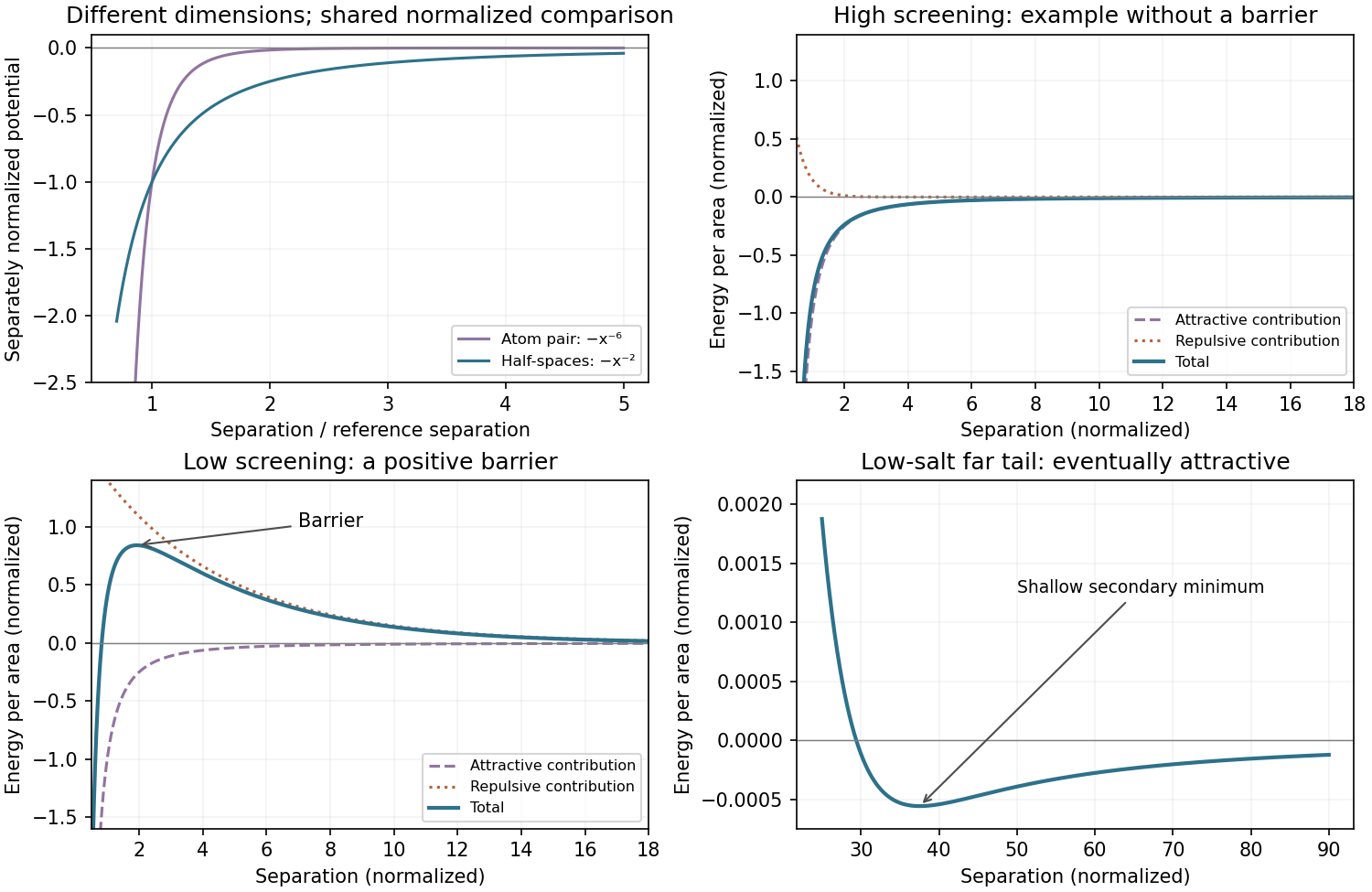
The microscopic pair potential falls as , whereas integrating over two half-spaces gives an interaction energy per area . The plate attraction therefore decays much more slowly with distance because many pairs contribute. The quantities have different dimensions, so the shared sketch uses separately normalized energies at a reference separation rather than pretending that joules and joules per square metre are directly comparable.
The attractive pressure isAt and the supplied effective ,The minus sign denotes decreasing separation. A total force cannot be calculated without the interacting area: for area in square metres, . This uses the supplied nonretarded half-space model; finite film thickness, geometry and retardation at larger distances can change it.

Choose a positively charged plate to match the question's labels for co-ions and for counterions. Let denote the outer edge of its compact Stern layer, and set the bulk potential to zero.
In the weak-potential Debye–Hückel approximation, the diffuse-layer potential isThe key length is the Debye–Hückel screening length. For a symmetric monovalent electrolyte, the Boltzmann distribution givesPositive co-ions are depleted near the positive plate, while negative counterions accumulate. Both approach the same bulk density as the potential decays. Attraction and repulsion by the surface compete with mixing entropy, so diffuse ions do not simply collapse into one plane. The compact Stern layer represents finite closest approach and specifically associated charge; the diffuse continuum begins outside it. For large potentials the linear exponential potential needs the nonlinear Poisson-Boltzmann equation, though the far-field screening scale remains the same in this simple electrolyte.
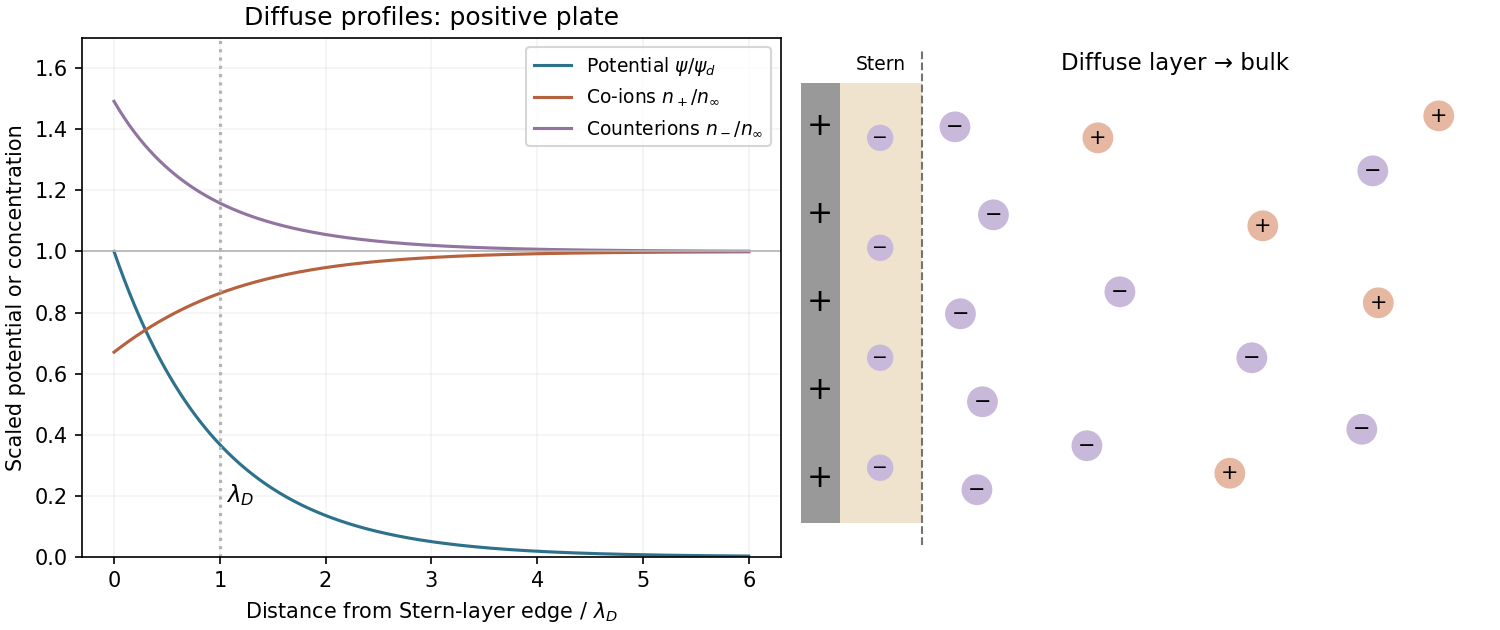

For an ideal electrolyte with species number densities , valences , solvent permittivity and common temperature,Increasing salt concentration supplies more mobile charge to screen a surface perturbation, so a shorter distance is needed for the potential to decay. At fixed ion composition, permittivity and temperature, .
A fivefold concentration increase therefore givesEquivalently, the inverse screening length grows by . Changing ion valence changes the ionic-strength weighting as well, and highly concentrated electrolytes can depart from this dilute-solution screening model.
For like-charged plates, DLVO theory combines an attractive dispersion contribution and a screened electrostatic repulsion. A useful far-field schematic model isAt high salt concentration, is short. The repulsion then disappears over a short distance, leaving attraction across much of the accessible range. The usual high-salt sketch has a greatly reduced or absent repulsive energy barrier, so approach into a primary attractive minimum is easier. At very small separations, short-range repulsion cuts off the unphysical divergence of the simple continuum expression.
The large-distance tail of the stated model is attractive because an exponentially decaying repulsion eventually becomes smaller than the algebraic attraction. A barrier is not ruled out by the words “high salt” alone: its existence also depends on surface charge or potential, charge regulation, and the boundary conditions that determine . The figure shows one declared barrier-free high-screening example rather than claiming a universal threshold concentration.
At lower salt concentration, the longer Debye–Hückel screening length allows the two diffuse layers to interact at greater separation. For sufficiently charged surfaces, this produces a positive free-energy barrier between separated plates and the short-range primary attractive region. Crossing a barrier costs free energy, so it can kinetically stabilize a dispersion even though a more attractive state exists at close approach. The relevant barrier in a finite object must be compared with thermal energy using the appropriate geometry and interaction area.
Over the experimentally relevant range of several screening lengths, the low-salt interaction can be predominantly repulsive, as drawn in the illustrative model. Strictly, at asymptotically infinite separation, the supplied nonretarded DLVO model still approaches zero from the attractive side, because decays faster than for any finite salt concentration. A shallow secondary minimum can therefore occur beyond the barrier. Calling the entire far field repulsive without specifying the distance range would conceal this distinction.
Lower salt alone does not guarantee a barrier: surface potential, charge regulation and attraction strength still matter. Extremely dilute or salt-free systems also require counterion and finite-cell constraints beyond blindly holding fixed while sending to zero.
Articles by others on the same topic
There are currently no matching articles.