A single-walled carbon nanotube confines the electron around its circumference while allowing motion along its axis. Nanotube zone folding therefore turns the graphene bands into one-dimensional subbands. A semiconducting carbon nanotube has no allowed circumferential wave vector through a Dirac valley; a metallic tube has a band crossing at the Fermi energy in the ideal model. Each massive subband edge gives a one-dimensional van Hove singularity in the density of states, and corresponding peaks appear in the joint density of states.
For light polarized along the tube, the main electric-dipole selection rule conserves circumferential angular momentum: transitions connect matching valence and conduction subbands. These finite-energy transitions are conventionally in a semiconducting carbon nanotube and in a metallic tube. A metallic band crossing does not make its first strong interband peak have zero energy. Perpendicular polarization admits different angular-momentum channels, often much weaker because of depolarization. Excitons, dielectric screening and trigonal warping modify the simple band-edge transition energies.
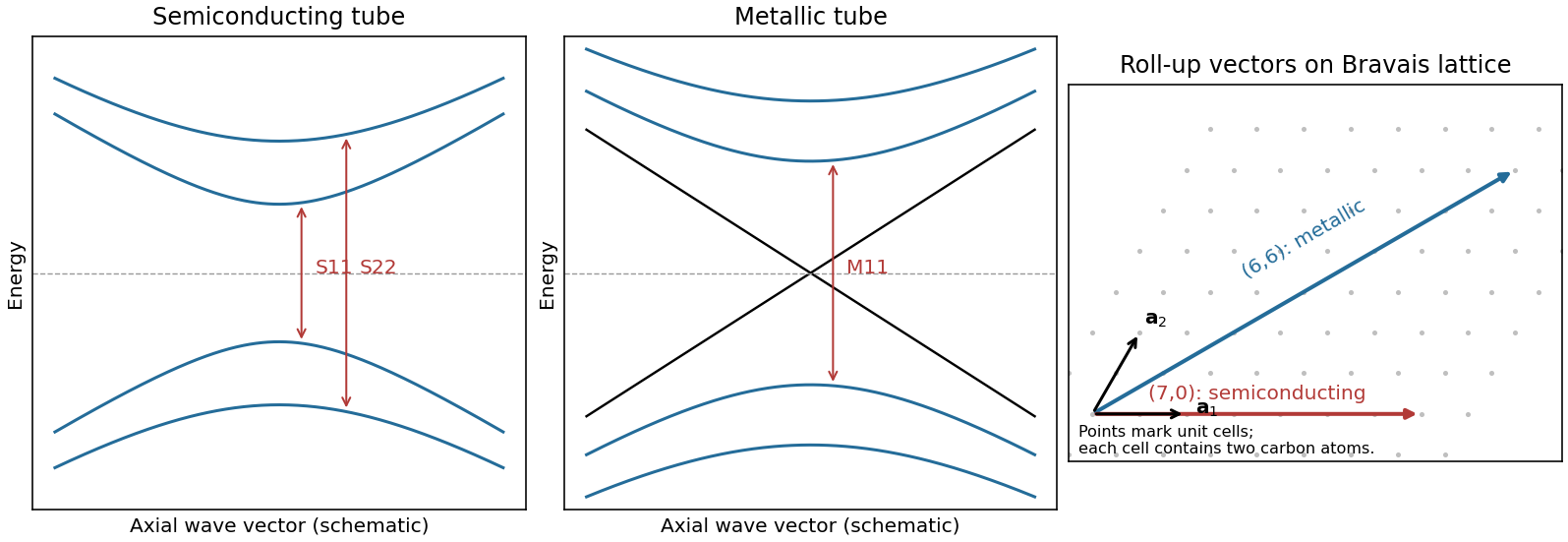
Nanotube optical transitions and two example roll-up vectors
. Original band and lattice schematics. Arrows indicate matching-subband transitions; the metallic crossing is separate from its finite-energy interband resonance. Lattice points represent graphene unit cells rather than individual atoms. Source. Details.
Experimentally, measure absorption versus photon energy; Raman spectroscopy becomes resonantly enhanced when the excitation matches an optical transition. A photoluminescence excitation spectrum of dispersed semiconducting tubes correlates excitation near with emission near after relaxation. Metallic tubes generally lack comparable bright emission because nonradiative relaxation is efficient. Combining optical energies with radial-breathing-mode Raman spectroscopy or electron diffraction assigns tube diameter and roll-up indices; a Kataura plot organizes those assignments.[ref]
Structure-assigned optical spectra of single-walled carbon nanotubes by Sergei M. Bachilo and others. Excitation-emission spectroscopy and assignments to nanotube structures
Let be equal-length primitive translation vectors of the graphene lattice, separated by . The carbon nanotube chiral vectoridentifies the two points joined when the sheet is rolled: is the circumference, not the tube axis. The right-hand panel of the preceding original diagram shows and .
The periodic boundary condition is , with an integer. Applying it at either Dirac valley gives the nanotube zone folding criterionfor a metallic tube. Thus is an armchair metallic example, whereas is a zigzag semiconducting example. Other choices with also give a semiconducting carbon nanotube.
This criterion is the ideal flat-sheet approximation. Curvature can open a small gap in nominally metallic non-armchair tubes; ideal armchair tubes remain gapless in that approximation. The property is determined by the wrapping vector, not simply by calling a tube “chiral” or by its diameter alone.
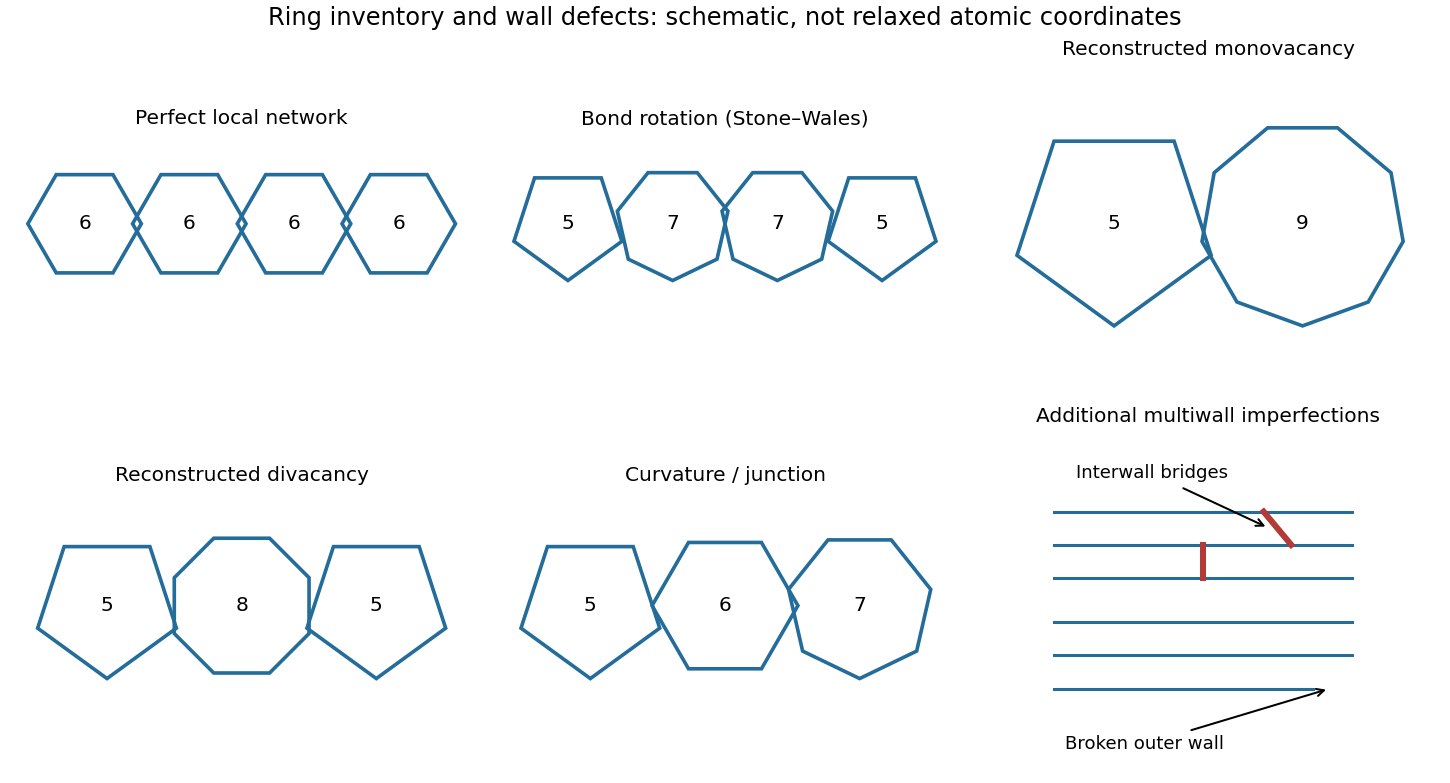
The important distinctions are changes of ring topology, missing or added atoms, and changes of local bonding:
- A Stone-Wales defect rotates one carbon-carbon bond by approximately , converting four hexagons into a --- ring arrangement without adding or removing atoms. It changes strain and electronic scattering.
- A carbon nanotube vacancy defect removes an atom. Reconstruction commonly gives a pentagon and a nine-membered ring, with an undercoordinated site; a reconstructed divacancy can give a -- arrangement. Larger vacancies make holes or broken walls.
- An adjacent pentagon-heptagon pair acts as a dislocation in the hexagonal network. It can connect regions with different wrapping indices, producing a bend or an electronic junction. Isolated nonhexagonal rings impose curvature: pentagons favor positive curvature and heptagons negative curvature.
- An interstitial defect, an adsorbed atom, or chemical functionalization can distort the network and locally change bonding toward . These defects can scatter carriers and create chemically reactive sites.

Closed end caps require nonhexagonal rings, typically six pentagons per hemispherical cap; these are part of the cap topology rather than necessarily damage. Kinks, buckling, branches and incomplete closure are larger-scale structural imperfections.
A multi-walled carbon nanotube can contain any of these defects in individual shells, plus interrupted or terminated shells, extra incomplete graphitic layers, irregular interwall spacing, and covalent interwall bridges formed by displaced atoms. Such bridges change intershell coupling and sliding. Different shells having different wrapping indices is normal and is not, by itself, a defect.
Articles by others on the same topic
There are currently no matching articles.