water first interacts with accessible surface sites and enters the near-surface region. Exchange of alkali ions with hydrogen-bearing species can release sodium before the silicate network has dissolved in bulk. A schematic site exchange ishydrolysis also breaks network linkages, illustrated byBoron-containing linkages and the rest of the network react in a composition- and pH-dependent way. Alkali exchange changes the water chemistry, and network hydrolysis releases or rearranges constituents rather than simply removing an intact molecular glass unit.
In a finite batch of initially deionised water, dissolved products accumulate and pH evolves. silicon can be retained in a hydrated alteration gel, and condensation or restructuring changes that layer's connectivity and transport properties. Reduced chemical driving force and a less permeable interfacial layer can lower the rate; a residual glass alteration rate can persist rather than all reaction stopping at an apparent plateau. Atomistic work published before the examination provides one account of how gel restructuring can hinder hydrated-species transport, without making that account universal for all glasses.[ref]
Atomistic origin of the passivation effect in hydrated silicate glasses by Tao Du and others. npj Materials Degradation 3, 6, 7 February 2019; hydrated-gel restructuring and transport simulations
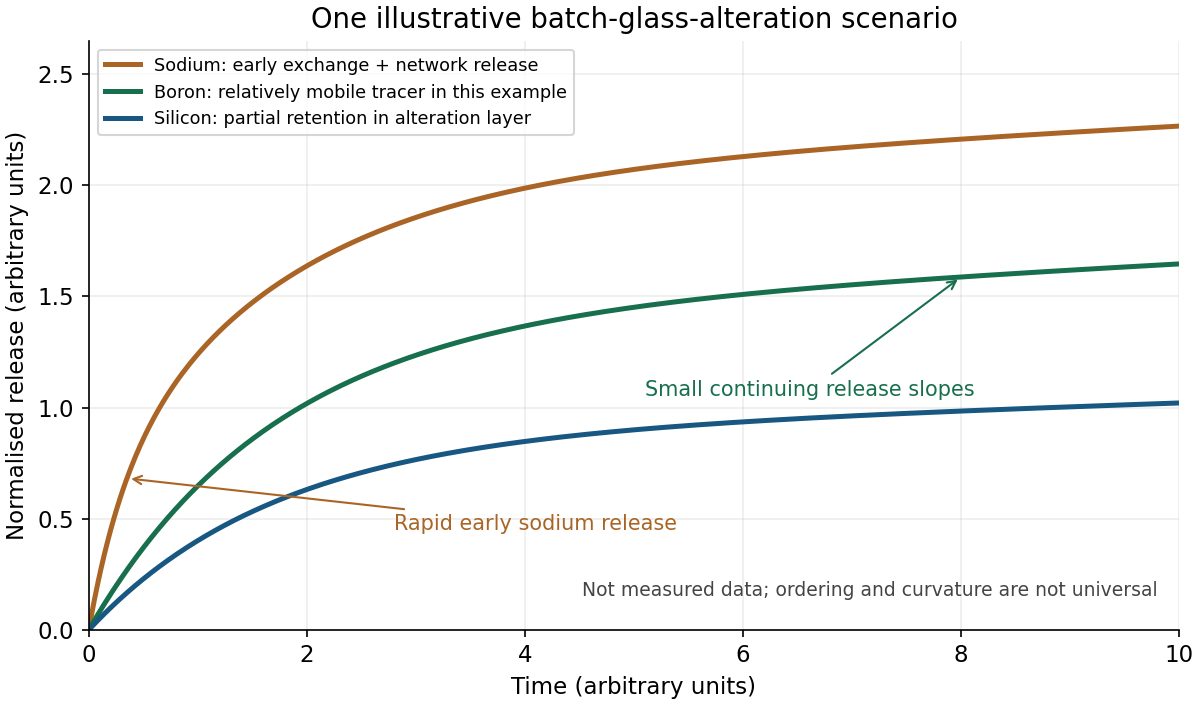

The original sketch shows one plausible scenario, not measured data or a universal ordering. sodium initially rises rapidly through exchange. boron acts as a relatively mobile tracer of network alteration, while a smaller solution silicon release reflects retention in an alteration layer. The slopes subsequently decrease as batch chemistry and the layer evolve; small continuing slopes represent residual release. Offsets can remain even if later release rates become similar. Initial deionised water does not imply that the solution remains neutral or dilute throughout the test.
boron need not be an ideal fully released tracer: it can be retained in some gels, changing the relation between aqueous boron and the depth of alteration. A later study, published in 2020, explicitly compared solution release with solid depth profiles and demonstrated that limitation; it is cited as a subsequent qualification, not evidence available to a student in May 2019.[ref]
Insights into the mechanisms controlling the residual corrosion rate of borosilicate glasses by Stephane Gin and others. npj Materials Degradation 4, 41, 11 December 2020; results comparing boron release with alteration-layer profiles
Secondary phases can further modify dissolved inventories and, by consuming solution components, sometimes accelerate alteration again. Neither a permanently flat terminal curve nor a later acceleration is compulsory. Without a specified glass, temperature, area/volume ratio and solution history, the defensible sketch communicates exchange, network reaction and evolving retention, with those assumptions stated.
Articles by others on the same topic
There are currently no matching articles.