Original worked solutions cover all four printed alternatives. The University of Cambridge release occupies physical PDF pages 17–20; the questions are on pages 18–20. [ref]
https://www.whatdotheyknow.com/request/past_exam_papers_16/response/2088673/attach/3/FOI%202022%20471%20Smith%20materials.pdf?cookie_passthrough=1#page=17. Original public PDF, physical pages 17–20
The glass-release plot is an illustrative model, and the materials arguments state when reversibility, crystallographic texture, temperature or exposure history changes the conclusion.
thermal cycling growth is permanent dimensional change remaining after a temperature cycle; irradiation growth is a radiation-driven change of shape that need not require an applied load. Neither is simply the reversible increase in dimensions of a warm specimen.
For a crystal in its principal axes, a small unconstrained thermal strain isanisotropic thermal expansion means that the principal components of differ. Adjacent crystal grains with different orientations therefore demand different strain tensors during the same temperature change. Their bonded boundaries impose compatibility and generate internal stresses. plasticity, creep, boundary motion or microcracking can accommodate this mismatch irreversibly; when the accommodation fails to cancel on cooling, a residual strain remains. Repeated cycles can accumulate directional thermal ratcheting, surface roughening or distortion. crystallographic texture, constraints, cycle amplitude and the temperature dependence of yielding and recovery determine the outcome.
Anisotropy alone is insufficient. A freely expanding single crystal under spatially uniform, fully reversible heating returns to its original dimensions. Even cyclic plasticity can settle into a stabilised response rather than ratchet indefinitely. Demonstrating thermal cycling growth means comparing dimensions at the same reference temperature after successive cycles, while controlling external loads, temperature gradients and phase changes. uranium dimensional instability under cycling was investigated directly in the early reactor-materials programme.[ref]
Thermal Cycling of Uranium by Nathaniel Stetson and Melbourne L. Winton. ORNL-1386, 1952, opening discussion of dimensional instability, preferred orientation and observed distortion
irradiation growth has a different source of irreversibility. displacement cascades create vacancies and self-interstitials; anisotropic migration, clustering and capture at oriented dislocations and boundaries can produce unequal strains along crystal directions. For approximately volume-conserving growth,although a rod may elongate substantially in one direction. The effect can occur at constant temperature without an external stress. Distinguish it from void swelling, which increases volume through cavities, and irradiation creep, whose directional deformation is stress-dependent. Experiments should therefore measure axial and transverse dimensions, density and the applied stress rather than identifying every increase in length as one mechanism.
The characteristic growth phenomena require an asymmetric material response and a way to retain irreversible change. Low crystal symmetry and directional defect or deformation behaviour make uranium and zirconium important examples, whereas an ideal cubic material has isotropic linear thermal expansion and no symmetry-selected traceless single-crystal growth tensor in an otherwise isotropic environment.
alpha uranium is orthorhombic and has strongly anisotropic thermal response. In a textured polycrystalline material, incompatible crystal grain strains can be accommodated asymmetrically over a thermal cycle and leave macroscopic distortion. The same metal can also show irradiation growth through anisotropic irradiation-defect evolution. zirconium and its hexagonal close-packed alloys are major examples of irradiation growth; their basal and c-axis directions need not acquire the same strain.
Cubic austenitic steel does not exhibit the same intrinsic orientation-driven response merely because it is irradiated. It can nevertheless undergo void swelling, irradiation creep, thermal-stress plasticity or distortion under gradients. Thus absence of this growth mechanism does not imply dimensional stability under all reactor conditions. Conversely, a noncubic crystal is not guaranteed to grow during every thermal cycle: constraints, inelastic accommodation and the microstructure still matter.
crystal grain structure controls both the source of incompatibility and its conversion into a bulk dimensional change. Separate orientation distribution, grain size, crystal grain shape and defect structure rather than treating “fine grained” as a universal cure.
In thermal cycling, different crystal grain orientations rotate the thermal expansion tensor into different laboratory directions. Bonding prevents each crystal grain from following its independent free strain. Coarse crystal grains can produce larger surface relief and longer local mismatch distances; finer crystal grains can distribute the accommodation more uniformly. However, changing grain size also changes strength, boundary-mediated deformation and creep. A fine but strongly textured material can still show directional growth, and enhanced boundary accommodation can itself be irreversible. crystallographic texture and the way mismatch is accommodated must therefore be measured separately.
For irradiation growth, crystallographic texture determines whether directional single-grain changes reinforce or cancel. An illustrative independent-grain average iswhere is a crystal grain volume fraction and its orientation. A random orientation average of a traceless growth tensor is zero, whereas crystallographic texture can retain a preferred bulk strain. For an ideal hexagonal crystal grain with principal growth strains , the strain along a direction making angle to the c-axis isRandom crystallographic texture has and cancels this ideal directional growth. This is an orientation model, not proof that real crystal grain constraints or volume-changing processes vanish.
grain boundaries also absorb mobile defects. Boundary spacing and aspect ratio change directional sink distances, while dislocation density, cold working and recrystallisation change competing sinks and residual stresses. These affect the single-grain response before it is averaged. In one model compared with zirconium-alloy experiments, increasing grain size, reducing aspect ratio or reducing dislocation density decreased predicted growth. That result is a useful counterexample to assuming that smaller crystal grains always reduce irradiation growth.[ref]
Effects of Microstructural Factors on Irradiation Growth in Zirconium-Base Alloys by Noriyuki Sadaoka and Motomasa Fuse. Transactions of the Japan Institute of Metals 29, 970–976, abstract and stated microstructural trends
helium changes cavity stability and ductility; void swelling changes bulk volume and component dimensions. These effects interact, but a helium bubble and a vacancy-rich void are not interchangeable descriptions.
neutron reactions produce helium from alloy constituents and impurities. For example, capture by boron-10 can produce helium through ; the production per displacement dose depends on composition and neutron spectrum. Retained helium has low solubility and is trapped at defects or in bubbles. Bubble nucleation and growth at grain boundaries can assist intergranular cavitation, lowering tensile ductility and creep-rupture resistance, particularly when temperature permits the relevant transport. This is important even before a large bulk void swelling is measurable. A primary study linked high-temperature ductility loss to observed bubbles and grain-boundary weakening in irradiated stainless steel.[ref]
High-temperature Embrittlement of Stainless Steel irradiated in Fast Fluxes by A. S. Fraser and others. Nature 211, 291–292, abstract: mechanical observations, thin-foil bubbles and boundary-bubble interpretation
displacement damage continuously creates vacancies and self-interstitials. Their different capture efficiencies at dislocations and other sinks can leave a vacancy supersaturation available to cavities. A stable cavity grows when its net vacancy uptake exceeds vacancy emission and interstitial absorption. helium can help stabilise small nuclei, but the later volume increase is not simply the volume of gas inserted into an unchanged matrix. Changing helium content can also change cavity number, size and competition for point defects; a universal proportionality between helium concentration and void swelling is not justified.
For nuclear fuel cladding, void swelling can enlarge the diameter, alter the fuel–nuclear fuel cladding gap, reduce clearances and distort reactor coolant channels or nearby structures. Nonuniform void swelling generates additional stresses. Bubble-assisted embrittlement and stress-dependent creep then affect the ability of the wall to contain the fuel and internal pressure. The relevant measurements combine density or volume change, dimensional strain, cavity microscopy and mechanical tests. Pressurised-tube experiments explicitly separated void swelling, creep, plastic strain and precipitation strain; void swelling itself was approximately isotropic in that study.[ref]
The influence of cold-work level on the irradiation creep and swelling of AISI 316 stainless steel by E. R. Gilbert and F. A. Garner. Journal of Nuclear Materials 367–370, 954–959; PNNL abstract, separation of strain components
void swelling has a temperature window, rather than increasing monotonically with irradiation temperature. At sufficiently low temperature, vacancy migration and cavity growth are slow. At intermediate temperature, mobile defects, stable nuclei and unequal sink capture can support rapid cavity growth. At higher temperature, increased vacancy emission, recombination and changing sink populations can reduce the vacancy supersaturation and net void swelling. The precise peak depends on alloy, spectrum, dose rate and starting microstructure; lower void swelling at high temperature does not mean that creep or helium embrittlement is harmless there.
Distinguish void swelling from its slope. With displacement dose , a simple schematic description iswhere represents incubation and an approximately constant post-transient slope over a limited range. Real nucleation and sink evolution make the transition smooth; neither nor is a universal material constant. At larger dose, microstructural or compositional evolution may change the slope again.
neutron fluence is an integrated exposure, . Under an unchanged spectrum it can track displacement dose, but equal fluence does not necessarily imply equal damage or helium production. Even equal dpa can give different void swelling at different dose rates because recombination and transport compete in real time. Thus compare specimens at specified temperature, spectrum, dose rate and metallurgical condition; do not transfer one void swelling curve using fluence alone.
Delay cavity nucleation and prevent a large sustained vacancy flux to growing cavities. Select an austenitic alloy composition and heat treatment demonstrated to have low void swelling in the intended spectrum and temperature range; modest composition changes can alter precipitation, segregation and sink evolution. The grade label alone is insufficient.
cold working supplies a dislocation population that can alter defect capture and extend the low-swelling transient. Stable fine precipitates or other engineered sinks can promote defect removal, but capture bias matters as well as sink count. Irradiation and thermal recovery can erase the starting microstructure, so an initially favourable state must be checked at relevant dose. Controlled impurity and helium-producing constituent contents can reduce harmful gas effects, subject to corrosion resistance and phase-stability requirements.
Operating outside a strong-swelling regime, reducing accumulated exposure or replacing components before their qualified limit are complementary measures. Each trades against other constraints such as corrosion, creep, ductility and heat removal. “More cold working” or “more sinks” is not an unlimited prescription. Measurements must separate void swelling from creep; reducing one does not establish that the other was reduced. The pressurised-tube study is a particularly useful control because, after separating stress-enhanced void swelling, its derived creep strains were similar for annealed and cold-worked specimens.[ref]
The influence of cold-work level on the irradiation creep and swelling of AISI 316 stainless steel by E. R. Gilbert and F. A. Garner. PNNL abstract, comparison after correction for stress-enhanced swelling
Both terms concern time-dependent strain under stress. Here radiation-enhanced creep means irradiation accelerating a mechanism that also operates thermally, whereas radiation-induced creep emphasises deformation driven by irradiation-specific defect fluxes. The literature sometimes uses irradiation creep as an umbrella, so identifying the mechanism is more informative than treating the names as mutually exclusive experimental categories.
radiation-enhanced diffusion maintains mobile point-defect concentrations above their thermal equilibrium values. Under a load, this can accelerate diffusion-mediated deformation or dislocation climb and thereby enhance a creep mechanism. The effect depends on temperature, defect production, recombination and sinks; simply raising the specimen temperature by radiation heating is a different explanation and must be controlled.
radiation-induced creep can remain important where unirradiated creep is small. stress-induced preferential absorption gives differently oriented dislocations unequal capture of irradiation-produced defects, producing directional climb. Climb can also enable further glide by relieving obstacles. A schematic low-stress relation iswith a condition-dependent compliance , not a universal constitutive law. Coupling to void swelling and evolving sinks can add further terms.
Compare stressed and unstressed specimens in and out of irradiation at matched actual temperature, and resolve longitudinal, transverse and volumetric strains. Unstressed irradiation growth or void swelling is not itself evidence of creep, and stress-enhanced void swelling must not be included automatically in a fitted creep strain. These controls distinguish a mechanical response to irradiation defects from ordinary creep or a different dimensional-change mechanism.
A reactor coolant must remove heat reliably while remaining compatible with the core. Desirable properties include adequate heat capacity and heat transfer, manageable viscosity and pumping demand, stability over the operating range, limited corrosion of fuel and structures, acceptable neutron absorption and activation, and a tolerable leakage or chemical-reaction hazard. water is a standard example in light-water reactors: it transfers heat well and also moderates, but pressure, boiling behaviour, corrosion chemistry and loss of inventory must be managed. No single reactor coolant is best independently of reactor design.
A control-rod material must absorb neutrons effectively and retain mechanical and chemical integrity. It needs a suitable absorption cross section over the relevant spectrum, adequate absorber inventory over life, manageable capture heating and transmutation products, and compatibility with its sheath and reactor coolant. boron carbide is an example. Depletion, gas generation, radiation-induced swelling and cracking must be allowed for; a large initial cross section alone does not establish lifetime performance.
A neutron moderator must slow neutrons efficiently while absorbing relatively few. Light nuclei provide effective energy transfer per collision, but absorption, density, radiation stability, purity and temperature-dependent properties determine the usable moderation. heavy water is an example combining effective slowing with low parasitic absorption; graphite is another possible material in different designs. Heat removal and compatibility remain necessary even though moderation is its principal neutronic role.
nuclear fuel cladding must retain fuel and fission products while transferring heat and carrying load. Desirable properties include corrosion resistance, low neutron absorption, adequate thermal conductivity, strength and ductility, resistance to irradiation growth, void swelling and creep, and compatibility with fuel and reactor coolant. A zirconium alloy such as Zircaloy is a light-water-reactor example. Hydrogen uptake, corrosion and irradiation response constrain service; the low absorption benefit does not eliminate these materials problems.
A useful fuel combines neutronic suitability, heat removal, containment and dimensional stability. A sufficient fissile inventory and acceptable neutron economy permit the intended power and exposure, while unnecessary parasitic absorption wastes neutrons. These requirements are reactor-specific rather than a recommendation for one universal composition.
A high melting margin and stable phases help preserve geometry. Good thermal conductivity reduces the centre-to-surface temperature rise and associated thermal stress; heat capacity helps moderate transient temperature changes. Chemical stability and compatibility with reactor coolant and nuclear fuel cladding reduce corrosion and reactions at the interface with nuclear fuel cladding. Oxygen chemistry and other composition variables can affect both transport and interface reactions.
Under irradiation the fuel should tolerate displacement damage, restructuring, radiation-induced swelling and fission gas accumulation without unacceptable cracking, gap closure or pressure. Retention of radionuclides and controlled release of fission gas support the nuclear fuel cladding's containment function. Predictable creep can relieve stress, but excessive deformation may compromise geometry. Fabrication reproducibility, inspectable microstructure, resource availability and the practicability of subsequent waste management also matter.
uranium dioxide illustrates the compromises: it is a chemically robust, high-melting ceramic fuel, but its relatively limited thermal conductivity, irradiation-dependent microstructure and gas behaviour require explicit thermal and mechanical design margins. A desirable individual property does not establish the performance of the coupled nuclear fuel and nuclear fuel cladding system.
plutonium introduces decay heat, self-irradiation and composition-sensitive thermochemical behaviour, as well as demanding radiological handling and material accountancy. isotopic composition affects heat and neutron production, so total plutonium mass alone does not specify the handling environment. The elemental metal also has inconvenient allotropic and thermal behaviour; using an appropriate stable ceramic fuel form avoids treating bare metal as a straightforward substitute for uranium oxide.
In mixed oxide fuel, plutonium dioxide and uranium dioxide form the engineered ceramic system. Important challenges are composition uniformity, thermal conductivity and melting margin, oxygen chemistry, restructuring and fission gas behaviour, and compatibility with nuclear fuel cladding. A local composition variation can produce a local power or temperature variation. During service, actinide redistribution can change the initial spatial distribution; its direction cannot be inferred from the temperature gradient alone. Autoradiographic examination of irradiated mixed-oxide pins directly investigated the competing transport effects.[ref]
Plutonium redistribution in fast reactor mixed oxide fuel pins by M. Bober and others. Journal of Nuclear Materials 47, 187–197, abstract: irradiated-pin observations, thermal diffusion, evaporation–condensation and oxygen chemistry
Mitigation is to use a characterised fuel form and isotopic inventory, qualify composition and microstructure uniformity, retain suitable thermal margins, and establish irradiation performance and interface compatibility. radioactive material confinement, remote or protected handling and waste management address the accompanying contamination and exposure problems. These are materials requirements and verification objectives; no plutonium preparation, separation or fuel-manufacturing procedure is needed to answer them.
The two historically dominant commercial processes are gaseous diffusion enrichment and gas centrifuge enrichment. The first exploits differences in molecular transport through a barrier; the second exploits mass-dependent redistribution in a rotating gas. Both are isotope-separation principles rather than chemical separation of uranium from another element.
gas centrifuge enrichment had become predominant by the time of this examination. Its much smaller electricity demand reduces a major operating cost of diffusion technology. Modular capacity and the replacement of ageing diffusion plants contributed to commercial adoption. This historical conclusion does not require machine dimensions, operating conditions or a cascade design. The United States' final operating diffusion plant closed in 2013, consistent with the earlier transition rather than a claim based on current plant counts.[ref]
Backgrounder on Uranium Enrichment by the United States Nuclear Regulatory Commission. Institutional historical sections on gas centrifuges, electricity demand and diffusion-plant closures
glass accommodates a chemically diverse waste inventory without requiring every constituent to fit one specific crystal site. A borosilicate network can incorporate many constituents while producing a dense monolithic waste form. An established melt-and-pour approach permits remote processing and a reproducible package geometry; suitable formulations combine useful waste loading with low aqueous release rates. The absence of crystalline grain boundaries also removes one possible preferential path, although cracks or other heterogeneity can still occur.
The flexibility has limits. Some constituents have limited solubility or can separate into undesired phases, and increasing waste loading can impair processability or durability. Melting can release volatile constituents that require capture and generate secondary wastes. Cooling stresses may crack the product and enlarge its accessible surface; devitrification or phase separation can change chemical durability. Heat and radiation can change density, bonding or microstructure even though the starting glass is already noncrystalline.
Most importantly, glass is an immobilisation medium, not an assertion of zero reaction with water. Durability depends on composition, temperature, solution chemistry and the evolution of alteration products. A low initial leach rate does not alone demonstrate long-term behaviour, and an amorphous structure does not make the material inert. Container and repository barriers complement rather than duplicate the glass's role. A suitable choice therefore balances processing, composition tolerance, radiation response and aqueous durability instead of maximising only one property.
Write for the exposed glass area. If is the blank-corrected dissolved mass concentration of element , its initial mass fraction in the glass and the leachate volume, thenThe numerator is the released element mass measured in solution. Dividing by converts this to an equivalent mass of the original glass, while dividing by expresses that mass per exposed area. With in and in , has units of glass-equivalent release. The fraction must be used as a fraction, not an unconverted percentage.
These corrections allow comparison of specimens of different size and composition without confusing a lower concentration with better durability. State how the area was measured; geometric area and a rough powder's accessible area need not coincide. For repeated sampling, include element mass removed in earlier aliquots and the volume remaining; for an initial blank in the leachant, subtract its corresponding inventory. Surface cracking and evolving porosity can make a rate based on initial area differ from a rate based on the true reactive area.
Under congruent glass dissolution, constituents enter solution in their bulk proportions, so their correctly normalised releases coincide. Preferential sodium release by ion exchange can instead give , while silicon retention in a gel or secondary precipitate can depress its dissolved release. Noncoincident curves show nonstoichiometric aqueous release, but do not uniquely identify the mechanism. Conversely, solution coincidence does not by itself establish that no secondary reactions occurred. A complete inference compares solution inventories with altered solids.
Normalisation removes composition and first-order area/volume scaling; it does not make different pH, temperature, solution composition or contact histories equivalent. In a batch test, even the same initial water changes composition and pH as reaction proceeds. Reporting those conditions and time is essential for a transferable comparison rather than treating as a condition-independent material constant.
water first interacts with accessible surface sites and enters the near-surface region. Exchange of alkali ions with hydrogen-bearing species can release sodium before the silicate network has dissolved in bulk. A schematic site exchange ishydrolysis also breaks network linkages, illustrated byBoron-containing linkages and the rest of the network react in a composition- and pH-dependent way. Alkali exchange changes the water chemistry, and network hydrolysis releases or rearranges constituents rather than simply removing an intact molecular glass unit.
In a finite batch of initially deionised water, dissolved products accumulate and pH evolves. silicon can be retained in a hydrated alteration gel, and condensation or restructuring changes that layer's connectivity and transport properties. Reduced chemical driving force and a less permeable interfacial layer can lower the rate; a residual glass alteration rate can persist rather than all reaction stopping at an apparent plateau. Atomistic work published before the examination provides one account of how gel restructuring can hinder hydrated-species transport, without making that account universal for all glasses.[ref]
Atomistic origin of the passivation effect in hydrated silicate glasses by Tao Du and others. npj Materials Degradation 3, 6, 7 February 2019; hydrated-gel restructuring and transport simulations
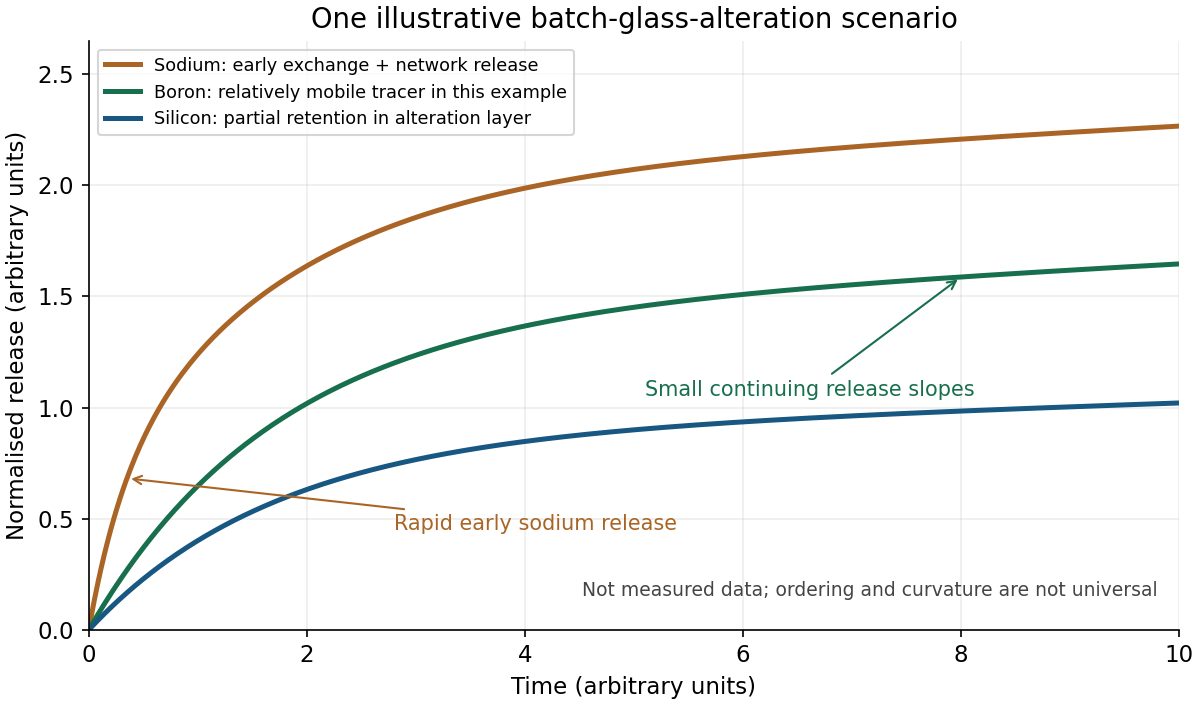

The original sketch shows one plausible scenario, not measured data or a universal ordering. sodium initially rises rapidly through exchange. boron acts as a relatively mobile tracer of network alteration, while a smaller solution silicon release reflects retention in an alteration layer. The slopes subsequently decrease as batch chemistry and the layer evolve; small continuing slopes represent residual release. Offsets can remain even if later release rates become similar. Initial deionised water does not imply that the solution remains neutral or dilute throughout the test.
boron need not be an ideal fully released tracer: it can be retained in some gels, changing the relation between aqueous boron and the depth of alteration. A later study, published in 2020, explicitly compared solution release with solid depth profiles and demonstrated that limitation; it is cited as a subsequent qualification, not evidence available to a student in May 2019.[ref]
Insights into the mechanisms controlling the residual corrosion rate of borosilicate glasses by Stephane Gin and others. npj Materials Degradation 4, 41, 11 December 2020; results comparing boron release with alteration-layer profiles
Secondary phases can further modify dissolved inventories and, by consuming solution components, sometimes accelerate alteration again. Neither a permanently flat terminal curve nor a later acceleration is compulsory. Without a specified glass, temperature, area/volume ratio and solution history, the defensible sketch communicates exchange, network reaction and evolving retention, with those assumptions stated.
Articles by others on the same topic
There are currently no matching articles.