glass accommodates a chemically diverse waste inventory without requiring every constituent to fit one specific crystal site. A borosilicate network can incorporate many constituents while producing a dense monolithic waste form. An established melt-and-pour approach permits remote processing and a reproducible package geometry; suitable formulations combine useful waste loading with low aqueous release rates. The absence of crystalline grain boundaries also removes one possible preferential path, although cracks or other heterogeneity can still occur.
The flexibility has limits. Some constituents have limited solubility or can separate into undesired phases, and increasing waste loading can impair processability or durability. Melting can release volatile constituents that require capture and generate secondary wastes. Cooling stresses may crack the product and enlarge its accessible surface; devitrification or phase separation can change chemical durability. Heat and radiation can change density, bonding or microstructure even though the starting glass is already noncrystalline.
Most importantly, glass is an immobilisation medium, not an assertion of zero reaction with water. Durability depends on composition, temperature, solution chemistry and the evolution of alteration products. A low initial leach rate does not alone demonstrate long-term behaviour, and an amorphous structure does not make the material inert. Container and repository barriers complement rather than duplicate the glass's role. A suitable choice therefore balances processing, composition tolerance, radiation response and aqueous durability instead of maximising only one property.
Write for the exposed glass area. If is the blank-corrected dissolved mass concentration of element , its initial mass fraction in the glass and the leachate volume, thenThe numerator is the released element mass measured in solution. Dividing by converts this to an equivalent mass of the original glass, while dividing by expresses that mass per exposed area. With in and in , has units of glass-equivalent release. The fraction must be used as a fraction, not an unconverted percentage.
These corrections allow comparison of specimens of different size and composition without confusing a lower concentration with better durability. State how the area was measured; geometric area and a rough powder's accessible area need not coincide. For repeated sampling, include element mass removed in earlier aliquots and the volume remaining; for an initial blank in the leachant, subtract its corresponding inventory. Surface cracking and evolving porosity can make a rate based on initial area differ from a rate based on the true reactive area.
Under congruent glass dissolution, constituents enter solution in their bulk proportions, so their correctly normalised releases coincide. Preferential sodium release by ion exchange can instead give , while silicon retention in a gel or secondary precipitate can depress its dissolved release. Noncoincident curves show nonstoichiometric aqueous release, but do not uniquely identify the mechanism. Conversely, solution coincidence does not by itself establish that no secondary reactions occurred. A complete inference compares solution inventories with altered solids.
Normalisation removes composition and first-order area/volume scaling; it does not make different pH, temperature, solution composition or contact histories equivalent. In a batch test, even the same initial water changes composition and pH as reaction proceeds. Reporting those conditions and time is essential for a transferable comparison rather than treating as a condition-independent material constant.
water first interacts with accessible surface sites and enters the near-surface region. Exchange of alkali ions with hydrogen-bearing species can release sodium before the silicate network has dissolved in bulk. A schematic site exchange ishydrolysis also breaks network linkages, illustrated byBoron-containing linkages and the rest of the network react in a composition- and pH-dependent way. Alkali exchange changes the water chemistry, and network hydrolysis releases or rearranges constituents rather than simply removing an intact molecular glass unit.
In a finite batch of initially deionised water, dissolved products accumulate and pH evolves. silicon can be retained in a hydrated alteration gel, and condensation or restructuring changes that layer's connectivity and transport properties. Reduced chemical driving force and a less permeable interfacial layer can lower the rate; a residual glass alteration rate can persist rather than all reaction stopping at an apparent plateau. Atomistic work published before the examination provides one account of how gel restructuring can hinder hydrated-species transport, without making that account universal for all glasses.[ref]
Atomistic origin of the passivation effect in hydrated silicate glasses by Tao Du and others. npj Materials Degradation 3, 6, 7 February 2019; hydrated-gel restructuring and transport simulations
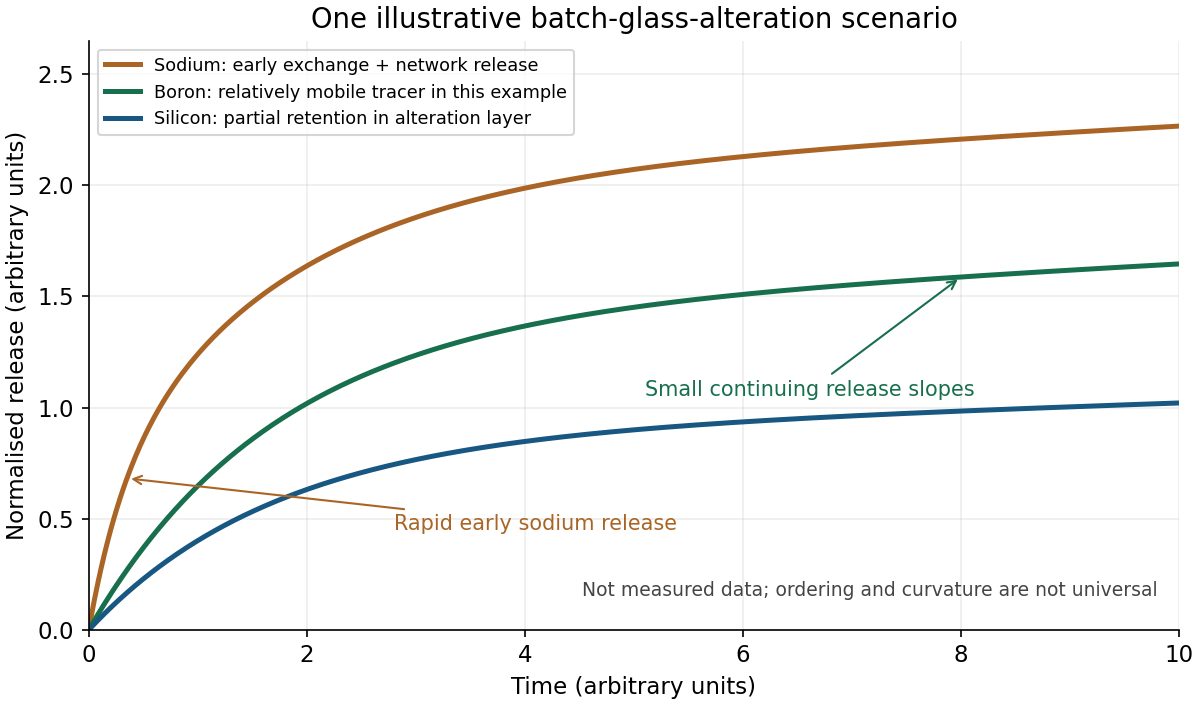

The original sketch shows one plausible scenario, not measured data or a universal ordering. sodium initially rises rapidly through exchange. boron acts as a relatively mobile tracer of network alteration, while a smaller solution silicon release reflects retention in an alteration layer. The slopes subsequently decrease as batch chemistry and the layer evolve; small continuing slopes represent residual release. Offsets can remain even if later release rates become similar. Initial deionised water does not imply that the solution remains neutral or dilute throughout the test.
boron need not be an ideal fully released tracer: it can be retained in some gels, changing the relation between aqueous boron and the depth of alteration. A later study, published in 2020, explicitly compared solution release with solid depth profiles and demonstrated that limitation; it is cited as a subsequent qualification, not evidence available to a student in May 2019.[ref]
Insights into the mechanisms controlling the residual corrosion rate of borosilicate glasses by Stephane Gin and others. npj Materials Degradation 4, 41, 11 December 2020; results comparing boron release with alteration-layer profiles
Secondary phases can further modify dissolved inventories and, by consuming solution components, sometimes accelerate alteration again. Neither a permanently flat terminal curve nor a later acceleration is compulsory. Without a specified glass, temperature, area/volume ratio and solution history, the defensible sketch communicates exchange, network reaction and evolving retention, with those assumptions stated.
Articles by others on the same topic
There are currently no matching articles.