Original public paper: Physical PDF pages 826–828. All three questions and all alternatives in question 2 are answered. Optical amplitudes and quadratures use the normalization printed in the paper; factors of two depend on that convention.
The process is sum-frequency generation, with . The same reversible three-wave mixing interaction permits the reverse conversion when the higher-frequency field supplies the pump. The second-order nonlinear polarization couples the three waves; its effective coefficient includes the crystal orientation and polarizations.
One efficiency limit is phase mismatch: contributions generated at different positions acquire different phases and can cancel. A second practical limit is spatial walk-off, which reduces the overlap of finite beams in a birefringent crystal. A beam radius and relative walk-off angle give an overlap length of order . Absorption and scattering provide further losses. Group-velocity mismatch matters for pulses, and pump depletion eventually invalidates an undepleted-pump calculation; none of these effects should be silently included in the ideal lossless plane-wave equations.
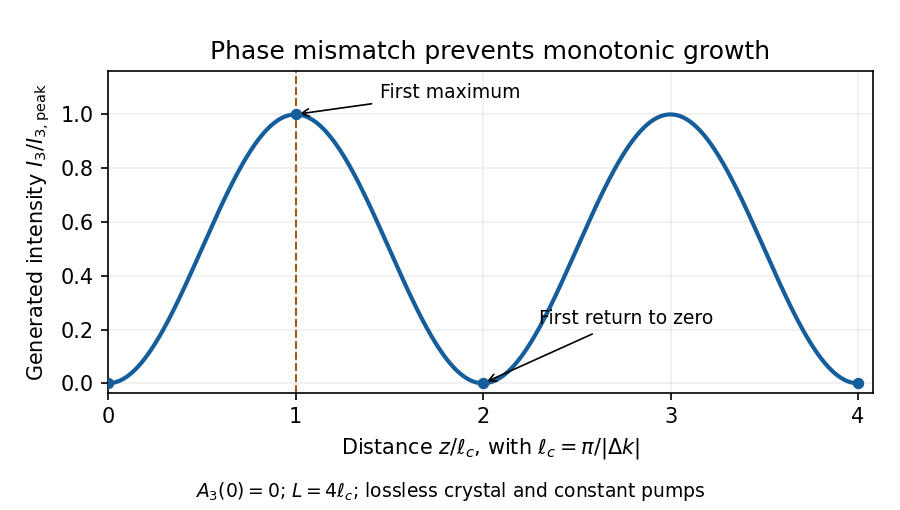
Define and hold constant. Direct integration of the driven equation giveswhere . The second expression has a continuous phase-matched limit. If the generated field is initially absent,For this is proportional to : the first maximum is at the nonlinear optical coherence length , and the first subsequent zero is at . A seed adds interference with the generated amplitude and can change that pattern. At exact phase matching, the unseeded result grows as only while pump depletion remains negligible.

To retain depletion consistently, differentiate each intensity before inserting the coupled equations:For real in the lossless convention, put . The result isThe signs follow the printed amplitude equations. In initial up-conversion, the newly generated makes , so the two input intensities decrease while the sum-frequency intensity increases. Adding the derivatives gives zero because . The total intensity is conserved, even though the three individual intensities change.
The Manley-Rowe relations areDividing an intensity by gives photon flux density. A conversion event removes one photon from each lower-frequency mode and adds one to the upper mode, or does the reverse. Therefore and count conserved sums of photon fluxes, while counts the conserved lower-frequency difference. They are not three independent invariants: . Energy conservation is also recovered as .
The unweighted combinations generally fail because the exchanged photons have different energies. Explicitly,The qualification “generally” matters: is conserved for equal lower frequencies in a distinct-mode degenerate case, and every derivative vanishes when there is no exchange. The equations establish nonconservation for generic unequal-frequency interaction, not for all special solutions.
The optical Kerr effect gives an intensity-dependent refractive index, , in the simplest instantaneous isotropic model. A beam whose intensity varies transversely therefore writes a transverse index profile into the medium. Over length its nonlinear phase is approximately , with .
For a bright-centered beam, positive raises the index at the center and produces self-focusing; negative produces self-defocusing. The medium acts as an intensity-dependent lens. This is a transverse effect, distinct from temporal self-phase modulation broadening a pulse's spectrum, though both originate in the same nonlinear index. Kerr lenses can provide intensity-dependent mode selection in a laser, and a beam's index profile can guide or deflect a second beam through cross-phase modulation.
The competition with diffraction appears in a paraxial model,In one transverse dimension, focusing can balance diffraction to support a bright spatial optical soliton under suitable boundary conditions. Transverse perturbations can also grow through modulational instability, breaking a broad beam into localized structures. In an ideal two-transverse-dimensional cubic model, sufficiently strong focusing permits collapse; the critical-power scale is proportional to , with its numerical coefficient depending on the convention and profile used.
A real medium does not develop an actual infinite intensity. Saturation, multiphoton absorption, ionization, nonparaxial propagation and damage can arrest or invalidate the simple model. Filament formation therefore requires more physics than inserting a real constant into a lens formula. The useful applications exploit a controllable index profile; the same positive feedback can be a serious limitation on transporting high-power beams.
Quasi-phase-matching compensates phase mismatch by deliberately modulating the nonlinear coefficient, rather than demanding that the material wavevectors themselves exactly match. In a periodically poled ferroelectric crystal, reversing domains changes the sign of the relevant second-order coefficient. Flipping it when the nonlinear interaction would begin to undo previous conversion restores constructive accumulation over many domains.
Write with . The amplitude integral contains phases , so a Fourier component is useful whenFor first-order compensation, and each domain has width . This is twice the single-domain coherence length for the complete sign pattern, not a full period equal to .
For ideal equal-width domains switching between and , the resonant first Fourier coefficient has magnitude . The effective amplitude coefficient is therefore reduced by , and conversion intensity by , relative to a perfectly phase-matched uniform crystal using that same . Nevertheless, quasi-phase matching can permit a larger tensor coefficient or wavelengths and polarizations inaccessible to ordinary birefringent phase matching, more than compensating that idealized reduction.
Periodically poled lithium niobate is a practical example. Such gratings support second-harmonic and sum-frequency generation, difference-frequency conversion, optical parametric oscillation and pair generation. The period and temperature select the operating wavelengths; finite length gives a finite mismatch acceptance. Domain duty-cycle errors, nonuniform temperature, absorption and finite spatial or temporal overlap limit the result. Chirped or apodized patterns can reshape bandwidth, but do not make these physical limits disappear.
An atom-field dressed state is an eigenstate of the coupled atom and drive, rather than an eigenstate of the isolated atom. A strong near-resonant field mixes the bare two-level states and changes the transition spectrum. In a frame rotating at the drive frequency, the rotating-wave approximation gives, for one convenient convention,Here is the resonant Rabi frequency. The two eigenvalues areAt resonance, the dressed states are equal-weight symmetric and antisymmetric combinations of the bare atom–field configurations. For a quantized drive, the appropriate paired configurations are and ; their coupling scales as . A strong coherent drive gives the familiar approximately classical Rabi frequency over its occupied photon-number range.
Radiative transitions connect neighboring dressed manifolds. Same-branch transitions have frequency near , while opposite-branch transitions give sidebands near . Under sufficiently strong resonant driving this produces the Mollow triplet in resonance fluorescence, with sidebands separated from the center by . Radiation damping determines widths and weights; detuning changes the relative intensities. Sidebands must be sufficiently separated compared with the decay scale to be resolved.[ref]
Power Spectrum of Light Scattered by Two-Level Systems by B. R. Mollow. 1969 primary calculation of near-resonant driven two-level fluorescence with radiative damping
A fluorescence experiment drives the transition with a narrow-band laser, collects scattered light away from the intense drive beam, and resolves its spectrum. Changing drive intensity changes and hence the splitting. This measures transitions of the interacting system, not merely a population oscillation in time. The emitted spectrum can include an elastic coherent contribution as well as the inelastic fluorescence peaks, so the observed line shape needs the specified drive, damping and detection model.
An optical squeezed vacuum has zero mean field, nonzero mean photon number , and unequal noise in two principal optical quadratures. With and , the vacuum variance is and . In axes aligned with the squeezing,The ideal pure state saturates . A below-threshold degenerate optical parametric amplifier or oscillator can generate it: a coherent pump drives pair creation into a mode, and the pump phase selects the squeezed quadrature. Loss mixes in vacuum noise, while technical phase fluctuations mix the squeezed and antisqueezed axes.
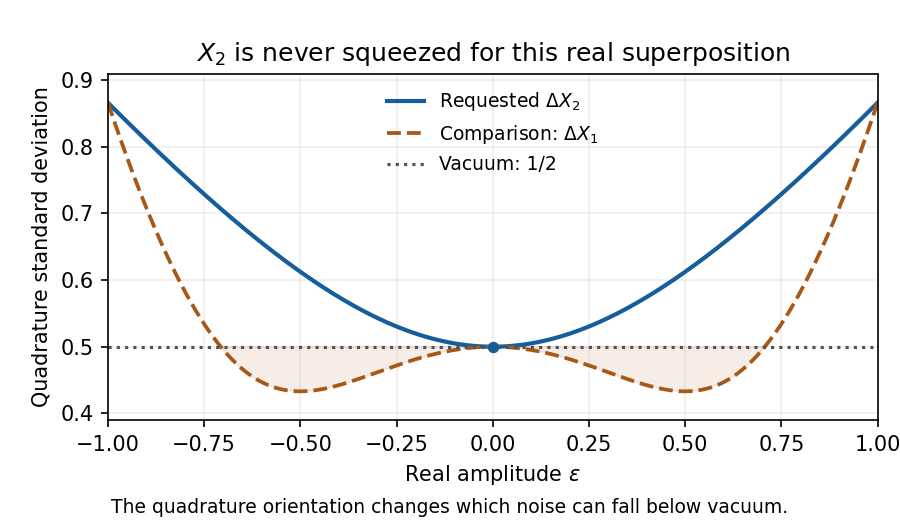
For the stated vacuum–one-photon superposition, normalization requires . Direct Fock-basis matrix elements giveUsing ,Consequently there is no squeezing of the specified quadrature:It equals the vacuum uncertainty only at and reaches at . The curve is even in . The orientation matters: the same real superposition has , which is below for . This does not turn it into a Gaussian squeezed vacuum; it simply illustrates quadrature squeezing of a vacuum–one-photon superposition.

For the printed beam splitter convention, expansion gives the operator identitiesThuswhere different input modes commute. The source's equality mixing an expectation on one side with an operator on the other is understood as this operator identity, or with expectation brackets on both sides. The mean difference reveals phase-sensitive mutual coherence between inputs; it is not by itself a photon-number correlation measurement of the usual Hanbury Brown–Twiss type. Repeated fluctuations, rather than one mean value, are needed to infer quadrature uncertainty.
For the independent coherent local oscillator, replace by in the mean. The effective signal operator isTherefore measures , and measures , each multiplied by . Choosing measures . These phase choices follow the specified complex beam-splitter matrix; importing a different beam-splitter convention would shift them.
This is balanced homodyne detection. A stable strong local oscillator supplies the phase reference, the signal and oscillator meet at a 50:50 beam splitter, and matched photodetector currents are subtracted. Varying the reference phase selects different quadrature projections. Recording their distributions supplies more information than their means and supports optical homodyne tomography.
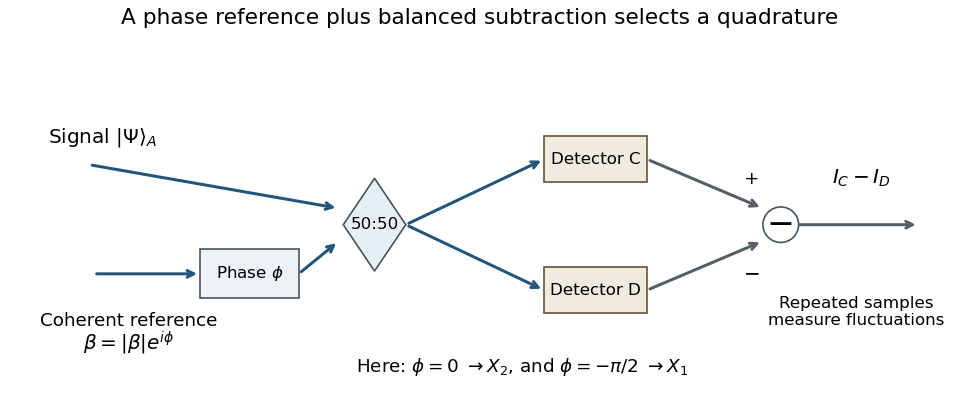

The strong-reference limit also needs a noise qualification. Define , with . For independent signal and coherent reference, an exact ideal-detector calculation givesOne derivation writes , where is in vacuum. The reference-amplitude term gives the first contribution; the remaining vacuum term contributes . Thus the normalized variance approaches the signal quadrature variance when the reference is sufficiently strong relative to the signal. A finite reference is not exactly a classical noiseless field.
A single detector can also carry quadrature information, but its mean alone still does not determine the variance. It measures , retaining the large reference background and its fluctuations. For fixed signal moments and a large coherent reference,The additional vacuum-level term and the uncancelled reference power must be calibrated. In practice the reference may also have much larger classical intensity noise. Balanced subtraction cancels the common total-power term and strongly rejects common-mode technical noise while retaining the phase-sensitive difference. Detector imbalance, unequal efficiencies and reference phase noise limit that advantage. It is therefore the more direct and usually more sensitive quadrature-noise measurement, rather than a claim that a single-port measurement contains no useful information.
Articles by others on the same topic
There are currently no matching articles.