2016 paper: Public original PDF, physical page 826. Student-answer availability for this paper remains unverified.
Original public paper: Physical PDF pages 826–828. All three questions and all alternatives in question 2 are answered. Optical amplitudes and quadratures use the normalization printed in the paper; factors of two depend on that convention.
The process is sum-frequency generation, with . The same reversible three-wave mixing interaction permits the reverse conversion when the higher-frequency field supplies the pump. The second-order nonlinear polarization couples the three waves; its effective coefficient includes the crystal orientation and polarizations.
One efficiency limit is phase mismatch: contributions generated at different positions acquire different phases and can cancel. A second practical limit is spatial walk-off, which reduces the overlap of finite beams in a birefringent crystal. A beam radius and relative walk-off angle give an overlap length of order . Absorption and scattering provide further losses. Group-velocity mismatch matters for pulses, and pump depletion eventually invalidates an undepleted-pump calculation; none of these effects should be silently included in the ideal lossless plane-wave equations.
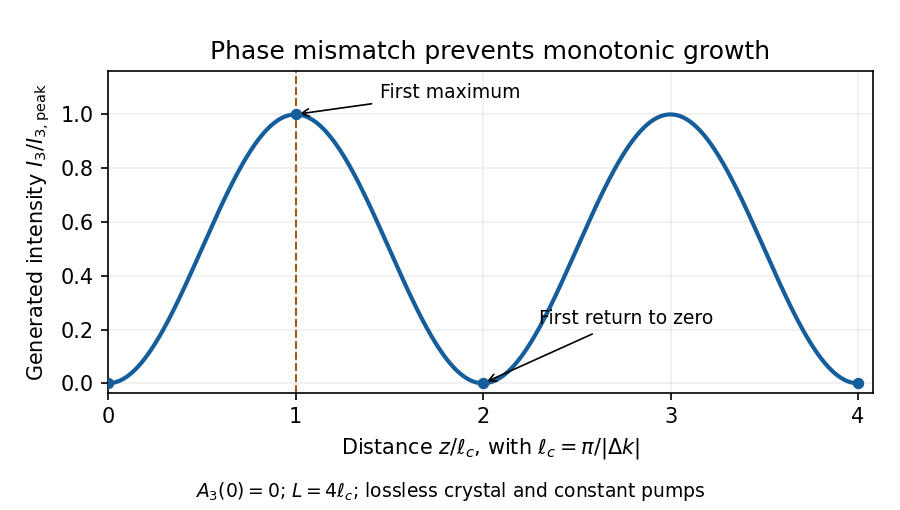
Define and hold constant. Direct integration of the driven equation giveswhere . The second expression has a continuous phase-matched limit. If the generated field is initially absent,For this is proportional to : the first maximum is at the nonlinear optical coherence length , and the first subsequent zero is at . A seed adds interference with the generated amplitude and can change that pattern. At exact phase matching, the unseeded result grows as only while pump depletion remains negligible.
To retain depletion consistently, differentiate each intensity before inserting the coupled equations:For real in the lossless convention, put . The result isThe signs follow the printed amplitude equations. In initial up-conversion, the newly generated makes , so the two input intensities decrease while the sum-frequency intensity increases. Adding the derivatives gives zero because . The total intensity is conserved, even though the three individual intensities change.
The Manley-Rowe relations areDividing an intensity by gives photon flux density. A conversion event removes one photon from each lower-frequency mode and adds one to the upper mode, or does the reverse. Therefore and count conserved sums of photon fluxes, while counts the conserved lower-frequency difference. They are not three independent invariants: . Energy conservation is also recovered as .
The unweighted combinations generally fail because the exchanged photons have different energies. Explicitly,The qualification “generally” matters: is conserved for equal lower frequencies in a distinct-mode degenerate case, and every derivative vanishes when there is no exchange. The equations establish nonconservation for generic unequal-frequency interaction, not for all special solutions.
The optical Kerr effect gives an intensity-dependent refractive index, , in the simplest instantaneous isotropic model. A beam whose intensity varies transversely therefore writes a transverse index profile into the medium. Over length its nonlinear phase is approximately , with .
For a bright-centered beam, positive raises the index at the center and produces self-focusing; negative produces self-defocusing. The medium acts as an intensity-dependent lens. This is a transverse effect, distinct from temporal self-phase modulation broadening a pulse's spectrum, though both originate in the same nonlinear index. Kerr lenses can provide intensity-dependent mode selection in a laser, and a beam's index profile can guide or deflect a second beam through cross-phase modulation.
The competition with diffraction appears in a paraxial model,In one transverse dimension, focusing can balance diffraction to support a bright spatial optical soliton under suitable boundary conditions. Transverse perturbations can also grow through modulational instability, breaking a broad beam into localized structures. In an ideal two-transverse-dimensional cubic model, sufficiently strong focusing permits collapse; the critical-power scale is proportional to , with its numerical coefficient depending on the convention and profile used.
A real medium does not develop an actual infinite intensity. Saturation, multiphoton absorption, ionization, nonparaxial propagation and damage can arrest or invalidate the simple model. Filament formation therefore requires more physics than inserting a real constant into a lens formula. The useful applications exploit a controllable index profile; the same positive feedback can be a serious limitation on transporting high-power beams.
Quasi-phase-matching compensates phase mismatch by deliberately modulating the nonlinear coefficient, rather than demanding that the material wavevectors themselves exactly match. In a periodically poled ferroelectric crystal, reversing domains changes the sign of the relevant second-order coefficient. Flipping it when the nonlinear interaction would begin to undo previous conversion restores constructive accumulation over many domains.
Write with . The amplitude integral contains phases , so a Fourier component is useful whenFor first-order compensation, and each domain has width . This is twice the single-domain coherence length for the complete sign pattern, not a full period equal to .
For ideal equal-width domains switching between and , the resonant first Fourier coefficient has magnitude . The effective amplitude coefficient is therefore reduced by , and conversion intensity by , relative to a perfectly phase-matched uniform crystal using that same . Nevertheless, quasi-phase matching can permit a larger tensor coefficient or wavelengths and polarizations inaccessible to ordinary birefringent phase matching, more than compensating that idealized reduction.
Periodically poled lithium niobate is a practical example. Such gratings support second-harmonic and sum-frequency generation, difference-frequency conversion, optical parametric oscillation and pair generation. The period and temperature select the operating wavelengths; finite length gives a finite mismatch acceptance. Domain duty-cycle errors, nonuniform temperature, absorption and finite spatial or temporal overlap limit the result. Chirped or apodized patterns can reshape bandwidth, but do not make these physical limits disappear.
An atom-field dressed state is an eigenstate of the coupled atom and drive, rather than an eigenstate of the isolated atom. A strong near-resonant field mixes the bare two-level states and changes the transition spectrum. In a frame rotating at the drive frequency, the rotating-wave approximation gives, for one convenient convention,Here is the resonant Rabi frequency. The two eigenvalues areAt resonance, the dressed states are equal-weight symmetric and antisymmetric combinations of the bare atom–field configurations. For a quantized drive, the appropriate paired configurations are and ; their coupling scales as . A strong coherent drive gives the familiar approximately classical Rabi frequency over its occupied photon-number range.
Radiative transitions connect neighboring dressed manifolds. Same-branch transitions have frequency near , while opposite-branch transitions give sidebands near . Under sufficiently strong resonant driving this produces the Mollow triplet in resonance fluorescence, with sidebands separated from the center by . Radiation damping determines widths and weights; detuning changes the relative intensities. Sidebands must be sufficiently separated compared with the decay scale to be resolved.[ref]
Power Spectrum of Light Scattered by Two-Level Systems by B. R. Mollow. 1969 primary calculation of near-resonant driven two-level fluorescence with radiative damping
A fluorescence experiment drives the transition with a narrow-band laser, collects scattered light away from the intense drive beam, and resolves its spectrum. Changing drive intensity changes and hence the splitting. This measures transitions of the interacting system, not merely a population oscillation in time. The emitted spectrum can include an elastic coherent contribution as well as the inelastic fluorescence peaks, so the observed line shape needs the specified drive, damping and detection model.
An optical squeezed vacuum has zero mean field, nonzero mean photon number , and unequal noise in two principal optical quadratures. With and , the vacuum variance is and . In axes aligned with the squeezing,The ideal pure state saturates . A below-threshold degenerate optical parametric amplifier or oscillator can generate it: a coherent pump drives pair creation into a mode, and the pump phase selects the squeezed quadrature. Loss mixes in vacuum noise, while technical phase fluctuations mix the squeezed and antisqueezed axes.
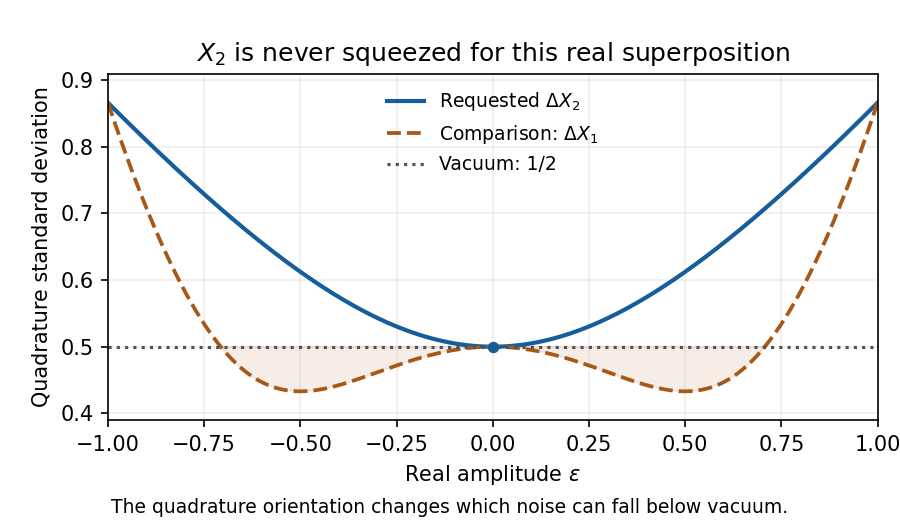
For the stated vacuum–one-photon superposition, normalization requires . Direct Fock-basis matrix elements giveUsing ,Consequently there is no squeezing of the specified quadrature:It equals the vacuum uncertainty only at and reaches at . The curve is even in . The orientation matters: the same real superposition has , which is below for . This does not turn it into a Gaussian squeezed vacuum; it simply illustrates quadrature squeezing of a vacuum–one-photon superposition.
For the printed beam splitter convention, expansion gives the operator identitiesThuswhere different input modes commute. The source's equality mixing an expectation on one side with an operator on the other is understood as this operator identity, or with expectation brackets on both sides. The mean difference reveals phase-sensitive mutual coherence between inputs; it is not by itself a photon-number correlation measurement of the usual Hanbury Brown–Twiss type. Repeated fluctuations, rather than one mean value, are needed to infer quadrature uncertainty.
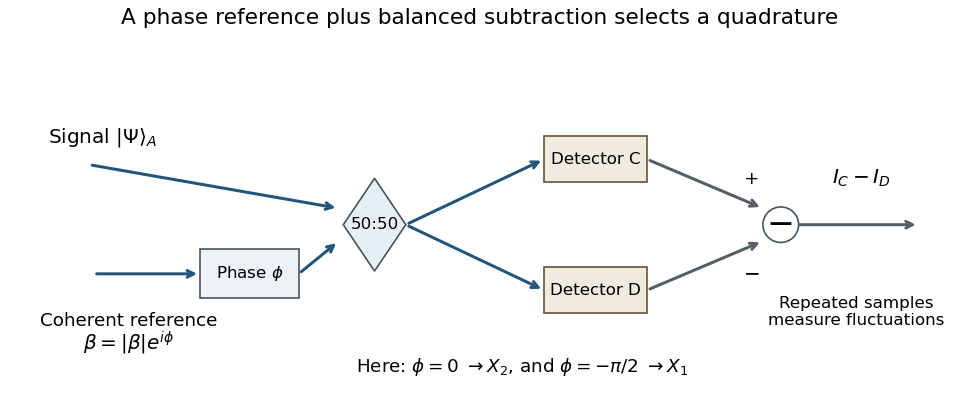
For the independent coherent local oscillator, replace by in the mean. The effective signal operator isTherefore measures , and measures , each multiplied by . Choosing measures . These phase choices follow the specified complex beam-splitter matrix; importing a different beam-splitter convention would shift them.
This is balanced homodyne detection. A stable strong local oscillator supplies the phase reference, the signal and oscillator meet at a 50:50 beam splitter, and matched photodetector currents are subtracted. Varying the reference phase selects different quadrature projections. Recording their distributions supplies more information than their means and supports optical homodyne tomography.
The strong-reference limit also needs a noise qualification. Define , with . For independent signal and coherent reference, an exact ideal-detector calculation givesOne derivation writes , where is in vacuum. The reference-amplitude term gives the first contribution; the remaining vacuum term contributes . Thus the normalized variance approaches the signal quadrature variance when the reference is sufficiently strong relative to the signal. A finite reference is not exactly a classical noiseless field.
A single detector can also carry quadrature information, but its mean alone still does not determine the variance. It measures , retaining the large reference background and its fluctuations. For fixed signal moments and a large coherent reference,The additional vacuum-level term and the uncancelled reference power must be calibrated. In practice the reference may also have much larger classical intensity noise. Balanced subtraction cancels the common total-power term and strongly rejects common-mode technical noise while retaining the phase-sensitive difference. Detector imbalance, unequal efficiencies and reference phase noise limit that advantage. It is therefore the more direct and usually more sensitive quadrature-noise measurement, rather than a claim that a single-port measurement contains no useful information.
Original paper: 22 April 2015, physical PDF pages 751–754.
The polarization generated by the relevant third-order nonlinear optical susceptibility is proportional to . Multiplication of its temporal and spatial wave phase factors givesThe two opposing pump arrows in the original diagram mean . Thus the mixing source points along , and its conjugate signal amplitude drives a backward field. This is counterpropagating-pump phase matching in four-wave mixing.
There is a phase matching qualification to the initial frequency statement. In the stipulated nondispersive isotropic medium, . Exact equality of the backward free-wave vector to therefore requires , hence . For unequal frequencies the backward direction remains the geometry suggested by the source, but the longitudinal phase mismatch has magnitude . Efficient generation over a finite length requires that mismatch times be small; a sinc function factor suppresses conversion otherwise. Nondispersion does not remove the magnitude mismatch. The remainder of the calculation is explicitly degenerate four-wave mixing, so this difficulty disappears.
At the pump frequency, for the strong field , self-phase modulation and cross-phase modulation by dominate the weak signal's influence. They change its propagation wave phase through its own intensity and the other pump's intensity. With continuous uniform plane waves, these are nonlinear wave phase shifts; finite pulses acquire temporal chirp, and finite transverse beams can acquire a lens. No universal factor of two should be assigned between the two shifts without specifying their polarization contraction and the field-amplitude convention.
Write and . Differentiating the exponential substitutions cancels the terms proportional to :Consequently and . Conjugate the latter before eliminating a field: , so . The backward four-wave-mixing boundary problem requires opposite-end boundary conditions: , where , and . The transfer matrix isAt , , so . Substitution givesThe printed target expression for has the opposite overall sign. This is present in the original PDF, not just the transcription. With its stated first-order equations, the derivative at the far face must be . The boxed result has that derivative; the printed expression has its negative. Reversing the convention for the mixing coefficient could reverse the generated phase, but would also change the coupled equations. The result above satisfies the equations and both boundary conditions together.
At the entrance, , so the returned amplitude is proportional to the complex conjugate of the signal. An ordinary ideal mirror gives , with a fixed reflection coefficient , rather than . The mixing pumps supply both the extra energy and a wave phase reference. The ideal conjugate reflectivity and signal transmission areThe constancy of along the medium is another direct check. The relation between the incoming signal and outgoing waves allows net output energy to come from the pumps. As , the undepleted-pump approximation fails: the predicted fields would extract an appreciable pump fraction. This is the ideal four-wave-mixing oscillation threshold; saturation, pump depletion and noise seeding replace the divergent linearized solution. It is not an unlimited source of reflected power. Amplified phase-conjugated propagation and parametric oscillation are also the effects identified in the primary analysis by Amnon Yariv and David M. Pepper.[ref]
Amplified reflection, phase conjugation, and oscillation in degenerate four-wave mixing by Amnon Yariv and David M. Pepper. abstract, amplified conjugate propagation and parametric oscillation
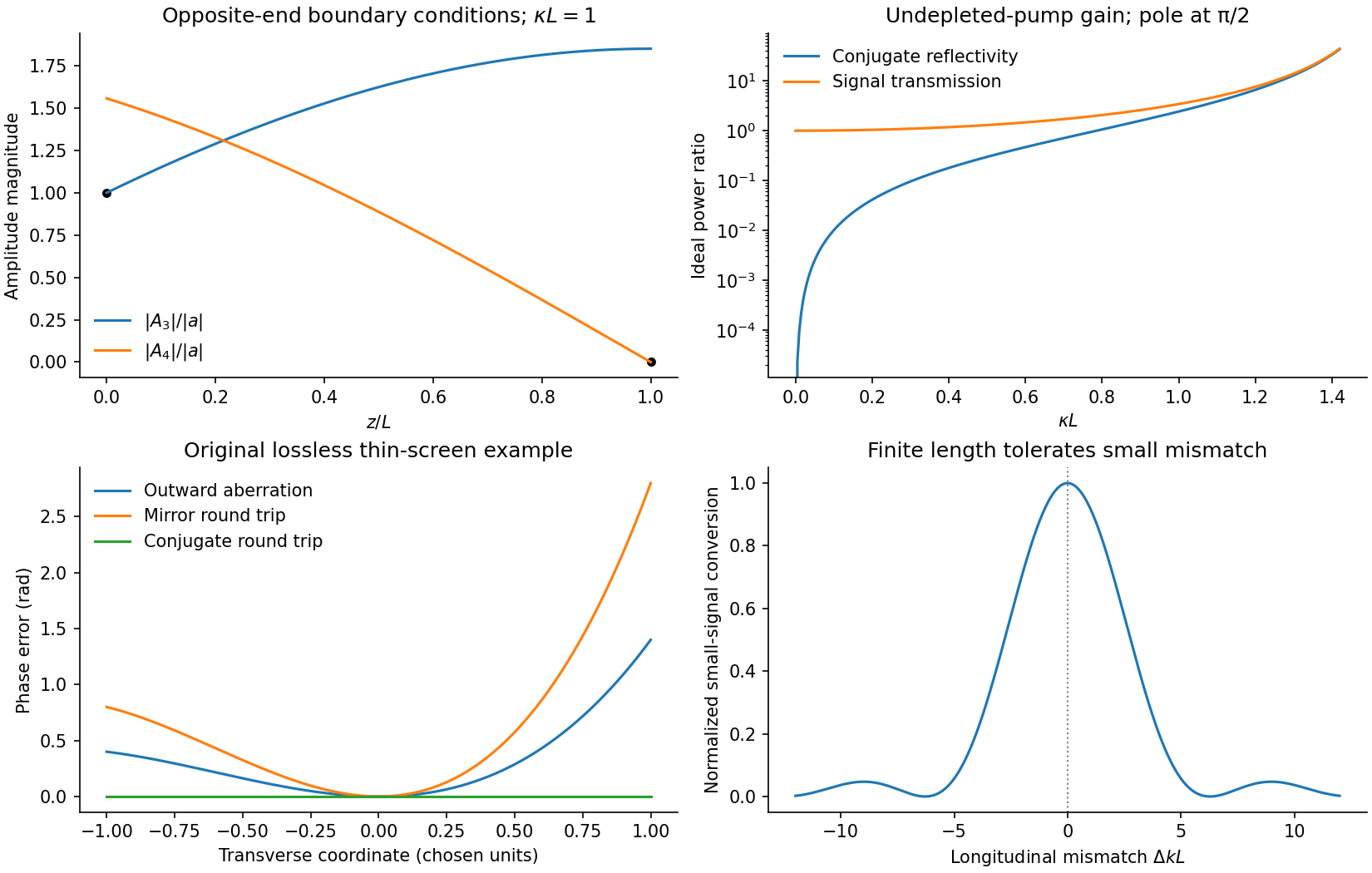
For the aberrating linear medium, assume its permittivity is real and stationary at this frequency. Taking the complex conjugate of the forward-envelope equation givesThis is the backward-envelope equation with carrier . Launching the conjugate boundary field therefore permits retracing of the distorted wave. In a transverse lossless phase screen model, let transmission be . A return proportional to acquires on its second passage and becomes . Thus the aberration phase cancels. A mirror instead gives , adding the aberration twice; merely reversing the central propagation direction does not reverse the wavefront phase.
The one-dimensional printed equation describes longitudinal variation; genuine transverse aberrations require the corresponding transverse Helmholtz equation or paraxial operator, for which the same real-coefficient conjugation argument applies. Exact reconstruction requires adequate aperture, the correct conjugate amplitude and polarization, uniform pump-product phase, and an unchanged reciprocal lossless medium. Absorption, missing scattered modes or a changed aberrator prevent a universal reconstruction. This is phase conjugation and thin phase-plate cancellation by phase conjugation under specified conditions, rather than reversal of every possible propagation loss.
A finite beam has an intensity gradient across its wavefront. In an instantaneous optical Kerr model, . A bright centre therefore sees a larger index for , accumulating more phase than the wings and producing self-focusing. Negative gives self-defocusing. For a short medium and Gaussian , expand the nonlinear phase near the axis:Compare with the in-medium thin-lens phase , where . The Kerr lens has . This local quadratic fit describes the central lens, not the whole Gaussian phase or a guaranteed aberration-free focus.
Propagation combines diffraction with the nonlinear phase. Choose and a scalar paraxial envelope, givingThe diffraction length is of order , while the nonlinear length is . Their competition depends on total beam power as well as spot size. In two transverse dimensions, balancing them gives a critical power scale for positive ; the numerical constant requires a specified transverse profile and critical solution. In the ideal unsaturated cubic model, sufficiently strong focusing can collapse rather than form a stable beam. Real saturation, absorption, ionization or nonparaxial propagation can stop that ideal singularity; the appropriate mechanism depends on the material and pulse regime.
A broad focusing beam can also break into filaments. Perturb the uniform solution by real amplitude and phase components with transverse wave number . Linearization gives the transverse modulational instability rateFor positive , modes with grow. diffraction suppresses very fine perturbations. A finite beam's boundaries and available propagation length limit which filaments develop. The defocusing sign has no growing band in this simple instantaneous local model.
A spatial optical soliton instead has a profile whose nonlinear focusing balances diffraction. A one-transverse-dimensional cubic focusing model supports a stationary bright solution; the existence of that solution does not establish robust two-dimensional cubic self-trapping. A beam can also act on another finite beam through cross-phase modulation, producing an induced lens or steering it towards a high-index region. Unequal polarization response can rotate or reshape the profile. Temporal self-phase modulation is a related consequence of a time-dependent intensity, but should be distinguished from these transverse effects.
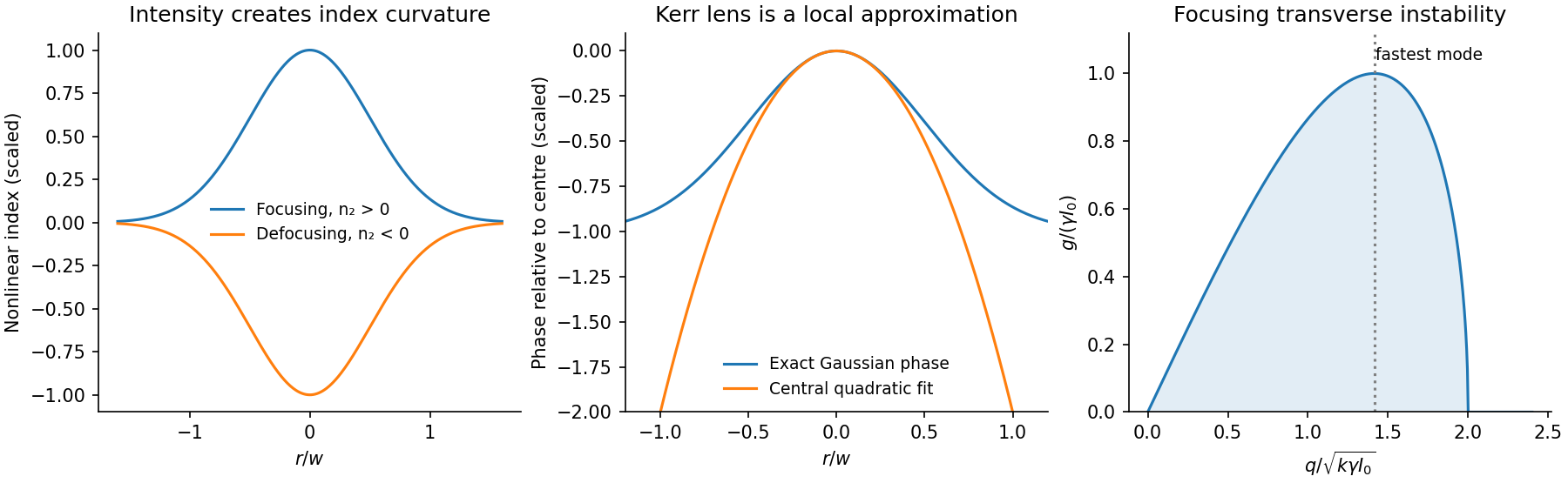
For an experimental check, vary power at fixed input waist and compare near- and far-field profiles with a low-power diffraction reference. Repeat with a second beam blocked to separate cross-phase modulation from self-action. Vary pulse duration or repetition rate to test thermal lensing against a prompt electronic response, and monitor transmission to distinguish nonlinear refraction from preferential absorption. A smaller output spot alone does not establish a soliton or a pure Kerr response.
For a local electric-dipole response of order , writeIts susceptibility is a rank- tensor. Initially it has components in three dimensions, before symmetries and frequency constraints are applied. nonlinear-susceptibility tensor symmetry involves several logically different restrictions.
Neumann's principle requires invariance under the material point group. For an operation ,For inversion, , so . Thus all even orders vanish in a centrosymmetric material's local bulk electric-dipole response. In particular there, while is permitted. Surface symmetry breaking, an applied bias or nonlocal magnetic/quadrupole response lies outside that statement. A noncentrosymmetric crystal permits some second-order components, but other point-group operations can still eliminate a chosen component.
Intrinsic permutation symmetry follows from interchanging commuting input field factors, provided the associated frequency labels are interchanged too. At second order,For equal input frequencies this makes the last two spatial indices symmetric, reducing 27 components to 18 before material symmetries. At unequal frequencies it does not identify the two index arrangements with the arguments held fixed. Reality of the time-domain polarization separately givescausality imposes dispersion relations; neither arbitrary real coefficients nor full index symmetry should be inferred merely from the word lossless.
Kleinman symmetry is a stronger approximation far from relevant resonances when frequency dispersion can be neglected. A frequency-independent effective interaction energy makes its derivatives interchangeable, allowing full permutation of output and input spatial indices. At second order a fully symmetric rank-three tensor has components. Close to resonance or across a dispersive band, that reduction can fail even when absorption at the measured frequencies is small. The original analysis distinguishes high-resonance electronic response from strongly dispersive lattice mechanisms and identifies additional symmetry constraints on the former.[ref]
Nonlinear Dielectric Polarization in Optical Media by D. A. Kleinman. abstract, mechanism dependence and additional symmetry requirements
For an isotropic fourth-rank susceptibility,If the relevant input slots are fully interchangeable, the coefficients coincide and . With distinct or mixed-sign frequency slots, frequency arguments must be followed and isotropy alone leaves the three displayed structures. These distinctions explain why tensor contractions, pump polarizations and operating frequencies must be specified before comparing effective self- and cross-phase coefficients.
spontaneous parametric down-conversion uses a second-order nonlinear polarization to convert pump energy into correlated signal and idler photons. With a classical undepleted pump, a single-mode interaction-picture model isThe creation term acts on the signal/idler vacuum, so no classical signal seed is required. The pump supplies the emitted energy; vacuum fluctuations are not an extra energy source. In the small-gain limit the SPDC pair state iswith normalization corrections understood at second order. More generally it is a two-mode squeezed vacuum with correlated pair numbers. A classical calculation with both generated fields exactly zero would miss the spontaneous start.
Efficient generation requires and approximate wave-vector matching . birefringence or a reciprocal grating vector in quasi-phase matching can compensate dispersion. In a continuum-mode treatment the pair amplitude includesThe pump spectrum constrains the sum frequency, while phase matching constrains the allowed frequency combinations and emission directions. type-I phase matching produces daughters in the same polarization class; type-II phase matching produces orthogonal ordinary/extraordinary classes. Correlation of pair numbers or orthogonal polarizations does not alone guarantee a polarization-entangled state in two chosen output paths.
One application is a heralded single-photon source: detect one partner and condition measurements on the other. Low gain suppresses multiple-pair contamination, whose probability begins at fourth order in the gain. Efficient collection and low detector noise matter. Spectral entanglement with an unresolved herald can leave the partner mixed; engineering or filtering the joint spectrum improves purity at a possible cost in brightness. Heralding does not make a photon appear in every pump pulse.
A second application is entangled-pair generation for quantum communication and tests of Bell inequalities. If the assignments and are indistinguishable except for polarization, their amplitudes can form . Walk-off, group delay or frequency labels can reveal which assignment occurred and destroy polarization interference. Their compensation is part of preparing the state, not merely an improvement in count rate.
A primary example pumped a 3-mm beta-barium-borate crystal with a argon-ion laser. Collecting the two intersections of its type-II emission cones selected paired output directions. Half-wave rotation and compensating birefringent crystals reduced temporal walk-off, and polarization analysers with avalanche photodiodes measured coincidence fringes. Varying analyser settings tested the correlations; accidentals, mode distinguishability and detector/collection assumptions limited interpretation. The reported visibility exceeded 97 percent and supported a Bell violation under the stated auxiliary assumptions, rather than a loophole-free claim.[ref]
New High-Intensity Source of Polarization-Entangled Photon Pairs by Paul G. Kwiat and others. pp. 4337–4340, Figs. 1–2, compensation, detectors and coincidence correlations
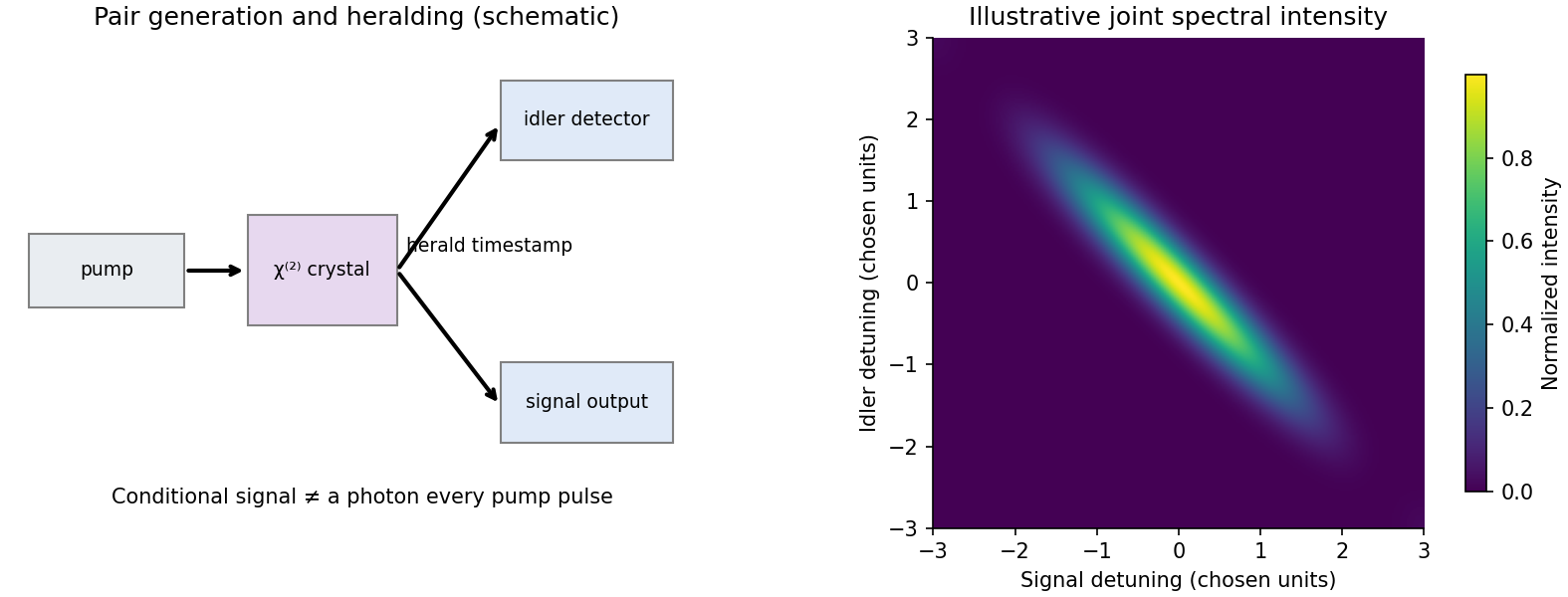
Original down-conversion and heralding schematic with an illustrative joint-frequency selection model
. Details. Other uses include preparing interfering photons for quantum-information experiments, correlation-based imaging, and pair-based detector calibration. All rely on specified spatial and spectral modes and coincidence statistics. A pump-blocked background run, delayed-coincidence estimate, gain dependence and polarization/temporal-overlap scans distinguish correlated pairs from fluorescence, detector dark counts and accidental coincidences. The useful resource is the controlled joint quantum state, not simply two bright output beams.
An ideal cross-Kerr interaction between two single modes is , with . The number operators commute with the interaction, so this coupling changes phases without transferring photons between the modes. To implement the specified positive conditional phase, usewhere within the one-photon polarization subspace. The horizontal branch has zero interacting occupation. Since , the specified conditional rotation follows. This is an ideal lossless single-mode model; an actual travelling-wave medium's bandwidth, loss and noise are not established by writing this Hamiltonian.
Use and . A coherent state has centre and variance in either optical quadrature. Multiplication of by rotates that centre anticlockwise through , keeping the coherent state noise disk unchanged. For real positive the two centres are and .
Normalize the initial polarization of an electromagnetic wave qubit. The output of the medium isThe joint state is generally an entangled state. The overlap magnitude is . The state factorizes when the amplitudes coincide, while nearly distinguishable amplitudes make the polarization nearly maximally entangled with the optical mode. Before any polarization conditioning, tracing out mode 2 gives the mixture , with no interference between branches.
Include the normalization factors in the half-wave plate map: and . The transformed joint state isConditioning on a vertical result and setting therefore preparesThis pure optical cat state is the conditional output; it is not the unconditioned reduced state immediately after the Kerr medium. The measurement erases the polarization label, allowing the two amplitudes to interfere. The calculated optical Wigner functions below display the resulting fringes; their negative regions are quasiprobability, not negative detection probabilities. These illustrative plots choose : the rotation panel uses , while the cat panels use the conditional Kerr rotation and three different relative phases .
The coherent-state overlap follows by expanding in the Fock basis:Thus andThe postselection probability for Kerr-cat preparation includes both the normalized input qubit and the wave plate. At the vertical branch has zero probability and no normalized conditional state. For the remaining calculation take real, as required.
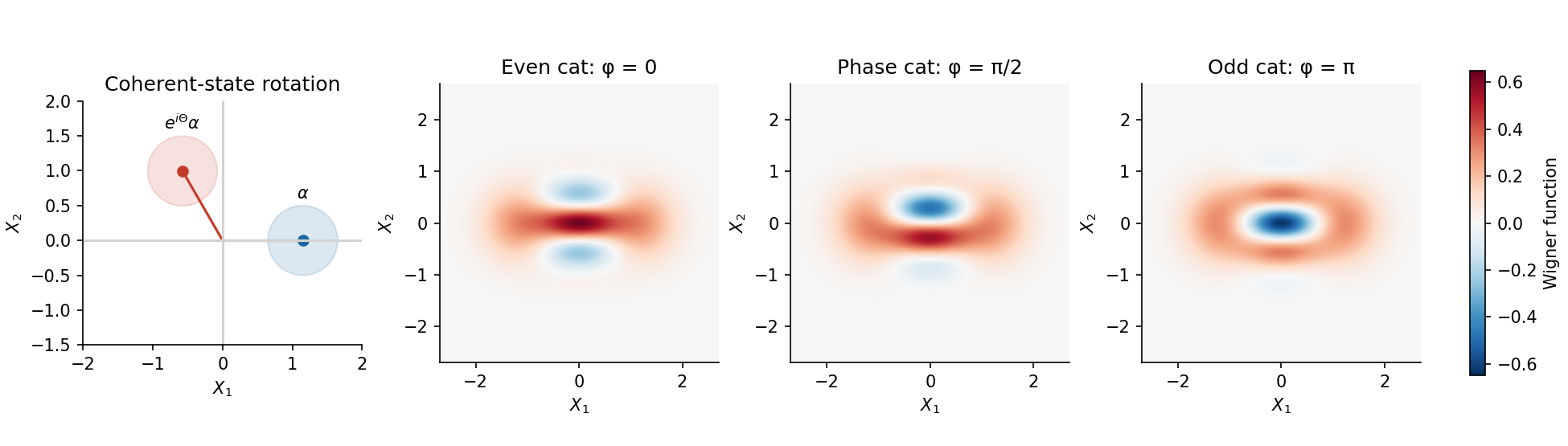
Original coherent-state rotation and calculated phase-space interference of three conditional cat states
. Details. Using , put . Directly evaluating diagonal and cross terms givesThe last quantity is the mean photon number in the conditional cat, which differs from the input coherent state mean . Since ,However, its first moment iswhich is generally nonzero. The original PDF's assertion of a zero mean for arbitrary is inconsistent with its stated pure state. Consequently its displayed expression is the second moment, not the general variance. The phase-dependent cat-state quadrature variance isThe printed result does become the variance for , notably the even and odd cat states. It could also describe an ensemble mixing equal weights of and : that different state's mean vanishes while its second moment is unchanged. Such phase averaging is not part of the specified pure-state preparation.
For nonzero finite , and . The correct quadrature squeezing condition in this quadrature is thereforeFor a representative phase in , this is . If instead one applies the printed second moment as a variance, the resulting condition is , or modulo . That is sufficient, but not necessary, for the actual pure state's squeezing. For example, at , while . This explicitly tests the difference.
For a fixed phase other than modulo , expandAs the input mean number , the normalized state tends to vacuum, andThis expansion is nonuniform near the odd-cat phase. At exactly the vacuum terms cancel and the normalized odd coherent-state superposition tends to , giving , while its postselection probability tends to zero. The even coherent-state superposition at instead contains only even photon numbers and tends smoothly to vacuum.
At large input mean number, , the two coherent state branches become nearly orthogonal, and for every fixed phase. The mean tends to zero as well. This does not make the state an incoherent mixture: phase-space interference still distinguishes the ideal quantum superposition, although its contribution to this low-order moment is exponentially small. The loss of coherence in an optical cat state arises when ordinary loss reveals the branch to the environment and suppresses that interference, with factor for transmissivity .
For the especially simple even cat,It starts at , falls to about at , and returns towards from below. The odd-cat curve decreases from towards from above. Other fixed-phase curves have the small- and large-amplitude limits derived above; for negative , squeezing ends when . In balanced homodyne detection, centre each quadrature distribution on its measured mean before inferring its variance.
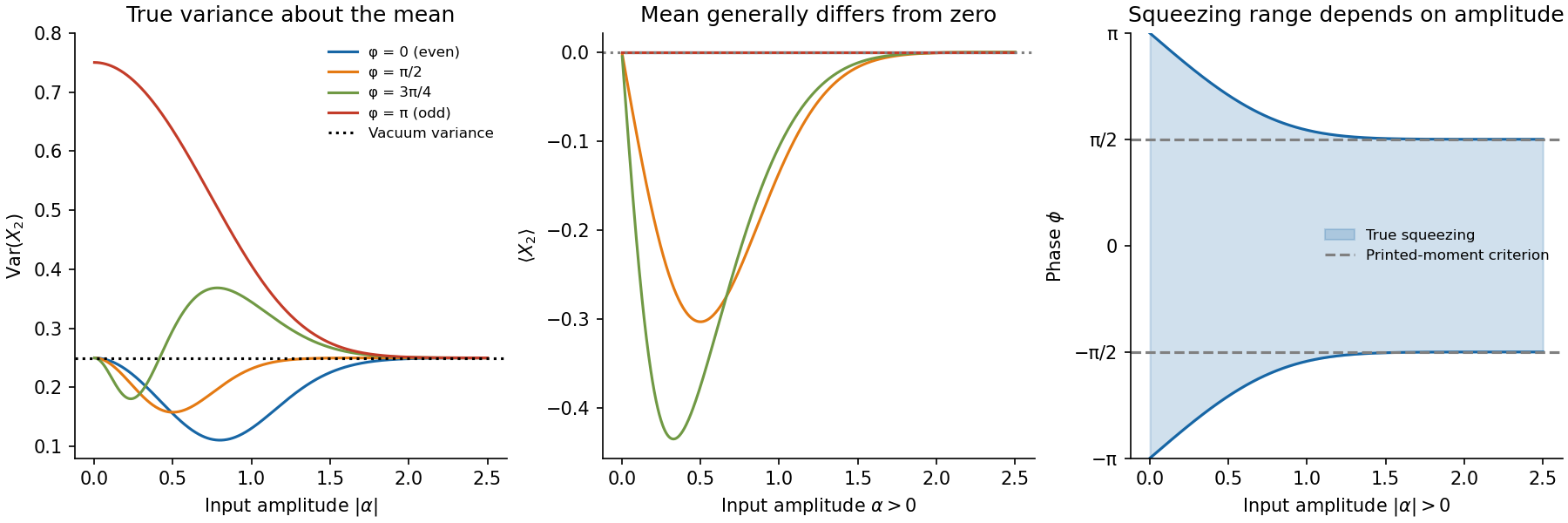
Calculated cat-state quadrature means, true variances, and the amplitude-dependent squeezing boundary
. Details. Original paper: 23 April 2014, physical PDF pages 678–680.
Put . For a temporally uniform envelope, and , so the propagation equation reduces to . Thus the power stays and the accumulated nonlinear wave phase is . The optical Kerr effect gives an intensity-dependent refractive index, and hence self-phase modulation. For the usual power normalization , with effective guided-mode area . Losslessness preserves the background power; it does not remove the self-phase modulation. The carrier wave phase has already been factored out.
Write . To first order,Cancelling the background and its phase derivative leavesThe last term couples a perturbation to its complex conjugate: the pump can transfer energy into a pair of sidebands. It is not an independent wave phase of each Fourier component. This sideband coupling is the linear origin of fibre modulational instability.
For real , put . Matching the two exponential coefficients givesA nonzero pair requires a zero determinant, henceFor unstable complex , the real-coefficient assumption is too restrictive. The consistent pair is , with complex . Its equations give the same determinant and allow the growing and decaying branches. Merely inserting imaginary while treating the two original coefficients as real would not respect complex conjugation.
For and nonzero , exponential growth requires andFor ordinary positive Kerr nonlinearity this means anomalous group velocity dispersion, . Define . The growing branch is , with amplitude growth rateSideband power grows at rate , rather than . The cutoff and zero-frequency modes have no exponential growth; in a degenerate zero-frequency sector a secular phase response can remain. Positive dispersion with positive gives real and oscillatory perturbations.
Initially small ripples grow into pronounced intensity peaks and deplete the uniform background. Dispersion and self-phase modulation can then support localized bright pulses. A fundamental temporal bright soliton obeys , so its width is comparable to when its peak power is comparable to the original power. The dominant ripple spacing is , not simply . Propagation distance is the evolution variable; measures time within the envelope. An ideal conservative fibre need not settle permanently into a unique pulse train: nonlinear compression, interactions and recurrence depend on the seed and boundary conditions.
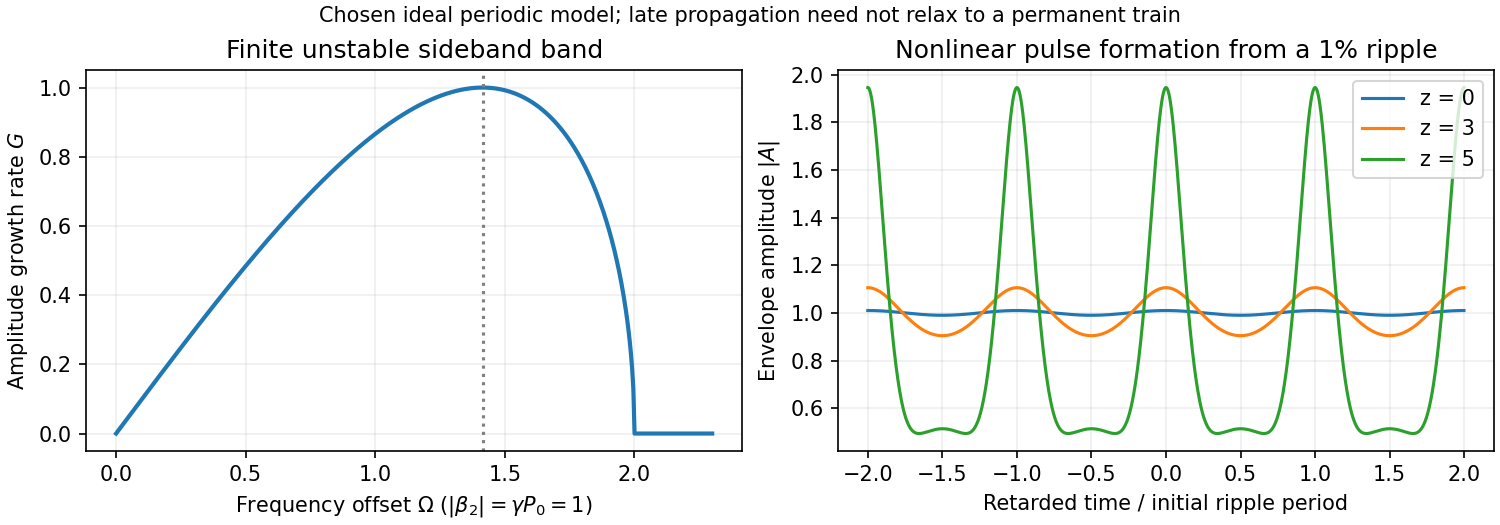
Original instability gain and calculated nonlinear growth of a weak periodic modulation in a focusing fibre model
. Details. A degenerate optical parametric amplifier sends a strong pump at through a phase-matched second-order nonlinear medium, creating pairs in a selected mode near . With the pump treated classically and undepleted, the effective interaction is quadratic in the mode's creation and annihilation operators. Vacuum input evolves into an optical squeezed vacuum; the pump phase fixes the quiet optical quadrature. A cavity enhances the interaction below oscillation threshold. balanced homodyne detection compares this optical quadrature's noise with the blocked-signal vacuum reference; phase locking, detector balance, electronic-noise measurement and loss calibration distinguish squeezing from an instrumental noise reduction. A primary cavity experiment observed below-vacuum noise by degenerate down conversion and balanced homodyne readout.[ref]
Generation of Squeezed States by Parametric Down Conversion by Ling-An Wu and others. 1986, abstract: cavity down conversion and homodyne noise reduction
Use , so . Write , and . Vacuum expectations then givePair creation makes the mean field zero while the mean photon number is positive. Expanding the transformed ladder operators in the vacuum gives the squeezed-vacuum photon-number moments: and ; equivalently .
The vectors produced by photon addition and photon subtraction in the paper are not normalized. Their squared norms are and , respectively. A particularly direct evaluation isBoth successful operations therefore prepare the same squeezed one-photon state, up to an overall phase, whenever subtraction has nonzero probability. Since , the unnormalized moments areThe printed photon-added formula equals , not a normalized mean. With its literal unnormalized convention, the corresponding subtraction result is andThis difference tends to one as and grows as for large positive . Keeping this convention recovers the paper's requested expression without misidentifying it as a physical conditional mean.
For the normalization of photon-added and photon-subtracted states, divide by the squared norms to obtain actual conditional means:These equalities for subtraction require . As the normalized successful subtraction tends to , but its success probability vanishes; exactly at , gives no conditional state. At large , both normalized means grow as , while their difference remains zero.
For the photon statistics of a squeezed vacuum, the even-number probabilities areAfter subtraction the normalized distribution is . It has only odd occupation and no vacuum component. photon addition gives , identical here to . The diagram uses normalized distributions with an explicitly chosen , rather than treating the unnormalized moments as means.
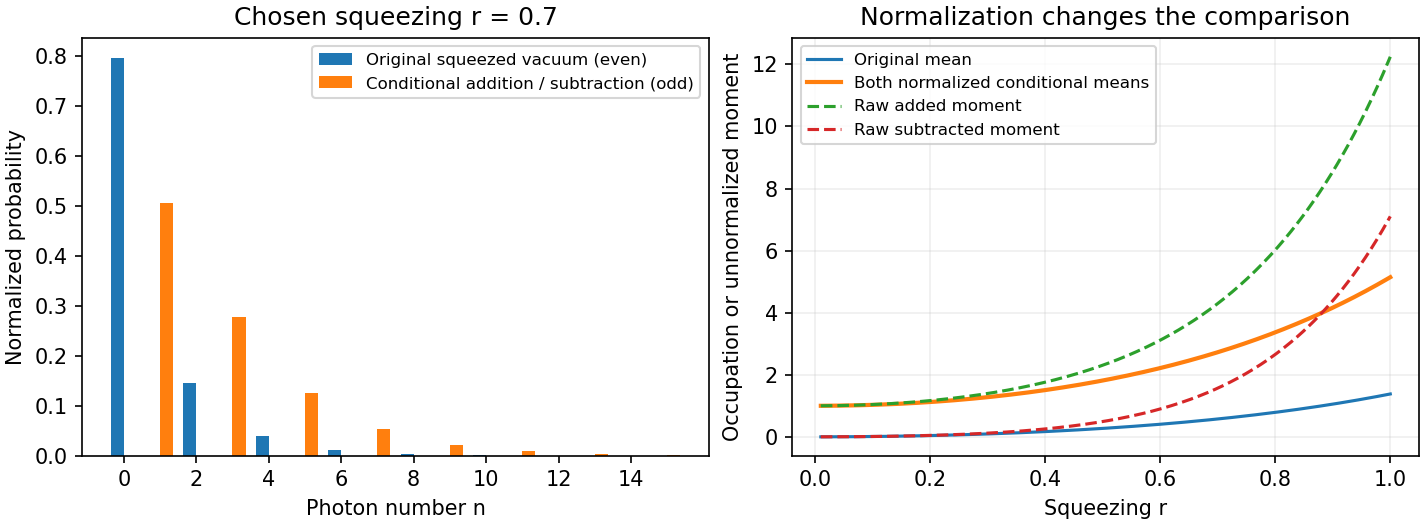
Original normalized even squeezed-vacuum and odd conditional photon-number distributions, with raw-moment and mean conventions distinguished
. Details. A subtraction event samples initial occupation with weight , preferentially selecting the larger components before removing one photon. In general . Here the large variance gives . This conditional photon-number bias does not create energy by removing a photon: the unconditional ensemble also includes the runs without a heralded event.
An optical soliton maintains a localized profile because nonlinear refraction compensates linear spreading. A temporal optical soliton balances group velocity dispersion against self-phase modulation; a spatial optical soliton balances diffraction against self-focusing. The relevant coordinate and sign of nonlinearity must be specified.
For anomalous group velocity dispersion and positive , a fundamental temporal bright soliton isThe identity verifies both the width relation and propagation phase. Its dispersion length equals its nonlinear length . Bright pulses decay to zero background. dark solitons are intensity depressions on a nonzero background with a phase change across the dip; black dips reach zero intensity, while grey dips do not. For positive the corresponding temporal defocusing regime has normal group velocity dispersion.
A higher-order temporal soliton has soliton order equal to an integer greater than one for the special initial profile in normalized units. It breathes through compression and splitting/recombination, rather than keeping one fixed shape. Separated fundamental solitons can interact and acquire collision shifts. An arbitrary pulse with noninteger is not automatically a pure higher-order soliton; dispersive radiation can carry part of its energy.
In ideal one-dimensional cubic propagation, dispersion and nonlinearity support stable fundamental bright pulses. Loss, higher-order dispersion, delayed nonlinear response and finite bandwidth change real-fibre propagation. A one-dimensional spatial bright solution also does not guarantee stability against two-dimensional collapse. Profile preservation, finite-energy background conditions and robustness should be checked rather than inferred from any solitary-looking peak.
A detector too slow to resolve a femtosecond field can measure its integrated nonlinear response instead. Split the pulse, delay one replica, overlap both in a thin phase-matched crystal, and select the sum-frequency signal. For negligible depletion and sufficiently broad phase matching, the cross-generated field is proportional to ; integrated signal gives the second-harmonic intensity autocorrelationA noncollinear geometry can reject each replica's individual second harmonic. The optical response supplies the fast gate while the detector integrates slowly. Crystal thickness, group-velocity mismatch, spectral acceptance, beam overlap and delay calibration limit resolution.
For a Gaussian pulse specified by its intensity profile, the autocorrelation's full width at half maximum is times the intensity full width at half maximum. For a sech-squared intensity profile the ratio is about . These are model-dependent conversion factors. An intensity autocorrelation is symmetric in delay and loses phase information; different pulses can share it. An interferometric autocorrelation retains rapid carrier fringes but still does not generally reconstruct an arbitrary complex field uniquely.
frequency-resolved optical gating also resolves the gated signal's spectrum, giving a two-dimensional delay-frequency record. For second-harmonic frequency-resolved optical gating,where is measured relative to the signal's carrier. An iterative retrieval seeks an envelope whose predicted record matches the measurement. Alternatively, polarization-gating frequency-resolved optical gating uses the optical Kerr effect to gate the probe by a delayed replica's intensity, with signal envelope proportional to . The original FROG work introduced nonlinear optical gating plus spectral resolution to characterize arbitrary femtosecond pulses.[ref]
Characterization of arbitrary femtosecond pulses using frequency-resolved optical gating by Daniel J. Kane and Rick Trebino. 1993, abstract: nonlinear gating and spectrogram construction
Absolute wave phase and absolute time origin remain undetermined by these intensity records. The SHG record also cannot distinguish from , so its time-direction ambiguity remains. Retrieval agreement, an independently measured spectrum, adequate signal dynamic range and gate-response calibration are practical consistency checks. A pulse train that changes between shots can yield an averaged record that no single pulse faithfully represents. Thus nonlinear gating solves the detector-speed problem but does not remove inverse problem ambiguities or experimental limitations.
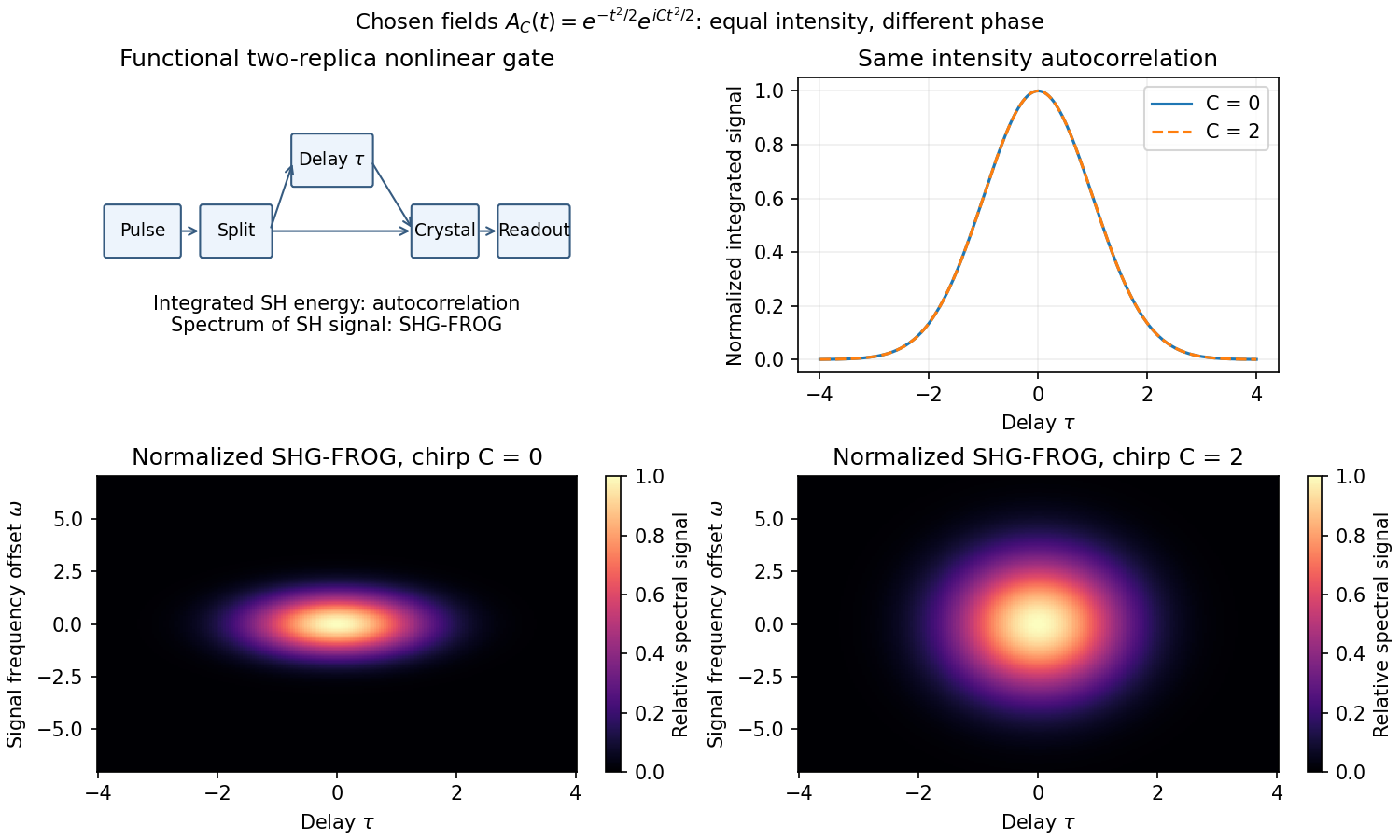
Original nonlinear pulse-gating layout and a calculated Gaussian chirp example distinguishing autocorrelation from spectral gating
. Details. For and , , so . Vacuum and coherent states have variance in either optical quadrature. quadrature squeezing means that some rotated optical quadrature has variance below this reference, with compensating noise elsewhere. A reduced second moment about zero is not the correct test when the field's mean is displaced.
For and , the quiet principal axis of the optical squeezed vacuum is at angle under the squeeze-operator convention used above, andThe pure Gaussian quantum state saturates the uncertainty product. Displacement moves its centre without changing its covariance ellipse; squeezed thermal states instead have a larger uncertainty product. The optical squeezed vacuum has zero mean field, even photon-number parity and mean occupation ; it need not have sub-Poissonian photon statistics. number squeezing and quadrature squeezing are different conditions.
Degenerate parametric amplification generates single-mode squeezing; a two-mode squeezed vacuum instead has correlated occupations and joint quadrature squeezing. Either individual mode of an ideal two-mode state is thermal after the other is ignored, not individually squeezed. balanced homodyne detection measures the noise versus local oscillator phase. Reference phase drift admixes the anti-squeezed optical quadrature, while electronic noise and detector imbalance need separate checks.
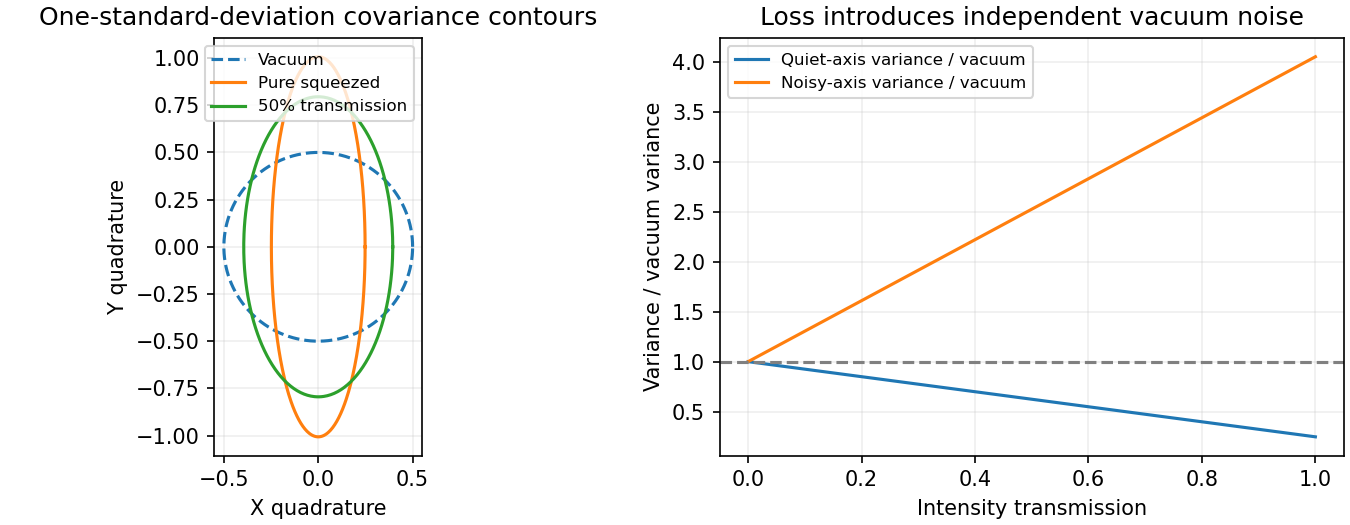
For an optical loss channel with efficiency and vacuum entering the unused port, optical squeezing degradation by loss givesThe linear-loss limit follows directly by writing the output field as with independent vacuum mode . Loss therefore places a floor under measured squeezing. Squeezed input can improve phase-sensitive measurements when aligned with the measured optical quadrature; it does not reduce every noise source or both conjugate uncertainties at once.


Articles by others on the same topic
There are currently no matching articles.