The fixed point equations give andThus the origin exists for every real . The nonzero fixed points arewith the same sign in both positions. At or these expressions coalesce with the origin and do not give additional fixed points. There are no nonzero real fixed points for .
The Jacobian matrix at the origin and its characteristic polynomial areThe fixed-point multipliers areBy the Jury stability criterion, both lie strictly inside the unit circle exactly whenThe last condition always holds, since . Therefore the origin is asymptotically stable exactly for among the hyperbolic parameter values.
For completeness, its linear stability throughout the parameter line is as follows. When , the complex-conjugate Floquet multipliers have modulus , so the origin repels. When , their modulus is , so it attracts with oscillation. At the repeated Floquet multiplier is , still attracting. For , both Floquet multipliers are real and in . For , and , so one Floquet multiplier lies in and the other exceeds one: the origin is a saddle fixed point of a map. For , the complex-conjugate Floquet multipliers have modulus , so it repels.
Possible changes at the unit circle are exhausted by , , or a nonreal pair with product one. They giveAt the Floquet multipliers are ; the nonzero fixed point branches in part (a) meet the origin, and part (c) identifies a subcritical pitchfork bifurcation. Indeed at the exact restricted map is , which makes the origin unstable despite its neutral linear direction.
At the Floquet multipliers are : this is a 1:4 strong resonance of a planar map, coinciding with the change from repelling to attracting as increases. A generic nonresonant Neimark–Sacker bifurcation conclusion would be unjustified. At there is a double Floquet multiplier ; the matrix has a nontrivial Jordan block, and the two further nonzero fixed point branches meet the origin. Linear stability alone is inconclusive at these unit-modulus boundary values. The repeated Floquet multiplier at is strictly inside the unit circle and gives no bifurcation.
Adjoin . At the origin the stable direction is the axis, with Floquet multiplier zero, while the and parameter directions have Floquet multiplier one. By the centre manifold theorem for a discrete dynamical system, write the extended centre manifold asOn it the scalar map is . Its discrete centre-manifold invariance equation isPut with . Since , the quadratic equation is simply . ThusIn particular, setting the stable variable identically to zero would lose the leading parameter correction. The reduced map through total degree three isIn the natural pitchfork bifurcation scaling this has leading form . Its nonzero fixed points satisfy , and their reduced fixed-point multipliers satisfy for small . The transverse Floquet multiplier remains inside the unit circle. Therefore the bifurcation at is a subcritical pitchfork bifurcation: the origin attracts for small negative , each nonzero branch is a saddle fixed point of a map, and the origin is a saddle fixed point of a map for small positive .
An exact check uses the full Jacobian matrix on either nonzero branch. Its trace is and its determinant is . Thuswhenever a nonzero branch exists. Also , so one real Floquet multiplier lies in and the other in . This proves that each nonzero branch is a saddle fixed point of a map throughout and , in particular near the requested bifurcation.
Use vertically and horizontally in the bifurcation diagram; the other coordinate is recovered from . The origin is the horizontal branch . Draw it solid on , where it is asymptotically stable, and dashed on the remaining hyperbolic intervals, where it is unstable. Its three nonhyperbolic fixed points in parameter space are marked at ; open markers distinguish these boundary cases from the strict linear stability classifications on the intervening intervals.
The nonzero fixed point branches are for and . Each is dashed because it is a saddle fixed point of a map, as proved in part (c). Near zero their shape is : the unstable branches lie on the same parameter side as the attracting origin, displaying the subcritical pitchfork bifurcation. The branches issuing from have . At no additional fixed point branch appears; the Floquet multipliers cross the unit circle at .
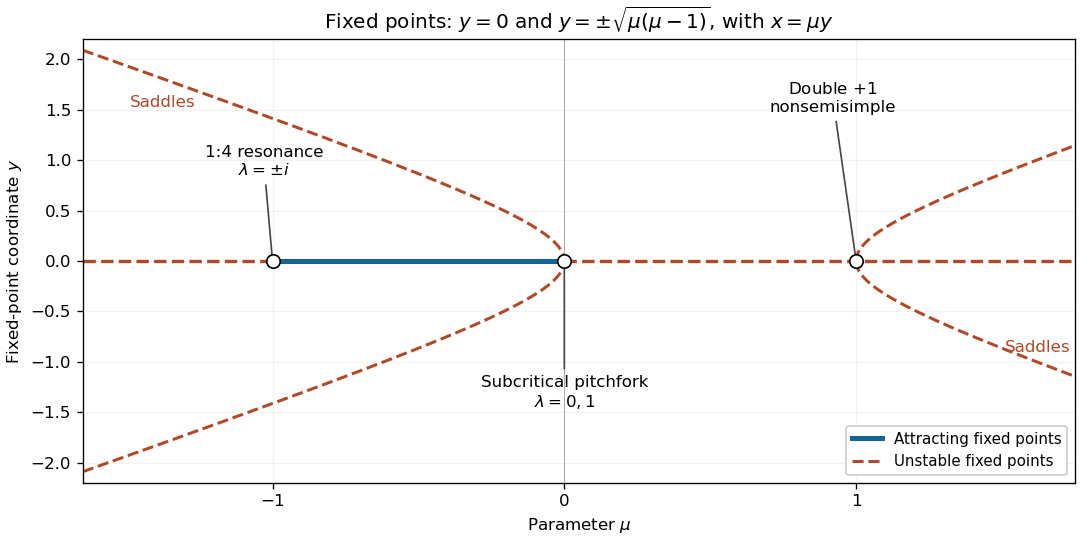
Fixed-point bifurcation diagram: solid denotes attracting, dashed denotes unstable, and open circles mark the three unit-circle crossings at the origin. Nonzero branches are saddles.
Details. 
Articles by others on the same topic
There are currently no matching articles.