Original solutions to all three questions of the nonlinear systems course of the University of Oxford Part B examination, held on 30 May 2023. Source: released examination PDF, bundle pages 236–238; paper pages 1–3. Numbering follows the original paper. In Question 1 the displayed centre manifold dynamics are a truncated local approximation; the neglected terms are specified below. At Question 2's parameter value , the fixed-point multipliers have a strong resonance of a planar map.
At a fixed point, the first equation gives , the second then gives , and the third gives . Thus there is exactly one equilibrium for every real :The Jacobian matrix there isOne eigenvalue is . The other two have product one and sum . For their real parts are negative, so the equilibrium is asymptotically stable; for both real parts are positive, leaving two unstable directions and one stable direction. At the eigenvalues are , withTherefore the only local bifurcation of this equilibrium is a Hopf bifurcation at . A repeated real eigenvalue away from zero does not itself cause a bifurcation: the equilibrium remains hyperbolic there.
The cubic centre manifold calculation below gives the Hopf normal form radial coefficient , so this is a supercritical Hopf bifurcation. Small attracting periodic orbits occur on the side. In particular, at the leading cubic radial drift is inward, although linear stability alone cannot decide that boundary case.
Adjoin and put . The extended centre manifold is a graph tangent to at the origin. The equations becomeHere is fixed. The centre-manifold invariance equation, obtained by the chain rule, isWrite , where and is a homogeneous quadratic polynomial. To quadratic order the centre-manifold invariance equation isThe terms have zero coefficients: their equations are homogeneous, and the operator is invertible on these quadratic polynomials. For , comparison of coefficients givesHence , and , givingSubstitution into the equation givesThe constant in the big O notation may depend on fixed . Thus the equations printed in part (b) are the retained terms of the local Taylor series, rather than an exact identity for the full reduced vector field.
For the Hopf bifurcation classification in part (a), set and use , . The radial derivative is . Its cubic angular mean isHere denotes the mean over one revolution. Removing the oscillatory cubic terms by a near-identity transformation gives this same cubic radial coefficient in the Hopf normal form. The linear radial coefficient is .
Apply the Poincaré-Lindstedt method to the truncated system from part (b). Since , its scalar equation isIntroduce the stretched time , with asymptotic expansionsPrimes in this part mean derivatives with respect to . At first order,The trigonometric identitiesreduce this toA periodic cannot have a secular term, so both fundamental-harmonic coefficients must vanish. Taking givesIn particular is necessary. Once these conditions hold, a bounded particular correction isadding fundamental sine and cosine terms adjusts the phase and the first correction to the amplitude. Consequently the required leading periodic orbit isHere is the leading amplitude, not an assertion that the exact finite- amplitude is independent of .
To justify existence beyond formal cancellation, the leading radial displacement in a Poincaré return map is , whereAt the positive root , . The implicit function theorem, applied after dividing the displacement by , continues this root to a periodic orbit for sufficiently small positive . Its radial Floquet multiplier is , so it is attracting. These statements apply to the truncated system with fixed ; its interpretation as a local approximation to the original three-dimensional system also requires small, so that stays near the Hopf bifurcation.
The fixed point equations give andThus the origin exists for every real . The nonzero fixed points arewith the same sign in both positions. At or these expressions coalesce with the origin and do not give additional fixed points. There are no nonzero real fixed points for .
The Jacobian matrix at the origin and its characteristic polynomial areThe fixed-point multipliers areBy the Jury stability criterion, both lie strictly inside the unit circle exactly whenThe last condition always holds, since . Therefore the origin is asymptotically stable exactly for among the hyperbolic parameter values.
For completeness, its linear stability throughout the parameter line is as follows. When , the complex-conjugate Floquet multipliers have modulus , so the origin repels. When , their modulus is , so it attracts with oscillation. At the repeated Floquet multiplier is , still attracting. For , both Floquet multipliers are real and in . For , and , so one Floquet multiplier lies in and the other exceeds one: the origin is a saddle fixed point of a map. For , the complex-conjugate Floquet multipliers have modulus , so it repels.
Possible changes at the unit circle are exhausted by , , or a nonreal pair with product one. They giveAt the Floquet multipliers are ; the nonzero fixed point branches in part (a) meet the origin, and part (c) identifies a subcritical pitchfork bifurcation. Indeed at the exact restricted map is , which makes the origin unstable despite its neutral linear direction.
At the Floquet multipliers are : this is a 1:4 strong resonance of a planar map, coinciding with the change from repelling to attracting as increases. A generic nonresonant Neimark–Sacker bifurcation conclusion would be unjustified. At there is a double Floquet multiplier ; the matrix has a nontrivial Jordan block, and the two further nonzero fixed point branches meet the origin. Linear stability alone is inconclusive at these unit-modulus boundary values. The repeated Floquet multiplier at is strictly inside the unit circle and gives no bifurcation.
Adjoin . At the origin the stable direction is the axis, with Floquet multiplier zero, while the and parameter directions have Floquet multiplier one. By the centre manifold theorem for a discrete dynamical system, write the extended centre manifold asOn it the scalar map is . Its discrete centre-manifold invariance equation isPut with . Since , the quadratic equation is simply . ThusIn particular, setting the stable variable identically to zero would lose the leading parameter correction. The reduced map through total degree three isIn the natural pitchfork bifurcation scaling this has leading form . Its nonzero fixed points satisfy , and their reduced fixed-point multipliers satisfy for small . The transverse Floquet multiplier remains inside the unit circle. Therefore the bifurcation at is a subcritical pitchfork bifurcation: the origin attracts for small negative , each nonzero branch is a saddle fixed point of a map, and the origin is a saddle fixed point of a map for small positive .
An exact check uses the full Jacobian matrix on either nonzero branch. Its trace is and its determinant is . Thuswhenever a nonzero branch exists. Also , so one real Floquet multiplier lies in and the other in . This proves that each nonzero branch is a saddle fixed point of a map throughout and , in particular near the requested bifurcation.
Use vertically and horizontally in the bifurcation diagram; the other coordinate is recovered from . The origin is the horizontal branch . Draw it solid on , where it is asymptotically stable, and dashed on the remaining hyperbolic intervals, where it is unstable. Its three nonhyperbolic fixed points in parameter space are marked at ; open markers distinguish these boundary cases from the strict linear stability classifications on the intervening intervals.
The nonzero fixed point branches are for and . Each is dashed because it is a saddle fixed point of a map, as proved in part (c). Near zero their shape is : the unstable branches lie on the same parameter side as the attracting origin, displaying the subcritical pitchfork bifurcation. The branches issuing from have . At no additional fixed point branch appears; the Floquet multipliers cross the unit circle at .
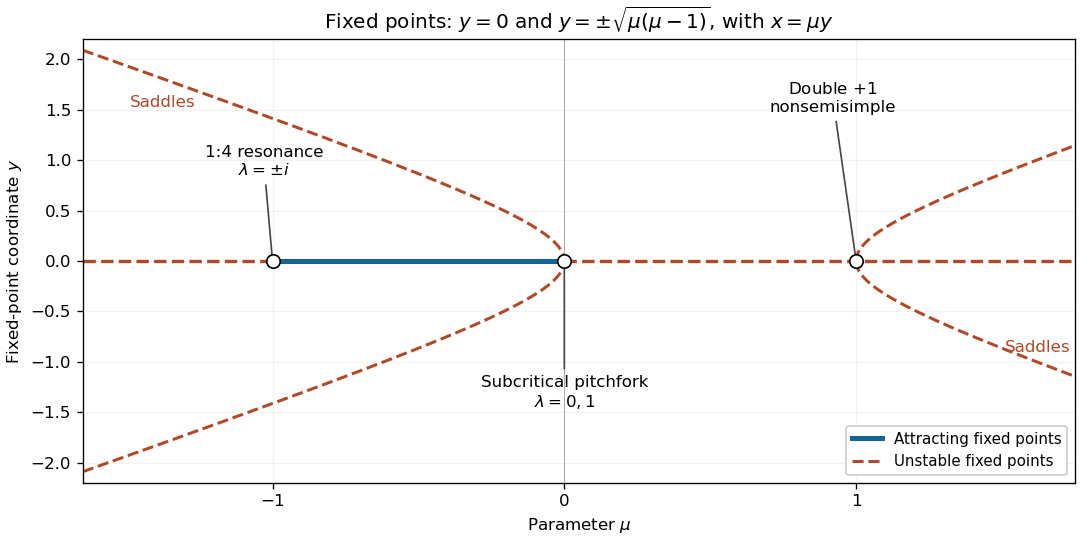
Fixed-point bifurcation diagram: solid denotes attracting, dashed denotes unstable, and open circles mark the three unit-circle crossings at the origin. Nonzero branches are saddles.
Details. 
For the left shift, precisely when the binary sequence is obtained by repeating its first symbols. There are exactly such sequences, although some have smaller least period. Hence the set of all periodic sequences is a countable union of finite sets and is at most countable. Passing from periodic points to periodic orbits cannot increase this cardinality.
To prove infinitude, for every integer take the repeated word . Its least period is , because its ones are separated by exactly positions; a smaller positive period would carry a one to a zero. Distinct least periods give distinct periodic orbits. Thus there are countably infinitely many periodic orbits.
The space of all infinite binary sequences is uncountable by the Cantor diagonal argument: given any list , the sequence differs from its th entry at position , so it is absent from the list. Part (i) shows that only countably many sequences are periodic. Their complement is therefore uncountable.
Each forward orbit is countable. If there were only countably many nonperiodic forward orbits, their union together with the periodic points would be countable, contradicting the preceding argument. Hence there are uncountably many nonperiodic orbits, rather than merely uncountably many nonperiodic starting points.
One can also exclude eventual periodicity. An eventually periodic sequence is specified by a finite initial word and a finite repeating word, so only countably many exist. Removing all of them still leaves an uncountable set. This proves the assertion even if “nonperiodic” is understood to exclude orbits that eventually enter a periodic orbit.
Construct one infinite binary sequence by concatenating every binary word of length one, then every word of length two, then every word of length three, and so on, in lexicographic order within each length. Every finite binary word occurs somewhere in .
Given any target sequence and any , choose such that . The word occurs in , beginning after some symbols. Thus agrees with in its first positions, and the prescribed metric givesEvery open open ball about every point therefore meets the forward orbit of . This forward orbit is dense in . The argument identifies finite-prefix cylinder sets as arbitrarily small neighborhoods in this metric; no binary-expansion convention for real numbers is needed.
For the real logistic map, factors asThere is always the fixed point . If there is also , distinct from zero unless . At the map is constant and zero is its only fixed point. Negative must be retained because the paper specifies .
Since , the fixed-point multipliers areThe fixed point stability for an iteration criterion gives attracting for , and attracting for . The respective fixed points are repelling when and . At the unit-modulus boundaries the linear criterion needs a nonlinear supplement.
At , the two fixed point branches meet and exchange stability: this is a transcritical bifurcation. Explicitly, with ,which has the required nonzero parameter and quadratic terms. At the critical value itself, attracts small positive points and pushes negative points away, so the merged fixed point is not stable from both sides.
At the origin’s fixed-point multiplier crosses , while at the nonzero fixed-point multiplier crosses . Both are period-doubling bifurcations. To check existence and stability of the new periodic orbit, factor the second iteration of a map:The two non-fixed roots areThey form a real period-two orbit for or . Its periodic-orbit multiplier isIt is less than one in absolute value just below and just above , respectively. Thus these are supercritical bifurcations in the direction where the parent fixed point loses stability. At the critical values the fixed points themselves are weakly attracting: at , ; at , setting gives after two steps. Both shrink sufficiently small nonzero absolute values. The bifurcation values for finite fixed points are thereforeThe disappearance of the formula for at corresponds to that branch going to infinity, not a local bifurcation at a finite fixed point.
Solving by the quadratic formula givesFor , . On the derivative is strictly positive, while on it is strictly negative. Thus the restrictions are strictly monotonic functions. Their endpoint values areBy continuity and strict monotonicity, each restriction maps its interval bijectively onto , with opposite orientations. The corresponding inverse functions are
Write . Because , taking the image under the same function composition givesThis uses preservation of set inclusion by every function, so decreasing inverse branches cause no difficulty. Since , cancellation of the first inverse branch gives the equality of imagesThese compact intervals are itinerary cylinders: their symbols record successive positions under iteration of a map. In particular,Conversely these three memberships allow successive substitution of the appropriate inverse branches, and therefore characterize exactly.
The set consists precisely of points whose first positions all lie in . HenceDeleting the first position preserves this condition, proving . For the reverse inclusion, if , take . Then and for every . Thus and . In fact both inverse branches give preimages in . Thereforewhich proves full invariance, not merely forward invariance.
For any infinite symbolic sequence , the itinerary cylinders are nonempty compact nested intervals. The nested interval theorem gives at least one point in their intersection. Every has a unique itinerary because . To justify that the itinerary also determines a unique point, it suffices to show the interval lengths shrink. The fact that logistic inverse branches contract in an angular coordinate works for every ; a direct claim that in the original coordinate would fail for some just above four.
Use the homeomorphism of . The transformed inverse branches areTheir derivatives satisfyThe inequality follows by squaring and using . Thus every length- transformed itinerary cylinder has length at most . Since , its original interval has length at most and shrinks to a point. This gives the claimed one-to-one identification with the one-sided full shift.
Finally part (ii) givesThus acts by the left shift. The identification is a topological conjugacy: matching long prefixes forces closeness by the shrinking estimate, while distinct finite itinerary cylinders are disjoint compact sets and so their inverse coding is continuous. In particular need not be one-to-one on , just as a one-sided left shift has two possible first symbols before any given tail.
Articles by others on the same topic
There are currently no matching articles.