Use the normalized local truncation errorThe Taylor theorem expansions about areSubstitution gives exactlyThus the theta method has order two exactly for , and otherwise order one, as a statement about the method on a sufficiently smooth class of problems. The leading term vanishes at one half, and a function with nonzero third derivative shows that the next term does not vanish universally. As usual, a uniform order estimate assumes bounded relevant derivatives; mere existence of on the open interval gives the stated pointwise remainders but not, by itself, a uniform bound. Special exact solutions can of course have zero truncation error even for a first-order method.
Put . Subtracting the numerical update from the exact update with its local truncation error givesThe Lipschitz condition in the solution variable and the triangle inequality implyThe assumed positive denominator permits division. With and , repeated substitution of this Lipschitz one-step error bound yieldsHere because , so the displayed geometric series quotient is well defined. For implicit steps, the same condition makes the scalar update map a contraction mapping, ensuring a unique numerical next value.
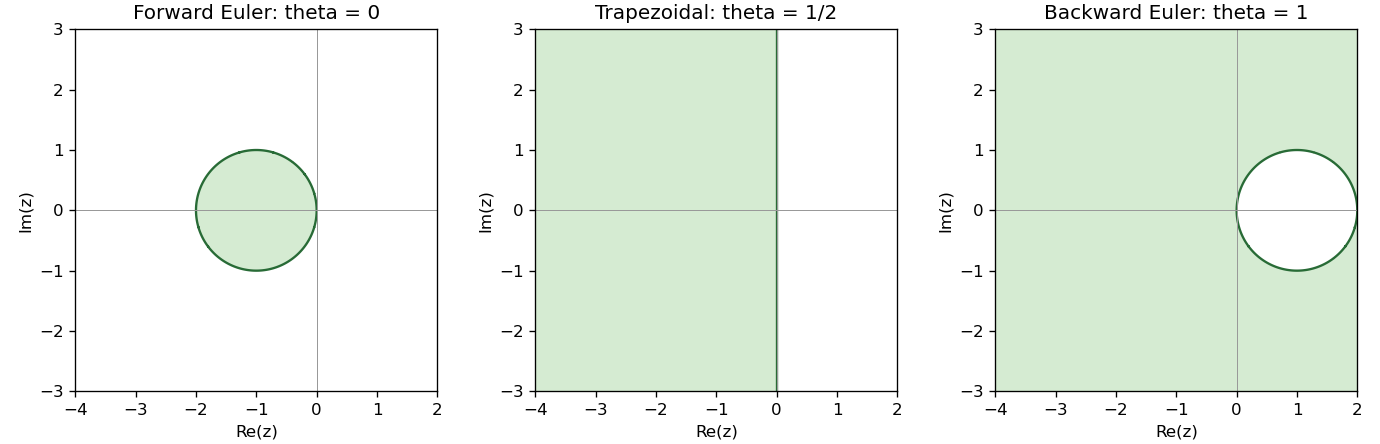
On the Dahlquist test equation, set . The theta method has stability functionWith the decaying-solution convention, its region of absolute stability is . Writing , squaring numerator and denominator givesFor this is the open disk with centre and radius . At it is the open left half-plane. For it is the exterior of the closed disk with centre and radius . The pole , when present, lies outside the stability region.
Every with satisfies the inequality exactly for . If , sufficiently large negative real fails it. ThereforeIf absolute stability is instead defined by bounded amplification, the boundary is included; this convention does not change the A-stability conclusion for the open left half-plane.

Articles by others on the same topic
There are currently no matching articles.