Each mutually incoherent patch of an extended star produces a displaced double-slit interference pattern. The detector adds their light intensities. For two apertures separated by a projected interferometric baseline , a source direction offset by a small angle changes their phase difference by . The normalized sum over the source's angular brightness distribution is its first-order optical coherence, whose magnitude is the interferometric visibility for equally bright channels.
For a uniform circular stellar disk of full angular diameter , the normalized angular Fourier transform gives the uniform-disk stellar visibilityHere is the order-one Bessel function of the first kind. This follows by integrating over the disk and dividing by its area. In particular, its power series gives .
For an ordinary slit separation , using the paper's and observing wavelength ,Even gives a visibility loss of only . Thus millimetre separation leaves the interference fringes almost indistinguishable from those of a point source; it gives very little sensitivity to the diameter.
The movable mirrors in the Michelson stellar interferometer collect light at a large adjustable separation and redirect it into closely spaced output beams. They increase the sampling interferometric baseline independently of the fixed output slit spacing : sets sensitivity to source structure, whereas the output optics set the screen's interference fringe spacing. The first Bessel function zero is , henceThe interference fringes disappear at this baseline even though each beam separately remains bright.
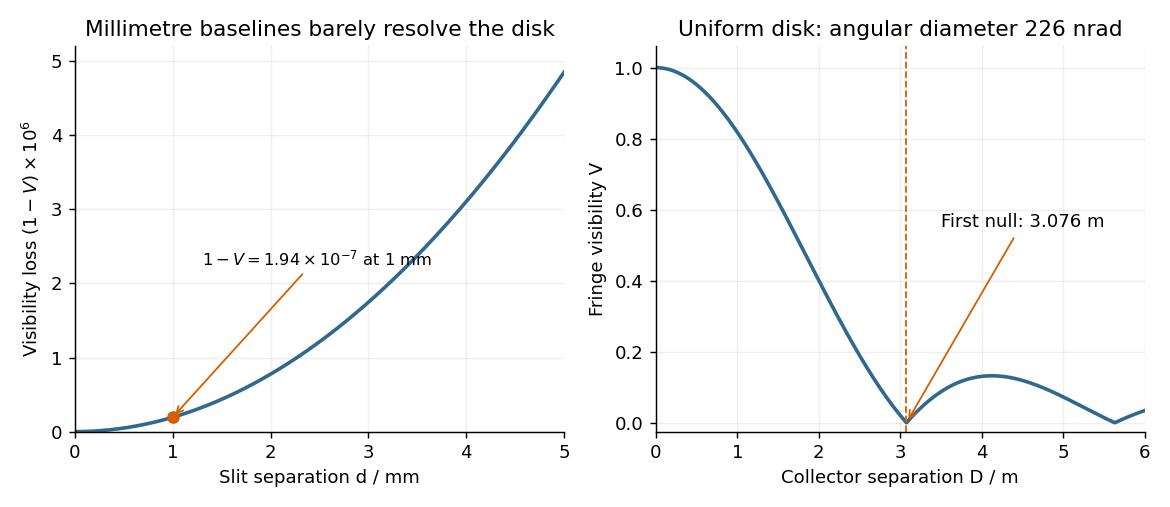

The value assumes a uniform disk. The original question supplies a diameter without a surface brightness law; real limb darkening changes the precise visibility zero. A one-dimensional uniformly bright strip of the same full angular width instead has a sinc function visibility and first zero . That is a different source model, not the circular-disk result. The robust conclusion without a surface brightness model is that a baseline of a few metres, rather than millimetres, is required.
Articles by others on the same topic
There are currently no matching articles.