The emission mechanism is Cherenkov radiation. An Electron moving faster than the phase velocity of light in the material excites electric polarization disturbances whose radiation adds coherently on a cone. This does not require the Electron to exceed the speed of light in vacuum. Taking as constant over the detected optical band, the Cherenkov cone angle satisfiesEmission requires . The detector accepts , soNumerically,The lower endpoint has vanishing Cherenkov radiation yield, and the upper endpoint is excluded by the stated strict angular acceptance. Faster Electrons emit at larger cone angles: at , , outside this detector's acceptance. The angular condition gives the accepted speed interval conditional on rays reaching the detector; no collection geometry or total signal yield is specified.
The Johnson-Nyquist noise formula gives the open-circuit mean-square voltage in a small frequency band . When a source electrical resistance drives a load with impedance matching, the load sees half the source voltage, so the available noise power isThe factor of four in the open-circuit formula is therefore not an extra factor in the delivered power.
The transmitter's antenna gain makes the axial spectral energy flux at range Multiplication by the receiving antenna effective area gives . Define the equivalent receiving antenna temperature by the available matched-load noise . ThenThis is the transmitter-induced equivalent noise temperature of the receiver port. It does not determine the actual physical temperature of its internal electrical resistance, or any additional receiver and background noise. The calculation assumes the usual far-field link, negligible path loss beyond geometric spreading, matched polarization of an electromagnetic wave at the two antennas and the stated effective collecting area. No additional one-half polarization factor is needed for the matched polarization of radiation from one transmitting antenna.
Each mutually incoherent patch of an extended star produces a displaced double-slit interference pattern. The detector adds their light intensities. For two apertures separated by a projected interferometric baseline , a source direction offset by a small angle changes their phase difference by . The normalized sum over the source's angular brightness distribution is its first-order optical coherence, whose magnitude is the interferometric visibility for equally bright channels.
For a uniform circular stellar disk of full angular diameter , the normalized angular Fourier transform gives the uniform-disk stellar visibilityHere is the order-one Bessel function of the first kind. This follows by integrating over the disk and dividing by its area. In particular, its power series gives .
For an ordinary slit separation , using the paper's and observing wavelength ,Even gives a visibility loss of only . Thus millimetre separation leaves the interference fringes almost indistinguishable from those of a point source; it gives very little sensitivity to the diameter.
The movable mirrors in the Michelson stellar interferometer collect light at a large adjustable separation and redirect it into closely spaced output beams. They increase the sampling interferometric baseline independently of the fixed output slit spacing : sets sensitivity to source structure, whereas the output optics set the screen's interference fringe spacing. The first Bessel function zero is , henceThe interference fringes disappear at this baseline even though each beam separately remains bright.
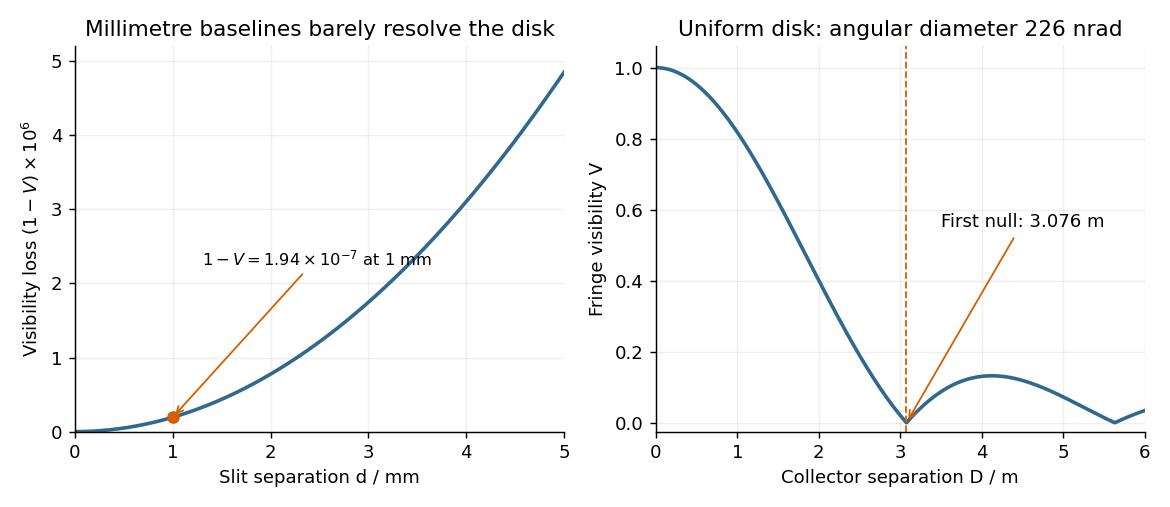

The value assumes a uniform disk. The original question supplies a diameter without a surface brightness law; real limb darkening changes the precise visibility zero. A one-dimensional uniformly bright strip of the same full angular width instead has a sinc function visibility and first zero . That is a different source model, not the circular-disk result. The robust conclusion without a surface brightness model is that a baseline of a few metres, rather than millimetres, is required.
Articles by others on the same topic
There are currently no matching articles.