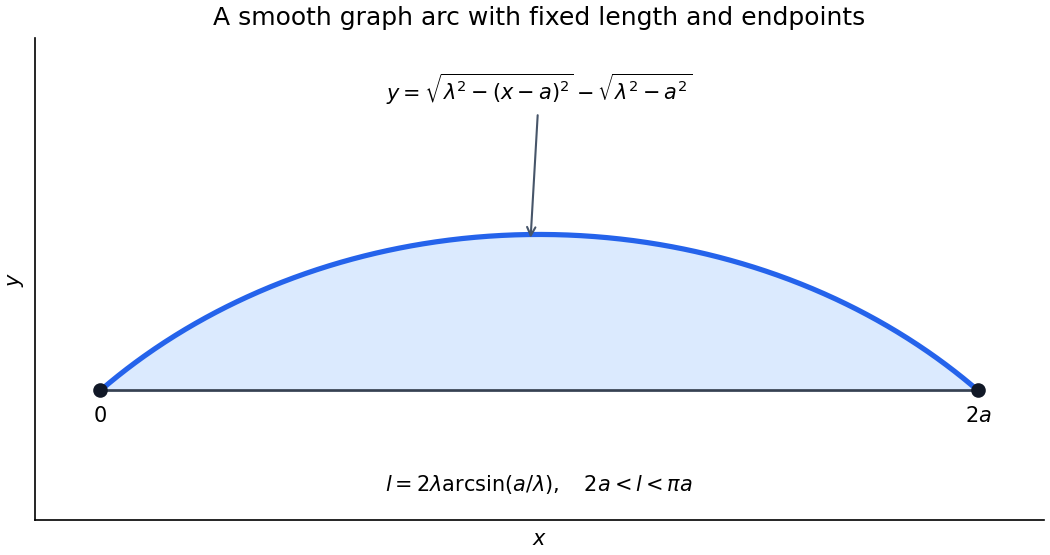
For the upper function graph, the vertical cross-section of the enclosed region has length , so its area is . A maximizing nonnegative arch therefore uses and in the normal Euler-Lagrange equation. It becomesIntegrating once gives . The concave upper branch has and integrates to . The equal zero endpoint heights force and . HenceIt is a circular arc. To find its parameter, substitute into the length integral: , givingThis scalar equation determines numerically when needed; no explicit solution is required.
The arch is a global maximum in its smooth function graph regime. For , the integrand is concave and strictly concave in its slope. Its supporting-tangent inequality, integrated against any competing function graph with the same endpoint values, has first-order term zero by the Euler-Lagrange equation. Thus . On the fixed-length class this is ; strict slope concavity also gives uniqueness.
The source leaves the length range implicit. A twice continuously differentiable function graph of this form needs , giving . At the straight function graph is the degenerate solution. The semicircle limit has vertical endpoint tangents and is outside that smooth function graph class. For , no arc in the claimed smooth function graph family exists, so the stated formula cannot describe a twice continuously differentiable maximizing function graph under those unrestricted data. Allowing overhanging curves changes the admissible class.

Articles by others on the same topic
There are currently no matching articles.