Parametrize the surface by , with . Its tangent vectors are orthogonal, of lengths and . Thus the area element is . Integrating over the angle gives
Discard the constant factor when forming the Euler-Lagrange equation. For it becomesThe Beltrami identity, since has no explicit dependence, gives . Combining with the differential equation yields . Its exponential solution has coefficients whose product is , by . Positivity therefore puts it in the formIts constants must satisfy and . Depending on the endpoint data, these equations may have no solution or more than one. A constant function can satisfy a formal first-integral equation but fails the full Euler-Lagrange equation; it is not an extra extremal.
The functional is unbounded above. Let be the positive affine interpolant between the two endpoint values, and choose a smooth nonnegative function that vanishes at the endpoints and is positive somewhere inside. The admissible curves satisfyThe claimed minimum conclusion does not follow and is false in general. A stationary point may have a negative second variation, even though the functional is unbounded above. Here is an explicit example within the allowed positive-graph class.
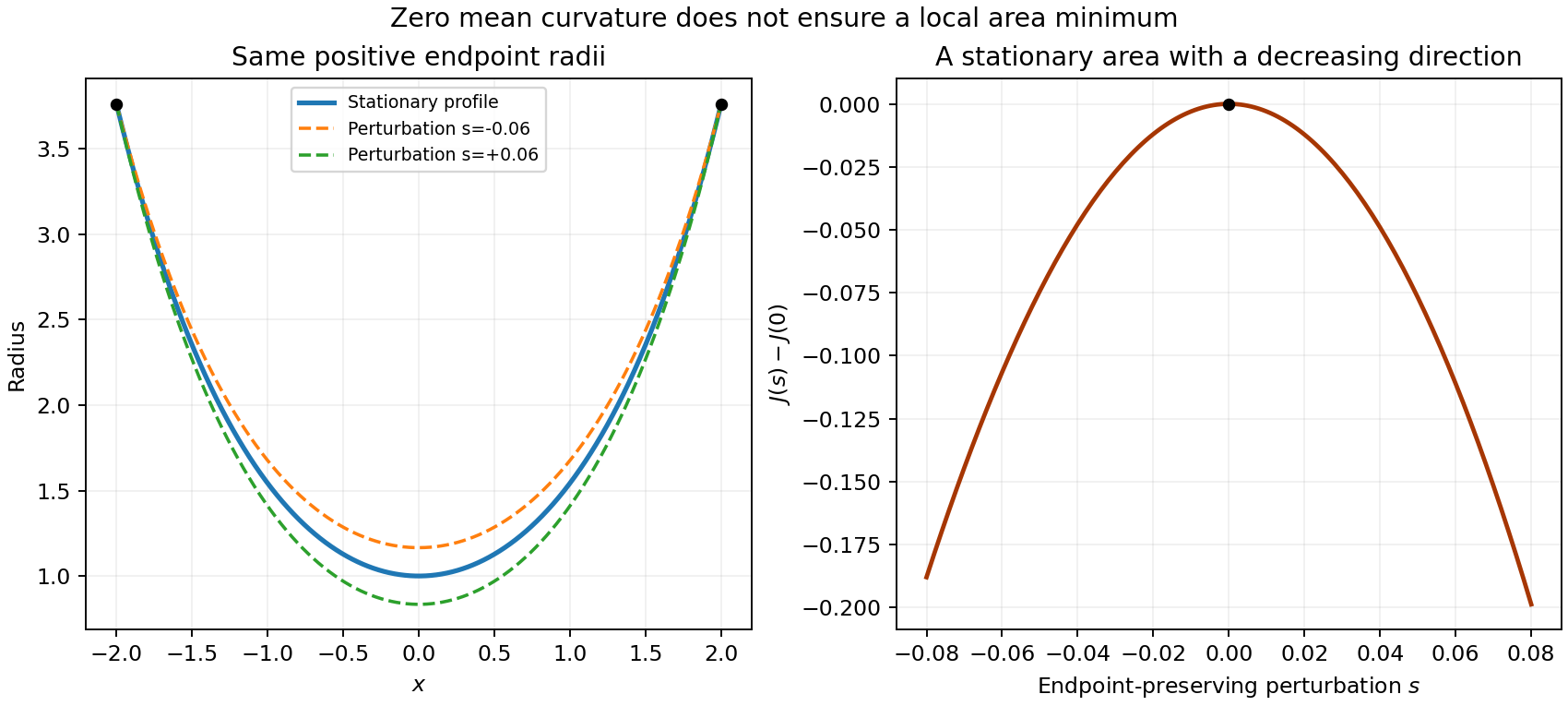
Take the stationary profile on , and the endpoint-zero variation . For sufficiently small perturbation parameter , remains positive and preserves both endpoint values. Put . Differentiating the area twice and integrating its mixed term by parts givesThis is strictly negative: the first term is less than , while . For example gives and , whose product already exceeds . Thus nearby positive profiles have smaller area. This catenoid is not a local minimum.
The corrected conclusion is that any smooth positive minimizer, if attained, must have the catenoid form. That necessary condition is not sufficient, and existence or stability requires a separate argument.

Articles by others on the same topic
There are currently no matching articles.