Orient the body boundary counterclockwise. Its outward body normal satisfies , so the pressure force has complex formBy steady Bernoulli's equation, , where . Constant terms integrate to zero around a closed curve. On an impermeable boundary, velocity is tangent, so . Therefore , yielding the Blasius force theoremFor a slit body, the contour encloses both faces and the tips, interpreted by a limiting exterior contour.
Choose the analytic branch outside the slit with at infinity. It may be written using the principal individual square roots. For , approaching from above gives , and from below gives .
NowThere is no term in . Since is analytic in the exterior, enlarging the contour to a large circle shows its integral is zero. ThusThis total-force argument retains the slit-tip contribution automatically.
On the upper face, ; on the lower face, . For , their zeros areThey are distinct face points even at , when both have coordinate zero. At , and everywhere in the exterior: there are no velocity-zero stagnation points. The limiting positions at the two tips must not be substituted into a singular expression and treated as zeros.
For the sketch at , the far-field velocity is , and streamlines are levels of . The plate is the zero-stream-function boundary, with the two stagnation points at on the indicated faces.
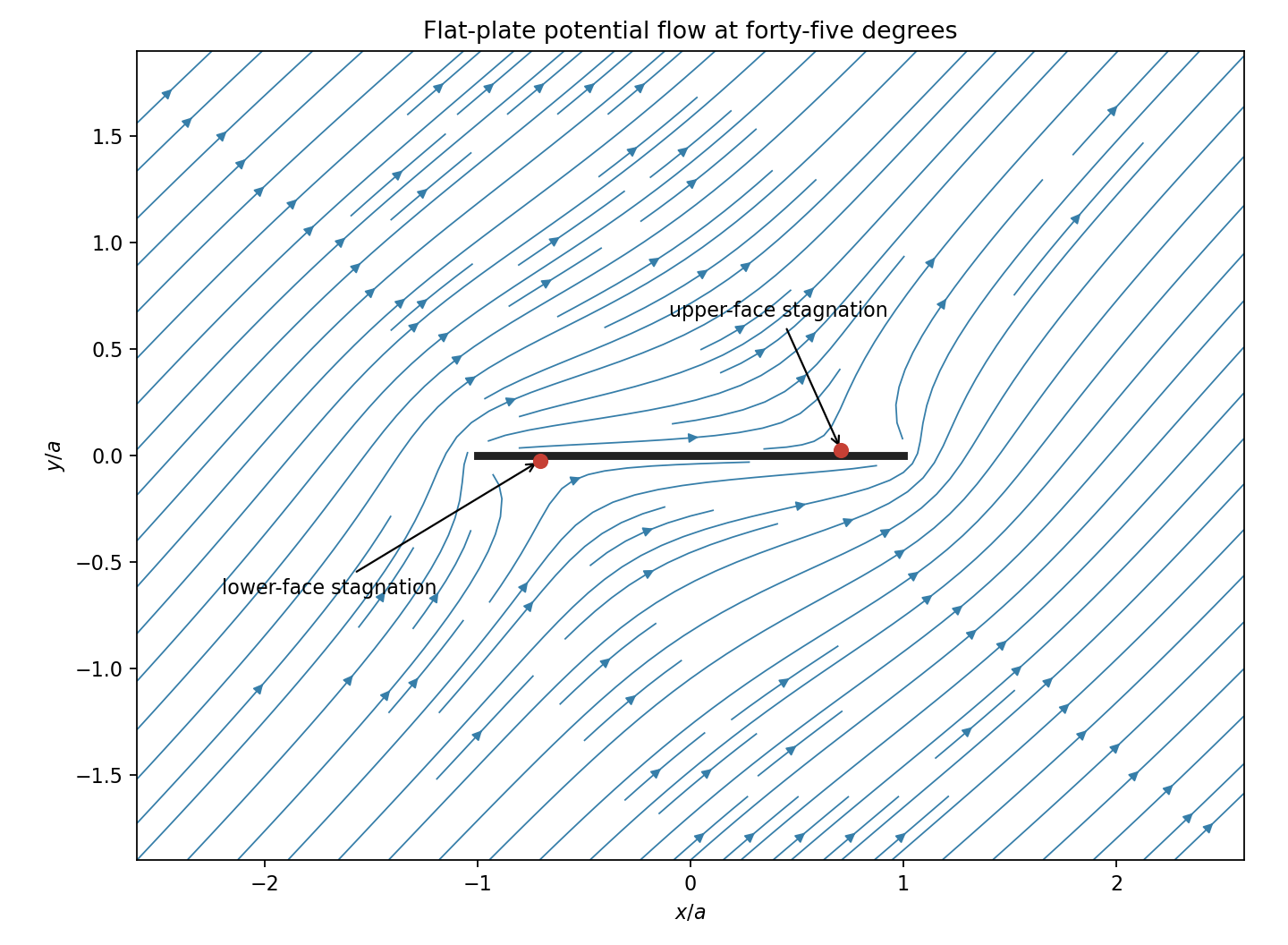
Potential flow past a flat plate at forty-five degrees
. The arrows show the flow direction. Marked stagnation points lie on different faces of the plate; both edges are singular in this non-circulating ideal flow. Details.
For a short channel slice, the fluid volume per unit length is and the axial volume flux is . The quasi-one-dimensional conservation of mass equation is thereforeNeglecting products of perturbations gives . This uses the section-averaged approximation stipulated in the problem; small transverse velocities ensure impermeability of varying-width walls but are not leading axial terms.
The Euler equations are . For irrotational flow, and , soAt the zero-pressure free surface, linearization about rest gives ; differentiate in to get . Differentiating the mass equation in time and substituting givesPut . For the exponential width, a time-harmonic amplitude satisfiesWriting removes the first derivative and gives , where . A nonzero real wavenumber, and hence a spatially travelling phase, exists precisely whenFor this case an outward-going solution matching the oscillating boundary isSubstitution in both linear equations verifies it, and . Below the cutoff the spatial exponents are real, giving evanescent responses; at equality the repeated-root solution has no travelling spatial phase.
Articles by others on the same topic
There are currently no matching articles.