The diphoton invariant mass follows by adding the two photon four-momenta: . ThusFor correlated diphoton mass resolution, at fixed angle, . If the two quoted fractional errors are independent one-standard-deviation uncertainties,An unknown common energy-scale error would be correlated: with correlation coefficient , the fractional variance is . Fully correlated scale errors give 10%, rather than 7.1%. A mass consistent with a candidate is not by itself evidence establishing its identity.
For the neutral strange B meson, a charged-current tree amplitude has followed by , while the initial is a spectator. The pair forms the J/psi meson and the pair forms the phi meson. Charge and quark flavour flow are conserved at each vertex except for the permitted weak flavour change. antiquark arrows point opposite their physical propagation direction.
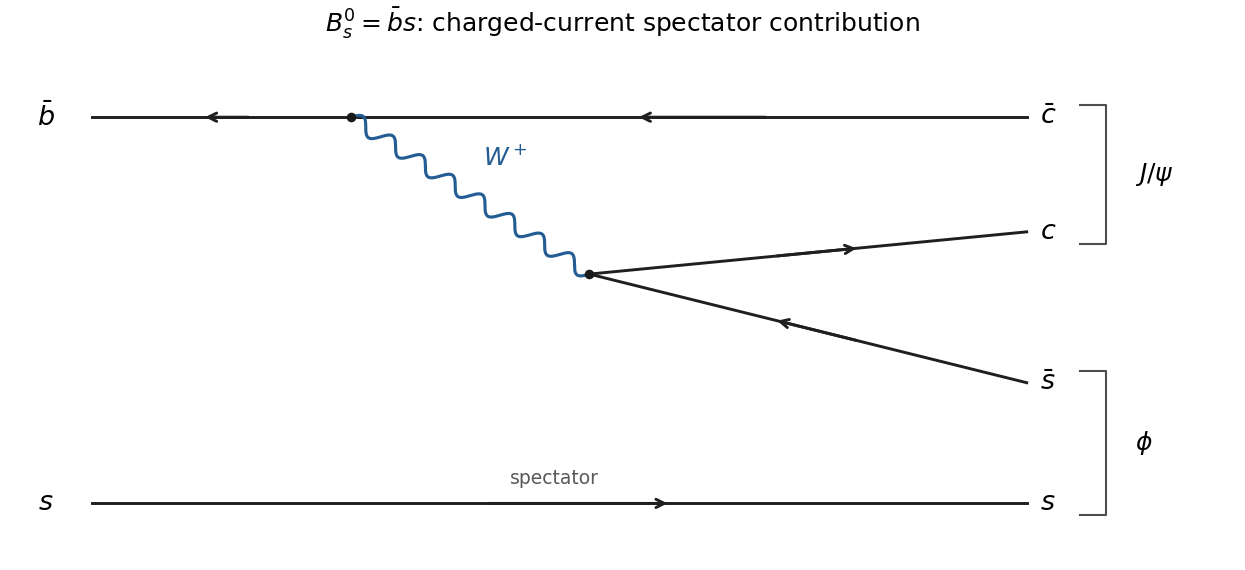
Original quark-level charged-current contribution to the neutral strange B-meson decay; arrows show fermion flow
. Details. 
Useful reconstruction modes are or , through a virtual photon, and , a strong decay. The latter is the largest individual mode, with also important. For the , the inclusive branching fraction versus reconstruction mode distinction matters: hadronic decays dominate inclusively, principally through three gluons; each charged-lepton pair accounts for about 6%, not most decays. The charm pair lies below open-charm threshold. These distinctions are confirmed by the official particle listings.[ref]
For a pure sample, nuclei. radioactive activity is with . Using a year of 365.25 days,The mass number supplies the approximate molar mass in grams per mole. This is initial parent activity; no daughter activity or isotope mixture has been assumed.
Articles by others on the same topic
There are currently no matching articles.