[ref]
https://www.whatdotheyknow.com/request/natural_science_tripos_physics_e_2/response/2340776/attach/2/FOI%202023%20399%20Zahid%20materials.pdf?cookie_passthrough=1. Original public PDF, physical pages 262–265; dated 29 May 2013
The diphoton invariant mass follows by adding the two photon four-momenta: . ThusFor correlated diphoton mass resolution, at fixed angle, . If the two quoted fractional errors are independent one-standard-deviation uncertainties,An unknown common energy-scale error would be correlated: with correlation coefficient , the fractional variance is . Fully correlated scale errors give 10%, rather than 7.1%. A mass consistent with a candidate is not by itself evidence establishing its identity.
For the neutral strange B meson, a charged-current tree amplitude has followed by , while the initial is a spectator. The pair forms the J/psi meson and the pair forms the phi meson. Charge and quark flavour flow are conserved at each vertex except for the permitted weak flavour change. antiquark arrows point opposite their physical propagation direction.
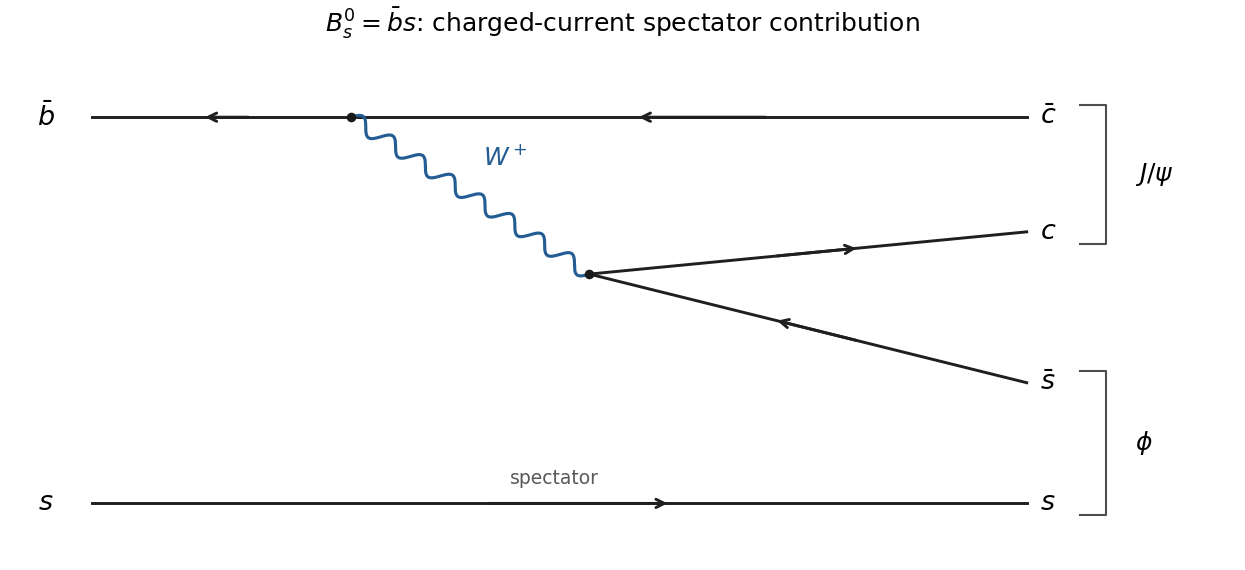
Original quark-level charged-current contribution to the neutral strange B-meson decay; arrows show fermion flow
. Details. Useful reconstruction modes are or , through a virtual photon, and , a strong decay. The latter is the largest individual mode, with also important. For the , the inclusive branching fraction versus reconstruction mode distinction matters: hadronic decays dominate inclusively, principally through three gluons; each charged-lepton pair accounts for about 6%, not most decays. The charm pair lies below open-charm threshold. These distinctions are confirmed by the official particle listings.[ref]
For a pure sample, nuclei. radioactive activity is with . Using a year of 365.25 days,The mass number supplies the approximate molar mass in grams per mole. This is initial parent activity; no daughter activity or isotope mixture has been assumed.
A nuclear excited state has internal energy above its ground state, with levels labelled by spin and parity and, where useful, approximate isospin. In the shell model, nucleons occupy orbitals split by spin-orbit coupling; nuclear particle-hole excitation and broken pairs produce excited configurations. An orbital has parity , and an even-even paired ground state is commonly . Residual interactions mix configurations, so shell spacings are not a complete spectrum.
Collective motion gives distinct patterns. A deformed nucleus can have a rotational band with , so a simple even-even band has . Near spherical shape, a quadrupole vibration gives a one-phonon excitation; two such phonons can couple to near twice that energy in the harmonic limit. Anharmonicity and coupling to single-particle motion modify these ideal patterns.
De-excitation occurs by gamma emission, internal conversion, or particle emission if energetically open. photon multipolarity must satisfy the angular-momentum triangle rule. Electric multipoles change parity by and magnetic multipoles by ; a single photon cannot connect . Large multipolarity or a small transition matrix element can make a long-lived nuclear isomer. Gamma energies, coincidence cascades, angular correlations and lifetimes constrain level schemes; inelastic scattering and transfer reactions supply complementary spin/configuration information. One observed line alone need not identify a unique level assignment.
parity reverses spatial coordinates and polar vectors such as momentum, while leaving axial vectors such as angular momentum unchanged. The correlation is therefore parity odd. For polarized beta-emitting nuclei one can measurewhere is measured from nuclear polarization, its magnitude and a decay-dependent coefficient. A nonzero spin–momentum asymmetry is incompatible with parity invariance.
The cobalt-60 experiment polarized nuclei at low temperature and compared beta emission along and opposite the polarization axis. Preferential emission on one side established weak-interaction parity violation. Reversing polarization tests whether the asymmetry follows nuclear orientation; warming the sample removes polarization, while gamma anisotropy monitors its loss. Detector acceptance, backgrounds and magnetic deflection of charged particles must be separated from a true emission asymmetry.[ref]
Experimental Test of Parity Conservation in Beta Decay by Chien-Shiung Wu and others. 1957, polarized cobalt-60 experiment and temperature/polarization checks
In the modern weak charged current, the V-A interaction couples to left-chiral fermion fields. In the massless limit this selects left-helicity neutrinos and right-helicity antineutrinos. Massive charged leptons need not be pure-helicity states, consistent with the factor . Strong and electromagnetic interactions conserve parity to the usual experimental approximation; parity violation alone should not be confused with CP violation or a failure of CPT.
The electroweak gauge group is . Left-handed fermions form weak-isospin doublets and right-handed charged fermions are singlets under . Before symmetry breaking the gauge fields are and , with couplings . A Higgs-doublet vacuum expectation value breaks the symmetry to electromagnetic .
In units , the physical combinations and tree-level relations areThe photon remains massless. charged currents change members of weak doublets, whereas the mediates weak neutral currents with parity-dependent couplings. At low energies exchange reduces to the Fermi contact interaction, ; the apparent weak suppression reflects the massive mediator. This unifies the gauge description, not the numerical equality of all low-energy couplings.[ref]
A Model of Leptons by Steven Weinberg. 1967, gauge structure, symmetry breaking and vector-boson mass relations
Neutral-current neutrino interactions and subsequent observation of massive weak vector bosons tested this structure. In a neutral-current neutrino experiment, an isolated hadronic interaction without an accompanying charged lepton is a candidate signal; entering neutral hadrons and missed charged-current leptons are important backgrounds. Gargamelle's neutral-current evidence supplied a direct experimental check beyond ordinary beta decay.[ref]
For the lowest spatial state, orbital angular momentum is zero and the spatial wavefunction is symmetric. A three-quark colour singlet is antisymmetric, proportional to . The Pauli exclusion principle for quarks therefore requires a symmetric spin–flavour factor. Colour and flavour are different degrees of freedom even though both use three-dimensional group representations.
The tensor product flavour decomposition is . Three spin-one-half particles have a symmetric spin- quartet and mixed-symmetry spin- sectors. The symmetric spin quartet combines with symmetric flavour factors to give a baryon decuplet. Mixed spin and mixed flavour factors instead combine to a symmetric spin–flavour state, giving one physical ground-state baryon octet, not two independent ground-state octets. Equivalently the symmetric spin-flavour SU6 representation has dimension . The antisymmetric flavour singlet would require a fully antisymmetric three-spin state, which does not exist for only two single-quark spin components.
The spin-one-half baryon octet contains , , and . The spin-three-halves baryon decuplet contains the four charge states, three states, two states and . Both have positive parity in this approximation. Strange-quark mass breaks the approximate flavour symmetry and splits multiplets.
In the baryon hyperfine mass formula, the constituent-mass sum accounts phenomenologically for common confinement energy. A colour-magnetic spin–spin interaction contributes a contact-type term proportional to : each magnetic moment supplies one inverse mass. The common colour and spatial-overlap factors are absorbed into . These are effective constituent masses, not short-distance current-quark masses. Use dimensionless spin operators with , as implicit in the supplied formula and coefficient.
Label the identical up quarks 1 and 2. Their flavour and spatial factors are symmetric, and their colour pair is antisymmetric, so their spin is a triplet, . ThusCoupling the strange spin givesThe two up–strange denominators are identical. HenceWith the supplied masses expressed in GeV units, the common mass is . The predicted values areThey are about and below the stated measurements, respectively. The predicted splitting is , compared with . The agreement is useful for such a simple model, but a common overlap constant neglects flavour-dependent spatial structure and other residual interactions.
For the weak decay, one contribution is , . The two spectator up quarks combine with into the proton, and the new supplies the neutral pion's corresponding component. This changes strangeness. In the strong decay, a gluon creates ; rearrangement gives and without changing strangeness.
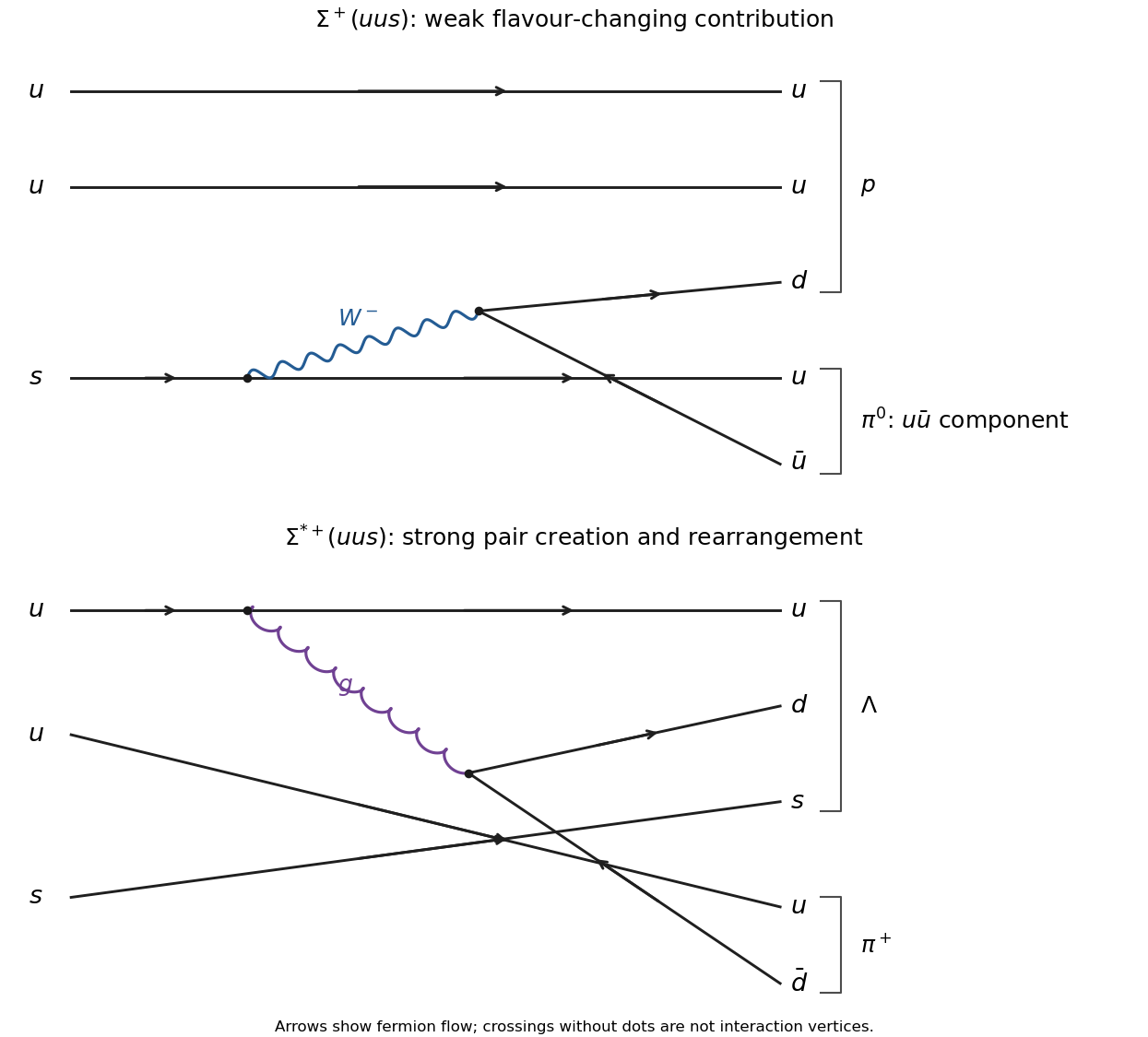
Original weak and strong quark-level contributions to the two charged Sigma-baryon decays; final groupings show the hadrons
. Details. The strong channel conserves parity: the positive-parity daughter baryon and negative-parity pion require odd relative orbital angular momentum, with a wave sufficient. The weak channel need not conserve parity. Using the mean lifetime relation ,The widths differ by about , principally because one is weak and flavour changing and the other is an open strong decay. They are not comparable transitions differing only by a small spin factor.
At energies far below the mass, replace its propagator by a constant. The modern V-A interaction form of Fermi's contact theory has, in units,Nucleons are treated nonrelativistically within nuclear states. To leading order in their velocity, the vector charge and axial spatial current give the two nuclear operatorswhere here means neutron-to-proton conversion. (i) The scalar Fermi operator permits , including , without parity change. The rank-one Gamow–Teller operator permits without parity change, excluding . Both terms can contribute when the same nuclear states permit them; their strengths contain nuclear matrix elements, not just phase space.
(ii) Expand the lepton waves across the nucleus in powers of their momenta times nuclear radius. When , the constant spatial term gives allowed transitions. If its matrix element vanishes by spin/parity selection, higher terms supply lepton orbital angular momentum: “forbidden” means suppressed, not impossible. First-forbidden terms change parity and can have ; the rank-two case is unique first-forbidden. Higher orders carry additional small spatial factors and different energy-dependent shape factors. The contact approximation alone does not imply the allowed approximation.
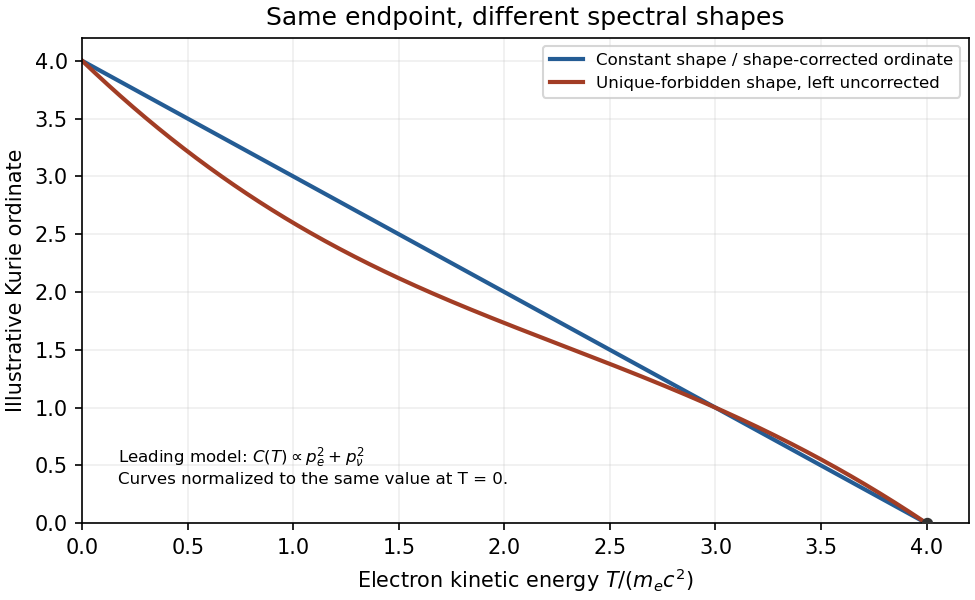
For a single branch, neglect recoil and neutrino mass and first assume an energy-independent nuclear shape factor. Fermi's golden rule integrates the neutrino phase space with , while the electron momentum volume is proportional to . Including Coulomb distortion,This momentum-bin Kurie ordinate is linear in kinetic energy and vanishes at its endpoint. If instead using counts per unit kinetic energy, in units; converting with recovers the supplied momentum-bin definition. No extra factor of should be left inside that definition of .
The graph's horizontal coordinate is , not in MeV. Its intercept is approximately –, soFor a ground-to-ground branch between bare nuclei, the emitted electron's rest energy must also be supplied:For neutral atomic masses the mass difference instead equals approximately , neglecting small electron-binding corrections. The graph supports this approximate precision, not a precise evaluated isotope mass. Interpreting a branch to an excited daughter would require adding its excitation energy; the ground-state comparison assumes the ground-state branch intended here.
The shell-model prediction for yttrium-91 beta decay follows from shell filling: the proton orbitals above 28 fill with four protons and with six, reaching 38. Yttrium has its 39th proton in , giving . Its 52 neutrons include the closed 50-neutron core and a pair in , coupled to zero in the simple paired ground state. Zirconium has 40 paired protons and 51 neutrons, leaving an unpaired neutron, so . ThereforeThe single-particle change is neutron to proton ; the parity change and rank two prevent an allowed Fermi or Gamow–Teller contribution.
The straight plotted line is a constant-shape idealization. For the shell-model transition just inferred, a leading unique-forbidden shape factor contains in units, with Coulomb/finite-size refinements. Consequently the uncorrected quantity specified in the paper is generally proportional to , not exactly linear. A consistent shape-corrected Kurie plot also divides its ordinate by . The source's exact straight-line construction and its forbidden-transition inference cannot both be exact with a Coulomb-only ; the approximate graphical endpoint can still be read as requested. Allowed and unique-forbidden spectral shapes are experimentally distinguishable.[ref]
Shapes of Allowed and Unique First-Forbidden β-Ray Spectra: 114In, 42K, 86Rb, 90Sr, and 90Y by H. Daniel and others. 1964 abstract; separate allowed and unique-forbidden spectrum measurements


Articles by others on the same topic
There are currently no matching articles.