High-energy elastic electron scattering probes nuclear charge through the electromagnetic interaction. Resolve the elastic peak with a spectrometer, measure its angular dependence and normalize by beam charge, target thickness and detector acceptance. In a plane-wave, approximately static treatment,Here is physical momentum transfer divided by , not the momentum itself. The low- slope, , determines the charge r.m.s. radius. A sharp uniform sphere hasIts first diffraction minimum is at , illustrating how angular structure determines size. Radii approximately follow , but a sharp radius, a surface half-density radius and an r.m.s. radius are different definitions.
A motivating experimental implementation is Hofstadter's magnetic-spectrometer measurement: selecting outgoing electron momentum separates elastic scattering from nuclear excitation, rather than treating every scattered electron as an elastic event. Beam-energy and angle calibration, empty-target or blocked-acceptance backgrounds, and target-thickness checks matter. Finite resolution mixes nearby excitations; multiple scattering and Coulomb distortion require correction before a precision density is inferred.[ref]
Electron Scattering and Nuclear Structure by Robert Hofstadter. §III(b), pp.222–223; §IV(a), pp.227–231, spectrometer scans and elastic/inelastic separation
Shape information comes from quadrupole moments, Coulomb-excitation transition strengths and rotational spectra. An intrinsic axial moment is positive for a prolate charge distribution and negative for an oblate one. A laboratory quadrupole moment is not identical to : a rotationally averaged spin-zero state can have zero laboratory moment despite intrinsic deformation. Collective rotational levels approximately follow , while measured strengths test the associated charge collectivity. Muonic-atom X-rays and isotope shifts supply complementary charge-radius constraints; hadronic probes provide additional, more interaction-dependent matter and neutron information. Neither a charge radius alone nor a finite-range form-factor measurement uniquely fixes the entire nuclear shape.
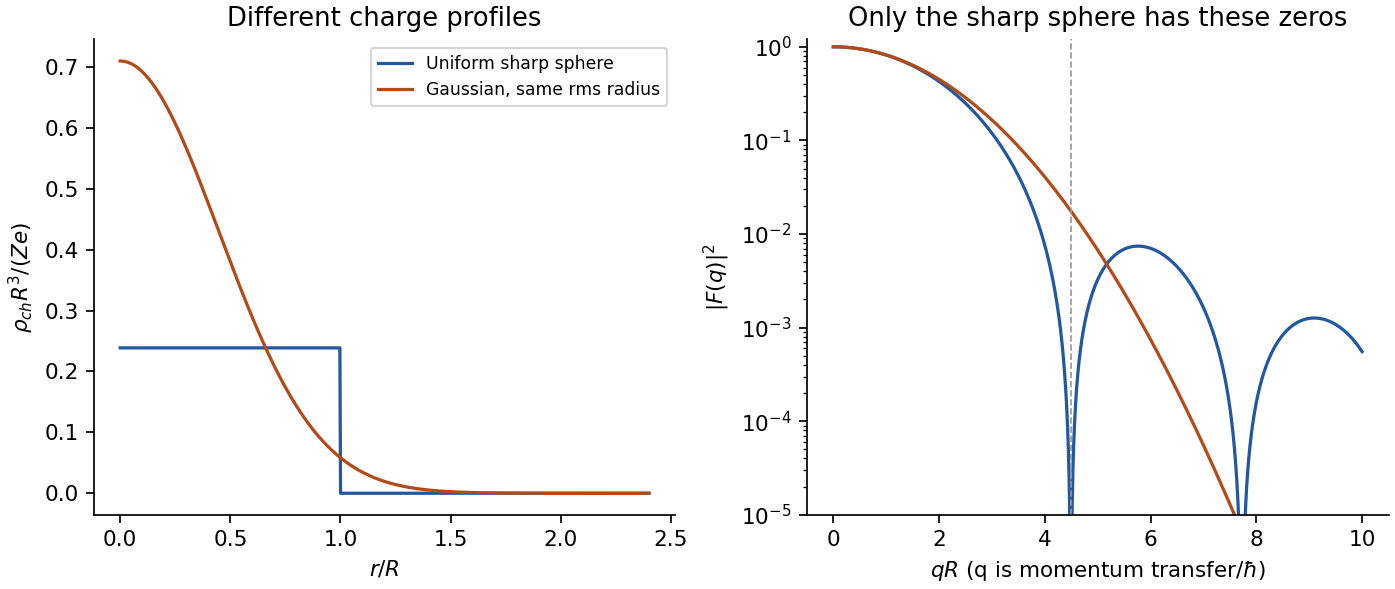
Original model charge form factors at equal r.m.s. radius; the diffraction structure carries information beyond the radius
. Details. 
Articles by others on the same topic
There are currently no matching articles.