A useful convention for the semi-empirical mass formula iswhere is the binding energy. The nuclear mass is . Atomic-mass comparisons instead use hydrogen-atom masses and account for electron binding at the desired accuracy. No numerical fit coefficients are specified here.
The volume term represents short-range nuclear attraction with saturation: each nucleon has a limited number of close neighbours. The surface term subtracts the binding lost by nucleons at the boundary. Coulomb repulsion penalizes a large proton fraction. The asymmetry term penalizes unequal neutron and proton populations, reflecting the cost of filling different Fermi seas and nuclear interactions. Pairing favours even-even nuclei and penalizes odd-odd nuclei; odd- nuclei have zero pairing term in this approximation. For example, one may choose ; an alternative fitted power requires a correspondingly different coefficient.
At fixed , the smooth mass dependence on is approximately parabolic. Neglecting the neutron-proton mass difference, pairing and small linear-in- Coulomb corrections, minimization givesThus the preferred neutron excess grows with mass number. The surface penalty disfavors very light systems, while the growing Coulomb penalty reduces the binding per nucleon of very heavy systems; this explains broad fusion and fission energy trends. The formula is a bulk approximation: shell closures, deformation and small separation-energy differences can give important exceptions. A fitted average binding trend is not a reliable substitute for a measured decay threshold near a boundary of stability.
High-energy elastic electron scattering probes nuclear charge through the electromagnetic interaction. Resolve the elastic peak with a spectrometer, measure its angular dependence and normalize by beam charge, target thickness and detector acceptance. In a plane-wave, approximately static treatment,Here is physical momentum transfer divided by , not the momentum itself. The low- slope, , determines the charge r.m.s. radius. A sharp uniform sphere hasIts first diffraction minimum is at , illustrating how angular structure determines size. Radii approximately follow , but a sharp radius, a surface half-density radius and an r.m.s. radius are different definitions.
A motivating experimental implementation is Hofstadter's magnetic-spectrometer measurement: selecting outgoing electron momentum separates elastic scattering from nuclear excitation, rather than treating every scattered electron as an elastic event. Beam-energy and angle calibration, empty-target or blocked-acceptance backgrounds, and target-thickness checks matter. Finite resolution mixes nearby excitations; multiple scattering and Coulomb distortion require correction before a precision density is inferred.[ref]
Electron Scattering and Nuclear Structure by Robert Hofstadter. §III(b), pp.222–223; §IV(a), pp.227–231, spectrometer scans and elastic/inelastic separation
Shape information comes from quadrupole moments, Coulomb-excitation transition strengths and rotational spectra. An intrinsic axial moment is positive for a prolate charge distribution and negative for an oblate one. A laboratory quadrupole moment is not identical to : a rotationally averaged spin-zero state can have zero laboratory moment despite intrinsic deformation. Collective rotational levels approximately follow , while measured strengths test the associated charge collectivity. Muonic-atom X-rays and isotope shifts supply complementary charge-radius constraints; hadronic probes provide additional, more interaction-dependent matter and neutron information. Neither a charge radius alone nor a finite-range form-factor measurement uniquely fixes the entire nuclear shape.
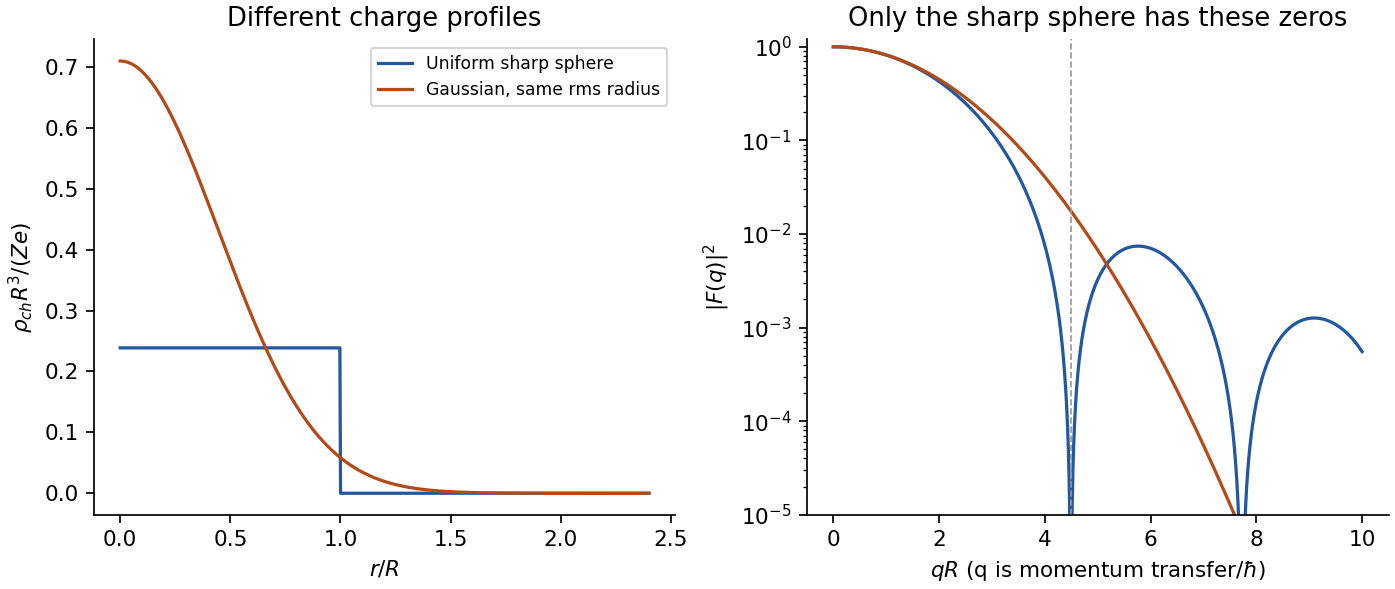
Original model charge form factors at equal r.m.s. radius; the diffraction structure carries information beyond the radius
. Details. 
An alpha emitter has an alpha-like cluster coupled to a daughter nucleus. Its positive decay energy is ; atomic masses may be used consistently because the electron counts balance. The daughter and alpha share this energy according to momentum conservation. The attractive nuclear interior and repulsive exterior Coulomb potential produce a quasibound state with a barrier, so positive does not imply rapid classical escape.
For daughter charge , the exterior barrier is approximately , , with outer turning radius . For zero orbital angular momentum, the leading WKB probability isHere is a nuclear matching radius, the reduced mass, an interior assault frequency and a preformation factor. The barrier factor alone cannot determine the latter two. Nonzero emitted orbital angular momentum adds a centrifugal barrier and can strongly hinder a transition.
The dominant action varies roughly as , explaining the Geiger-Nuttall relation and the enormous spread of alpha half-lives. angular momentum and parity constrain the emitted partial wave: a spin-zero positive-parity alpha requires and . Fine-structure alpha groups populate different daughter levels and therefore have different kinetic energies and penetrabilities. Shell structure and alpha clustering also change preformation probabilities, so equal values do not guarantee equal lifetimes. Escape conserves the total energy throughout tunnelling; the particle does not borrow a measured energy from the barrier.
Articles by others on the same topic
There are currently no matching articles.