Original solutions to all questions and alternatives. [ref]
https://www.whatdotheyknow.com/request/natural_science_tripos_physics_e_2/response/2340776/attach/2/FOI%202023%20399%20Zahid%20materials.pdf?cookie_passthrough=1#page=307. Original public PDF, physical pages 307–311; dated 28 May 2014
In time the particle advances , while a light wavelet travels . Coherent addition along the direction of emitted photons gives the Cherenkov cone angleThe angle is measured between photon propagation and the particle velocity. It is complementary to the angle between the conical wavefront surface and the trajectory; confusing those two angles exchanges sine and cosine. At threshold the photon cone closes, .
The decay is energetically open, but two spin-zero pions have total angular momentum equal to their relative orbital angular momentum . Conserving the parent spin requires . Interchanging two identical neutral pions multiplies this orbital state by , whereas their total state must be symmetric by Bose statistics. There is no different spin or species label to supply another minus sign. Thus the two-neutral-pion final state is forbidden. Its parity for would actually be , matching the parent; the decisive obstruction is identical-boson symmetry, not the energy or the shared quark-wavefunction component.
Away from thresholds and narrow resonances, photon-mediated annihilation gives one colour copy proportional to relative to the muon cross-section. The accessible flavours are , each with three colours, soBottom production is closed. QCD radiative corrections raise the leading parton-model result by a relative term beginning at ; the requested estimate does not require a supplied value of .
A useful convention for the semi-empirical mass formula iswhere is the binding energy. The nuclear mass is . Atomic-mass comparisons instead use hydrogen-atom masses and account for electron binding at the desired accuracy. No numerical fit coefficients are specified here.
The volume term represents short-range nuclear attraction with saturation: each nucleon has a limited number of close neighbours. The surface term subtracts the binding lost by nucleons at the boundary. Coulomb repulsion penalizes a large proton fraction. The asymmetry term penalizes unequal neutron and proton populations, reflecting the cost of filling different Fermi seas and nuclear interactions. Pairing favours even-even nuclei and penalizes odd-odd nuclei; odd- nuclei have zero pairing term in this approximation. For example, one may choose ; an alternative fitted power requires a correspondingly different coefficient.
At fixed , the smooth mass dependence on is approximately parabolic. Neglecting the neutron-proton mass difference, pairing and small linear-in- Coulomb corrections, minimization givesThus the preferred neutron excess grows with mass number. The surface penalty disfavors very light systems, while the growing Coulomb penalty reduces the binding per nucleon of very heavy systems; this explains broad fusion and fission energy trends. The formula is a bulk approximation: shell closures, deformation and small separation-energy differences can give important exceptions. A fitted average binding trend is not a reliable substitute for a measured decay threshold near a boundary of stability.
High-energy elastic electron scattering probes nuclear charge through the electromagnetic interaction. Resolve the elastic peak with a spectrometer, measure its angular dependence and normalize by beam charge, target thickness and detector acceptance. In a plane-wave, approximately static treatment,Here is physical momentum transfer divided by , not the momentum itself. The low- slope, , determines the charge r.m.s. radius. A sharp uniform sphere hasIts first diffraction minimum is at , illustrating how angular structure determines size. Radii approximately follow , but a sharp radius, a surface half-density radius and an r.m.s. radius are different definitions.
A motivating experimental implementation is Hofstadter's magnetic-spectrometer measurement: selecting outgoing electron momentum separates elastic scattering from nuclear excitation, rather than treating every scattered electron as an elastic event. Beam-energy and angle calibration, empty-target or blocked-acceptance backgrounds, and target-thickness checks matter. Finite resolution mixes nearby excitations; multiple scattering and Coulomb distortion require correction before a precision density is inferred.[ref]
Electron Scattering and Nuclear Structure by Robert Hofstadter. §III(b), pp.222–223; §IV(a), pp.227–231, spectrometer scans and elastic/inelastic separation
Shape information comes from quadrupole moments, Coulomb-excitation transition strengths and rotational spectra. An intrinsic axial moment is positive for a prolate charge distribution and negative for an oblate one. A laboratory quadrupole moment is not identical to : a rotationally averaged spin-zero state can have zero laboratory moment despite intrinsic deformation. Collective rotational levels approximately follow , while measured strengths test the associated charge collectivity. Muonic-atom X-rays and isotope shifts supply complementary charge-radius constraints; hadronic probes provide additional, more interaction-dependent matter and neutron information. Neither a charge radius alone nor a finite-range form-factor measurement uniquely fixes the entire nuclear shape.
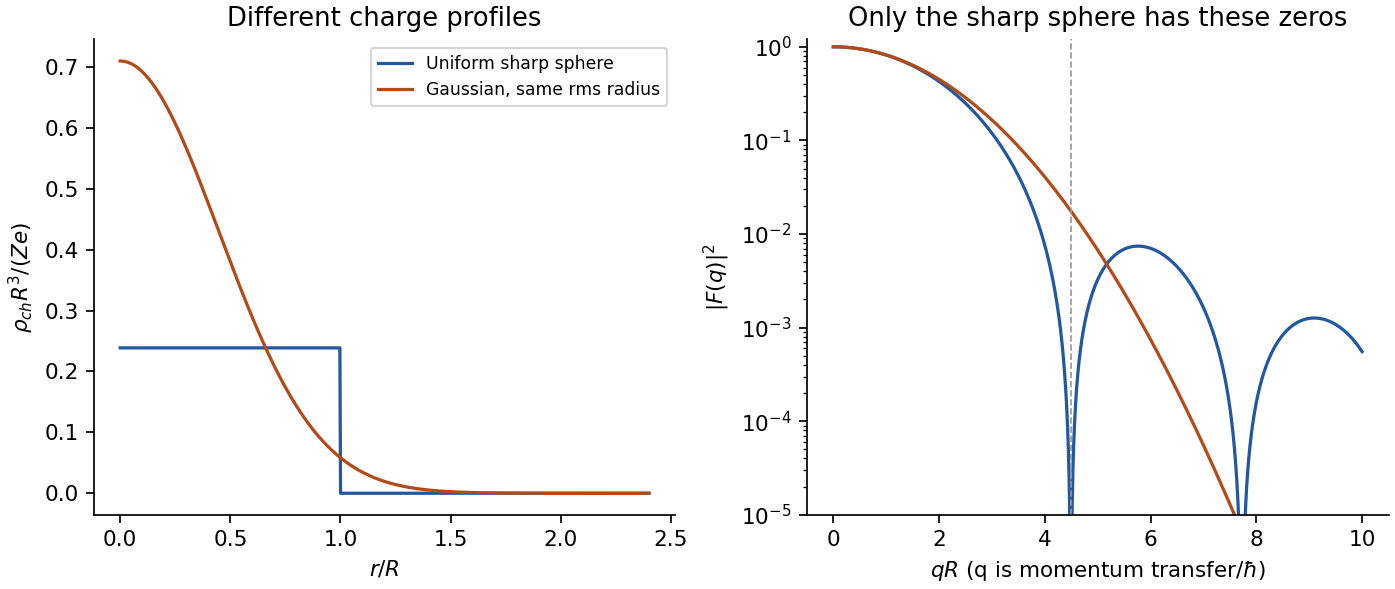
Original model charge form factors at equal r.m.s. radius; the diffraction structure carries information beyond the radius
. Details. 
An alpha emitter has an alpha-like cluster coupled to a daughter nucleus. Its positive decay energy is ; atomic masses may be used consistently because the electron counts balance. The daughter and alpha share this energy according to momentum conservation. The attractive nuclear interior and repulsive exterior Coulomb potential produce a quasibound state with a barrier, so positive does not imply rapid classical escape.
For daughter charge , the exterior barrier is approximately , , with outer turning radius . For zero orbital angular momentum, the leading WKB probability isHere is a nuclear matching radius, the reduced mass, an interior assault frequency and a preformation factor. The barrier factor alone cannot determine the latter two. Nonzero emitted orbital angular momentum adds a centrifugal barrier and can strongly hinder a transition.
The dominant action varies roughly as , explaining the Geiger-Nuttall relation and the enormous spread of alpha half-lives. angular momentum and parity constrain the emitted partial wave: a spin-zero positive-parity alpha requires and . Fine-structure alpha groups populate different daughter levels and therefore have different kinetic energies and penetrabilities. Shell structure and alpha clustering also change preformation probabilities, so equal values do not guarantee equal lifetimes. Escape conserves the total energy throughout tunnelling; the particle does not borrow a measured energy from the barrier.
Set and use metric . In the rest frame of B, and . Since ,The denominator is because this is the B rest frame, not the C rest frame. In this frame C and have equal, parallel three-momenta.
The second decay has in the B rest frame. Using and givesThis is an ordinary two-body decay in its parent's rest frame.
Let and . In the B frame these are the energies of and . If is their relative angle,The minimum has parallel massless particles; the maximum has antiparallel ones. The isotropic decay allows both limiting directions. The bounds are Lorentz invariant even though the B frame makes their calculation simple.
Since , the same angle gives . ThereforeThe minimum now occurs when and are antiparallel. The eventwise identity independently checks the opposite ordering of the two endpoints.
Use and . In the first reaction a proton can join the incoming to form the component of the neutral pion, leaving . In the second, a pair can annihilate into a gluon which creates ; the remaining joins in the outgoing kaon, leaving . Thusbaryon number is one in both cases. Strong strangeness conservation provides a separate check: the first baryon has strangeness ; the second has strangeness because the outgoing carries . The Feynman diagrams show representative quark-line flavour rearrangement and pair-annihilation topologies. Bound hadrons require nonperturbative binding, so a single drawn gluon is not an exclusive cross-section calculation.
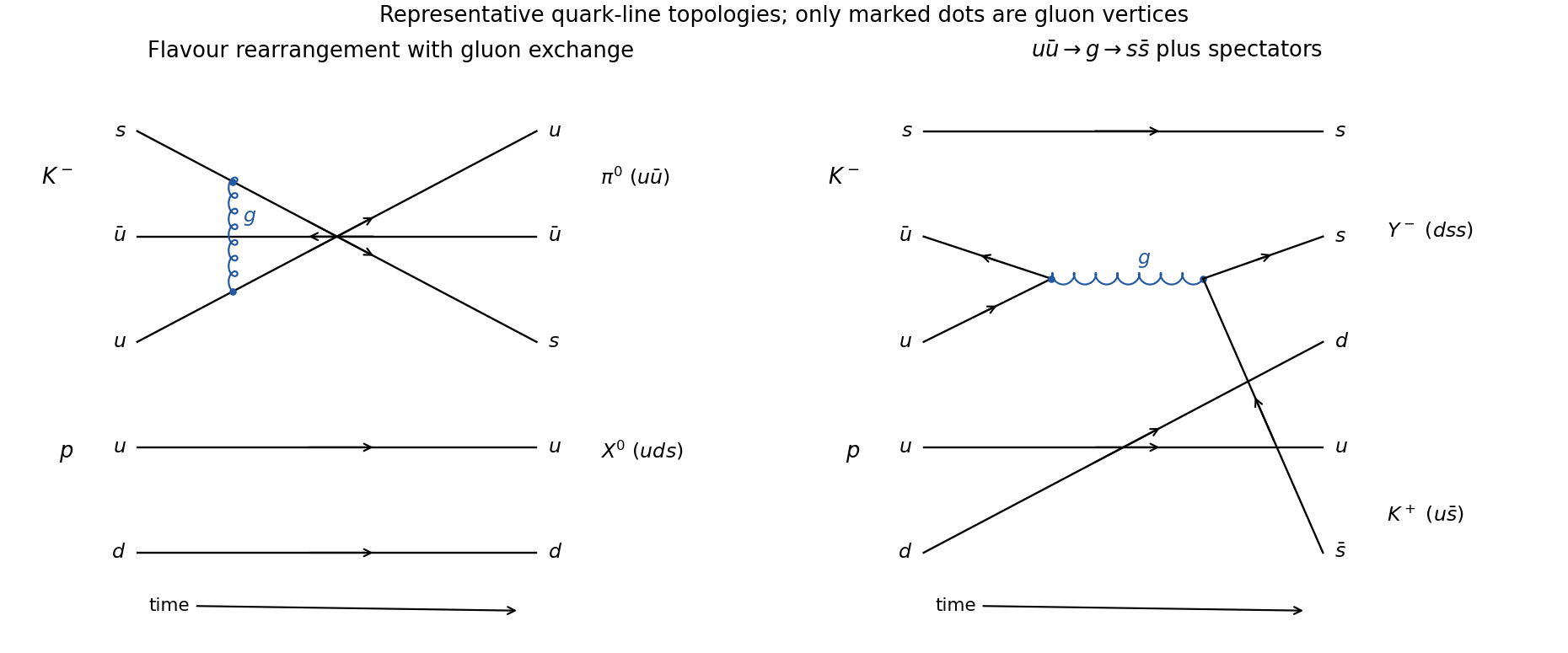
Original representative quark-line diagrams: flavour rearrangement and u-antiu annihilation into an s-antis pair
. Details. 
The radiative decay conserves strangeness and proceeds electromagnetically. A strong decay is closed because even the lighter neutral-pion threshold exceeds the supplied mass. The decay has about of available energy, but changes strangeness from to , so it requires the weak interaction. Its lifetime is therefore ordinarily much longer than the electromagnetic lifetime of ; no numerical lifetime follows from these masses alone.
Both particles are baryons with half-integer spin. A radiative transition to spin can couple through photon multipoles , giving . Electromagnetic parity is conserved, but without the electric/magnetic multipolarity neither nor its parity is fixed. In the weak decay, coupling orbital to the final spin gives ; parity conservation cannot be imposed on that weak amplitude. The supplied modes therefore do not determine unique spin-parity assignments.
The masses and flavours identify the familiar candidates as and . Their established ground-state assignments are both , consistent with the lowest-orbital quark model, but this is additional empirical/model information rather than a consequence of the two decay channels alone.[ref]
Review of Particle Physics by Particle Data Group (2022). Sigma-zero and Xi-minus listings, each p.1, established quantum numbers and decay information
Assume the quoted intensities represent relative emitted photon numbers, with efficiency corrections implicit, as required for population-flow bookkeeping. The prominent branch obeys , and identifies a serial two-photon branch. The energies obey and within their uncertainties. The weak fifth line directly spans D to A. Reversing which end contains the line-1 step and interchanging the serial line-2/line-3 order produces the four possibilities.
Take A as zero. A gamma-ray energy-network fit to the five energy differences gives the following approximate excitation energies in keV:The line connections, in the order , are respectively: I: ; II: ; III: ; IV: .
For I and II, the B population entering through lines 2 or 3 and line 4 exits through line 1. For III and IV, line 1 feeds C and its intensity splits into the direct line 4 and serial lines 2/3. The small direct D-to-A branch bypasses these intermediate balances. The central measured energies do not obey every sum exactly; all four fitted arrangements have for two energy constraints. Assigning the weakest line's central energy as an exact excitation energy would discard the more precise cascade measurements.
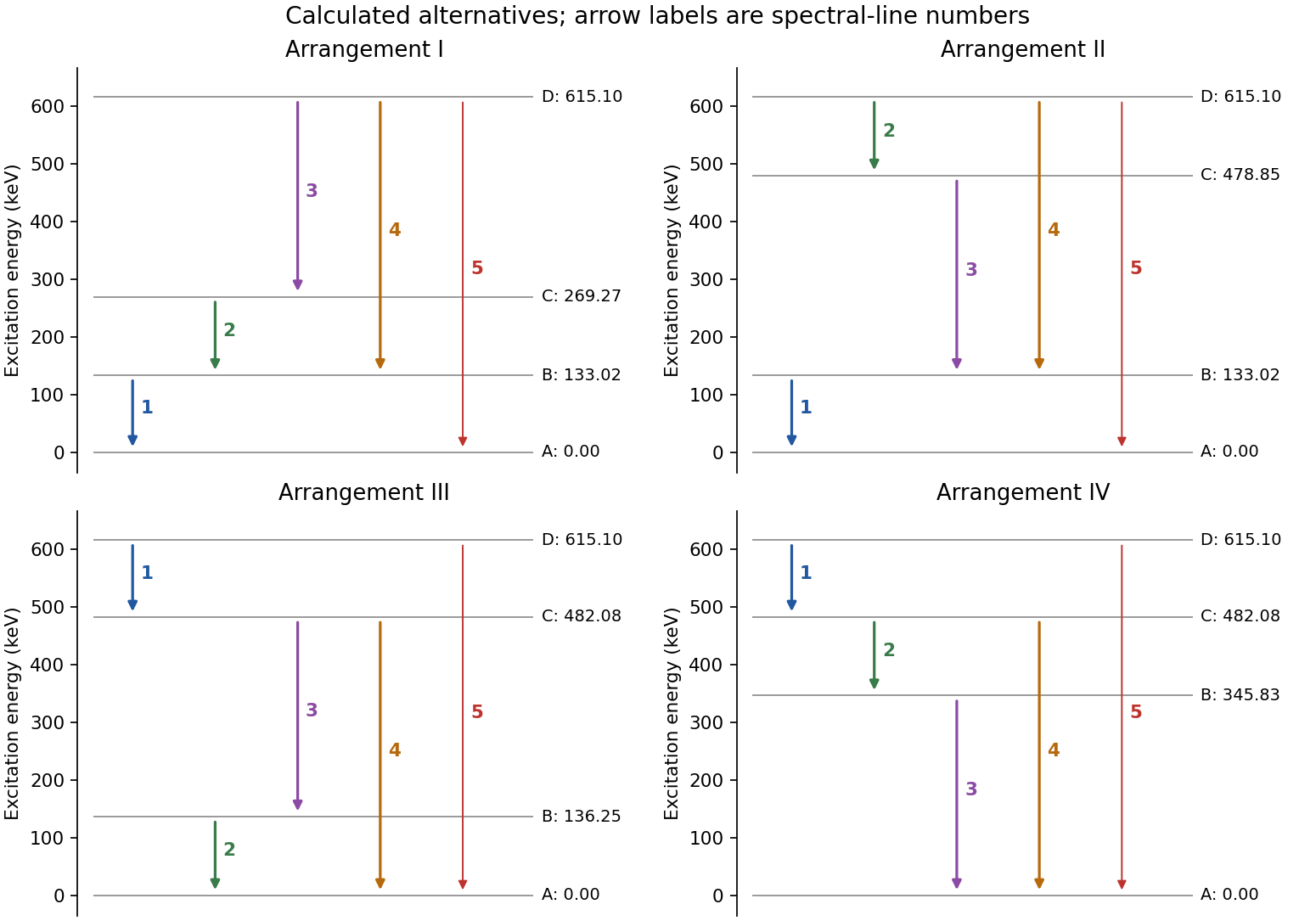
Original reconstructed solutions I–IV, with all five observed line numbers attached to calculated transitions; excitation energies are fitted, not a copy of the source diagram
. Details. 
The symbols and mean electric and magnetic radiation multipoles of order . The orders are called dipole, quadrupole and octupole. They describe the angular structure of charge/current radiation and the total angular momentum carried by the radiation; they do not change the photon's intrinsic spin from one. A real single photon has no monopole radiation mode.
An electric multipole has radiation parity and a magnetic multipole parity . The radiation quantum numbers are thereforeEquivalently, an transition requires , while an transition requires .
For comparable transition energies and ordinary single-particle nuclear strengths in the long-wavelength regime, the usual qualitative ordering is , , , , , from faster to slower. Each increase of multipole order is strongly suppressed, and magnetic radiation is usually weaker than electric radiation of the same order. More precisely,The nuclear reduced transition strength is essential: collective enhancement, cancellation and selection rules can overturn this benchmark. It is not a universal ranking between arbitrary transitions of different energies. The weak measured M3 branch is consistent with high-multipole suppression, but its absolute lifetime cannot be obtained from its arbitrary-unit intensity alone.[ref]
Guidelines for Nuclear Structure Evaluators by Murray J. Martin. Appendix C, printed pp.60–67, transition rates and Weisskopf single-particle estimates
For a single-photon transition, angular momentum addition requires , , together with the electric/magnetic parity rules above. Thus a known final state and a measured multipole restrict both the spin difference and parity of the emitting level. For example, an E1 line reverses parity and allows except ; a mixed M1+E2 line preserves parity and must satisfy both angular triangles. An E2 line preserves parity and allows spin differences up to two.
Line energies identify connected levels, while calibrated intensities and coincidences test cascade flow and branching. If a proposed assignment permits a fast low-order transition to a lower state, an experimentally stringent absence of that line argues against the assignment. Nevertheless, an allowed transition can have a small or vanishing nuclear matrix element. Pure E2 radiation alone does not prove that M1 is forbidden by angular momentum. Detection sensitivity, efficiency and overlap must be considered, and in real nuclei internal conversion can remove photons; this question explicitly excludes that competing channel. Lifetimes or reduced-strength estimates make a missing-line argument substantially stronger than a bare selection-rule statement.
Use arrangement III. Lines 2 and 4 connect B and C to A, line 3 connects C to B, line 1 connects D to C, and line 5 connects D to A. Every measured multipole preserves parity, so B, C and D all have positive parity. The two mixed M1+E2 transitions to strictly implyThe measured E2 C-to-B and D-to-C transitions require and , with their angular sums at least two. The M3 D-to-A line gives and . These inequalities, with half-integer spins, are the strict observed-line constraints. They do not alone fix unique spins.
The customary low-multipole-dominance inference goes further. If lower-order allowed radiation would not be accidentally hindered, a pure M3 D-to-A decay indicates , giving or . Its E2 connection to C then forces or , respectively. Treating the pure E2 C-to-B transition similarly as a spin change of two selectsIn either assignment the missing D-to-B line changes spin by four. Its lowest parity-preserving multipole is E4, so it is naturally much weaker than the observed E2 D-to-C branch. This spin-reflection ambiguity around the reference spin is not resolved by the spectra under this approximation.
The boxed alternatives are conditional on ordinary, unhindered lower-multipole strengths. If accidental or structural hindrance is allowed, other spins satisfying the preceding inequalities remain possible: an upper limit on an unobserved lower multipole does not mathematically prove its selection-rule prohibition. The supplied intensities and absence of other comparable lines support the usual assignments but do not supply measured reduced strengths sufficient to eliminate that qualification.
Articles by others on the same topic
There are currently no matching articles.