Strictly, it is the infinitesimal generators, not every unitary matrix with unit determinant, that are traceless. For a continuous one-parameter family , unitarity requires the generator to be Hermitian. The determinant condition givesDifferentiating at yields . A Hermitian matrix has real diagonal parameters and real off-diagonal parameters; one real trace constraint leaves independent generators. ThusThe identity matrix supplies a concrete counterexample to interpreting the claim as one about arbitrary group elements: but . Also, at a single parameter value only fixes the trace modulo ; the continuous neighbourhood is essential.
Embed the two off-diagonal Pauli matrices in each of the , and two-dimensional subspaces. Together with two independent embedded diagonal Pauli matrices, this produces the Gell-Mann matrices:To construct the last matrix explicitly, the diagonal embedding is and the embedding is . Their difference is , and their sum divided by is . There are only two independent diagonal generators.
Each matrix is Hermitian and traceless. Their inner products satisfy , proving linear independence. With , arbitrary transformations near the identity have . The eight matrices span the generators; they are not a vector-space basis of group elements themselves.
Writing , the ladder operators areThe ordered pair on each right-hand side gives the plus and minus operators respectively. Thus , and , with reverse actions for the minus operators; their other actions on the fundamental triplet vanish.
The remaining Flavor SU(3) Cartan generators can be chosen as and . Their eigenvalues label isospin and flavor hypercharge:These diagonal operators multiply a flavor eigenstate by an eigenvalue; exponentiating them changes relative phases rather than converting one quark flavour into another. The weight diagram makes the distinction visible: the ladder operators connect different points, while the diagonal eigenvalues supply the axes.
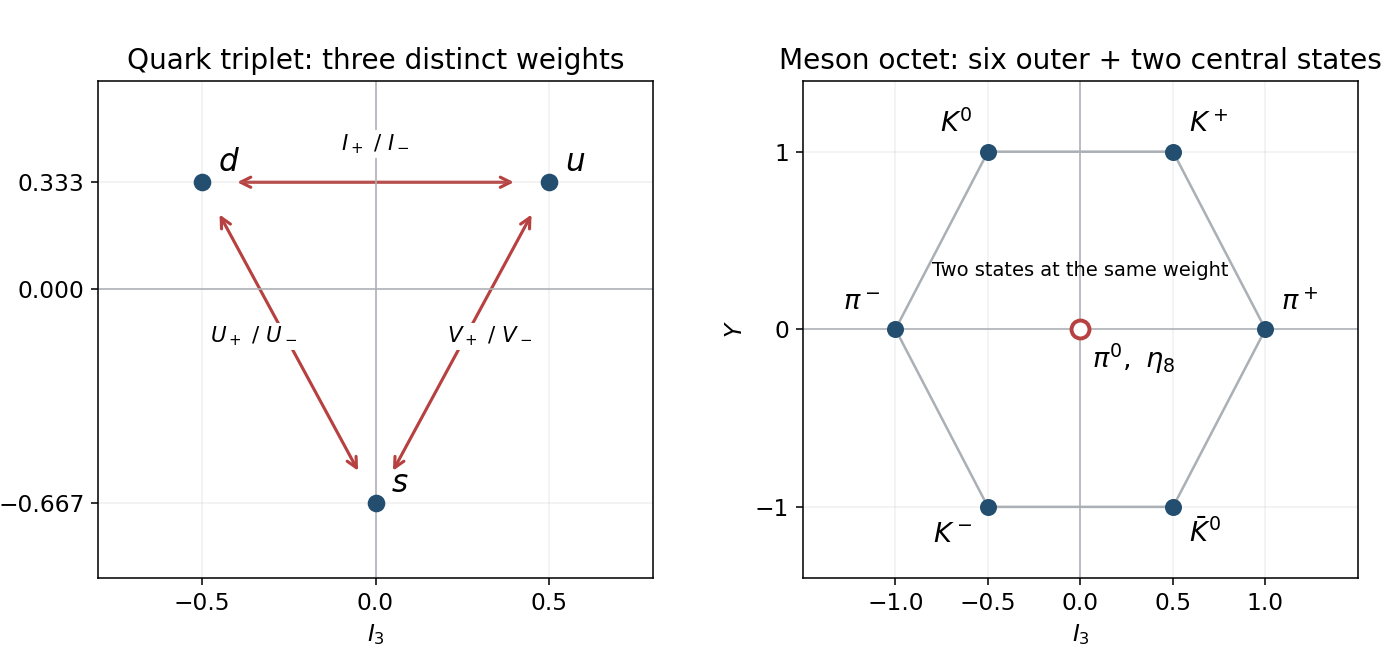

Represent a quark-antiquark state by a matrix with . Under flavor symmetry, , so an infinitesimal generator acts by . The minus sign in this commutator is the antiquark transformation law; acting on the quark alone would miss states.
Start from . Three useful first steps areFurther actions give , and . Overall phases are conventional. FinallyThus the second neutral octet state is obtained by removing the known component. Equivalently it is the normalized diagonal state orthogonal to both and the singlet. The full meson octet isTheir flavour matrices are traceless; the independent singlet is . The source uses for this ideal singlet. That notation is a basis convention here: the physical eta and eta prime mesons is not an exactly pure singlet because physical neutral pseudoscalar mesons mix.[ref]
Quark Model in the 2024 Review of Particle Physics. Section 15.3, singlet-octet wave functions and physical pseudoscalar mixing
The neutral vector mesons with isospin zero have the same conserved quantum numbers, so an off-diagonal mass matrix can mix the singlet and octet . Choose phases such thatAt the ideal mixing angle , or , these becomeThe overall sign of is unobservable. The omega meson near decays predominantly to three pions, whereas the phi meson near strongly favours kaon-antikaon channels when they are open. Suppression of its nonstrange channels agrees with the OZI rule and a predominantly strange state. The omega meson is below the two-kaon threshold, so its absence of that channel alone would not establish the mixing angle; masses and the broader decay pattern provide the evidence together.[ref]
Articles by others on the same topic
There are currently no matching articles.