Source paper: Oxford source archive, member
Finals papers/A11047W1_C4_2016.pdf. The cover establishes 2016; the alternative annual bundle is named for 2015.The parton model treats a fast proton as an ensemble of approximately collinear, nearly free quarks and antiquarks. A hard deep inelastic scattering collision resolves one parton on a time scale short compared with its binding motion. The probabilities are parton distribution functions; the simplest approximation neglects intrinsic transverse momentum, quark masses and the proton mass in the hard collision. Quantum chromodynamics introduces logarithmic violations of Bjorken scaling, so the parton distribution functions depend on a resolution scale as well as a parton momentum fraction.
Write the incident electron and proton four-momenta as , the scattered electron four-momentum as , and set . With the Minkowski metric, the Bjorken scaling variable and the inelasticity areAn incident parton with four-momentum emerges on shell, giving . Thus : the observable Bjorken scaling variable measures the struck parton momentum fraction in this approximation.
For clarity, measure the scattering angle from the incoming electron direction, and denote the outgoing electron energy by . Direct four-momentum products giveThe expression uses the known beam energies and two measured quantities. An electromagnetic calorimeter measures ; a tracking detector, the collision interaction vertex and the position of the electromagnetic shower determine . Coverage close to the incoming electron direction matters at small . A hadronic calorimeter supplies an independent consistency check and rejects backgrounds. If the angle is instead measured from the incoming proton, its sine and cosine half-angle factors interchange.
At the parton level, the dominant valence reactions are through W boson exchange and through W boson exchange. The first also acts on , while the second acts on with the appropriate Cabibbo-Kobayashi-Maskawa matrix factors; crossing supplies the antiquark reactions. The lines in the figure show fermion number flow; the Positron and antineutrino arrows point opposite to their momenta.
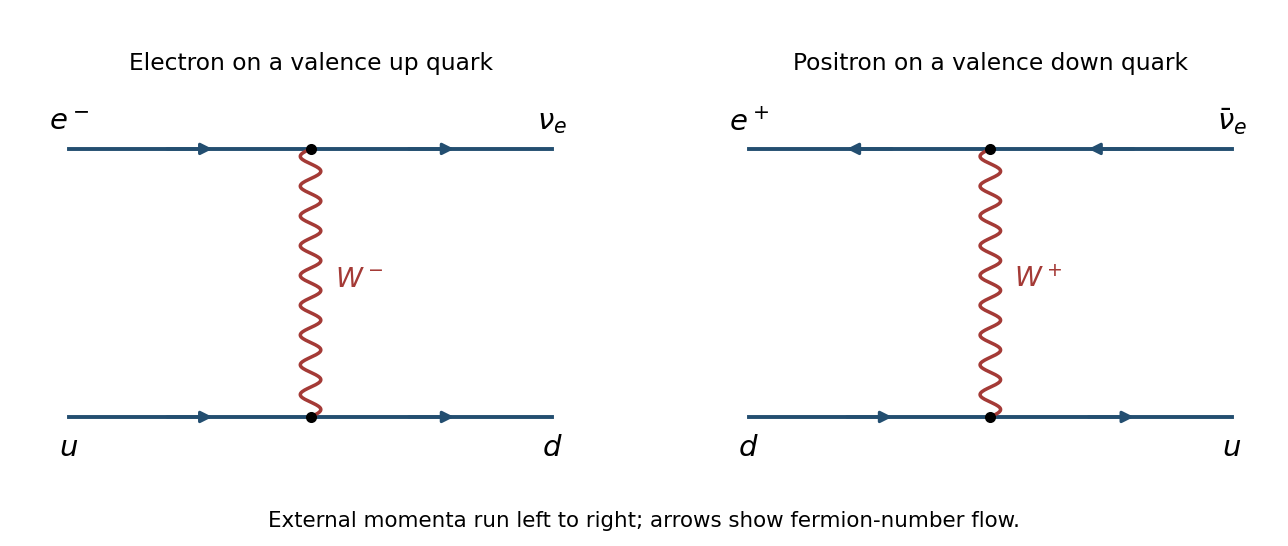
For unpolarized beams, the leading charged current cross sections, suppressing Cabibbo-Kobayashi-Maskawa matrix factors, have the formHere each parton distribution function is evaluated at . The proton has two valence up quarks and one valence down quark; moreover, its valence contribution in the Positron reaction carries the chiral angular factor . Both effects favour . Increasing at fixed collider energy enforces , progressively suppressing the sea relative to the valence quarks; large further suppresses the Positron valence term. There is no universal factor of two valid at every .
The escaping neutrino prevents direct reconstruction from a scattered charged lepton. Instead use the Jacquet-Blondel reconstruction. With the axis along the proton beam, measure the complete hadronic final state and formThese relations follow from four-momentum conservation, with the unobserved neutrino transverse momentum opposite to the measured hadronic sum. A nearly hermetic hadronic calorimeter, supplemented by tracking detectors, must measure jets, their energies and their directions. Forward losses, initial-state radiation and small cause significant reconstruction uncertainties.
The photon propagator gives approximately , whereas a massive W boson gives . Up to different coupling constant values, parton distribution functions and angular factors,Consequently the low- charged current suppression disappears as approaches . The source graph shows comparable cross sections at of order , so the relevant mass scale is of order .
A more quantitative, still rough reading uses the ratio near and near , where denotes , not . If varies slowly over this interval, set . ThenThe reading is compatible with roughly –; it is not a precision mass determination. In particular, Z boson exchange contributes to the neutral current at high , and the parton distribution functions do not cancel exactly. Equality of two inclusive cross sections alone does not define .
An observable that reverses sign under parity but has a nonzero expectation in a suitably prepared experiment tests parity violation. A polar momentum reverses, whereas an axial spin angular momentum does not. Thus and helicity are parity-odd; an apparatus asymmetry must be separated from a physical asymmetry by reversing the preparation or analyser.
In the Wu experiment, polarized cobalt-60 nuclei preferentially emit beta decay electrons in one direction relative to the nuclear spin angular momentum. The distribution contains ; its sign changes under spatial inversion. Reversing the nuclear polarization reverses the observed asymmetry.[ref]
In the Goldhaber experiment, the sign of the circular polarization of selected gamma rays determines the sign of the neutrino helicity. A preference for negative helicity is parity-odd because spatial inversion would produce the positive-helicity state. This provides a different experimental observable from the electron angular distribution.
The relevant sequence is electron capture followed by nuclear gamma decay:The nuclear spin angular momenta are . The captured K-shell electron has total angular momentum , so the initial atom-plus-electron system cannot be treated as having zero angular momentum. The atomic vacancy also produces subsequent X-rays or Auger electrons; these are not the selected nuclear transition.
Choose the neutrino momentum along and the recoil momentum along . For a negative-helicity neutrino, . With the two initial electron spin projections, angular momentum conservation allows the daughter to have or . A photon emitted exactly along the recoil direction is transverse, and the transition selects the component. Its spin angular momentum points along , opposite to its momentum.
Thus in the selected collinear geometry the daughter and photon have the same negative helicity as the neutrino, while their spin angular momenta point opposite to the neutrino spin. Reversing all these spin projections gives the positive-helicity alternative. In normalized notation,The actual eigenvalues of are for the neutrino and for the photon; the equality concerns their normalized signs.
The nuclear gamma ray can be absorbed by ground-state samarium-152, excite the same level and be re-emitted: nuclear nuclear resonance fluorescence. Its energy in the absorber rest frame must overlap the nuclear absorption line within the relevant natural and thermal broadening. Atomic radiation from refilling the K shell does not have the required transition energy.
Let the excitation energy be and the nuclear mass be . A free stationary emitter loses recoil energy while a free stationary absorber requires recoil energy:For the gap is about . A photon emitted along the daughter recoil receives a positive Doppler shift of approximately , whereas one emitted opposite the recoil is redshifted. Emission before the daughter slows down therefore selects photons roughly opposite to the neutrino. Comparable neutrino and photon energies nearly compensate the recoil mismatch; finite line widths and thermal motion permit overlap. Exact compensation need not hold for every atom, and this is not an assumption of recoil-free emission.
Magnetized iron supplies polarized electrons. Their Compton scattering cross section depends on the relative electron spin and photon helicity, so the iron attenuates the two circular polarizations differently. Reverse the magnetization and measure the resonance-selected count asymmetry . With a calibrated analysing power and background correction, determines the sign and magnitude of the circular polarization. A scintillation counter such as NaI(Tl), coupled to a photomultiplier, determines the gamma ray energy from calibrated pulse height; a semiconductor detector could perform the same spectroscopic function.
The functional arrangement below separates the polarization analysis from the resonance selection. The shield prevents the direct source beam from overwhelming the detector; the off-axis detector accepts gamma rays re-emitted by the samarium scatterer.
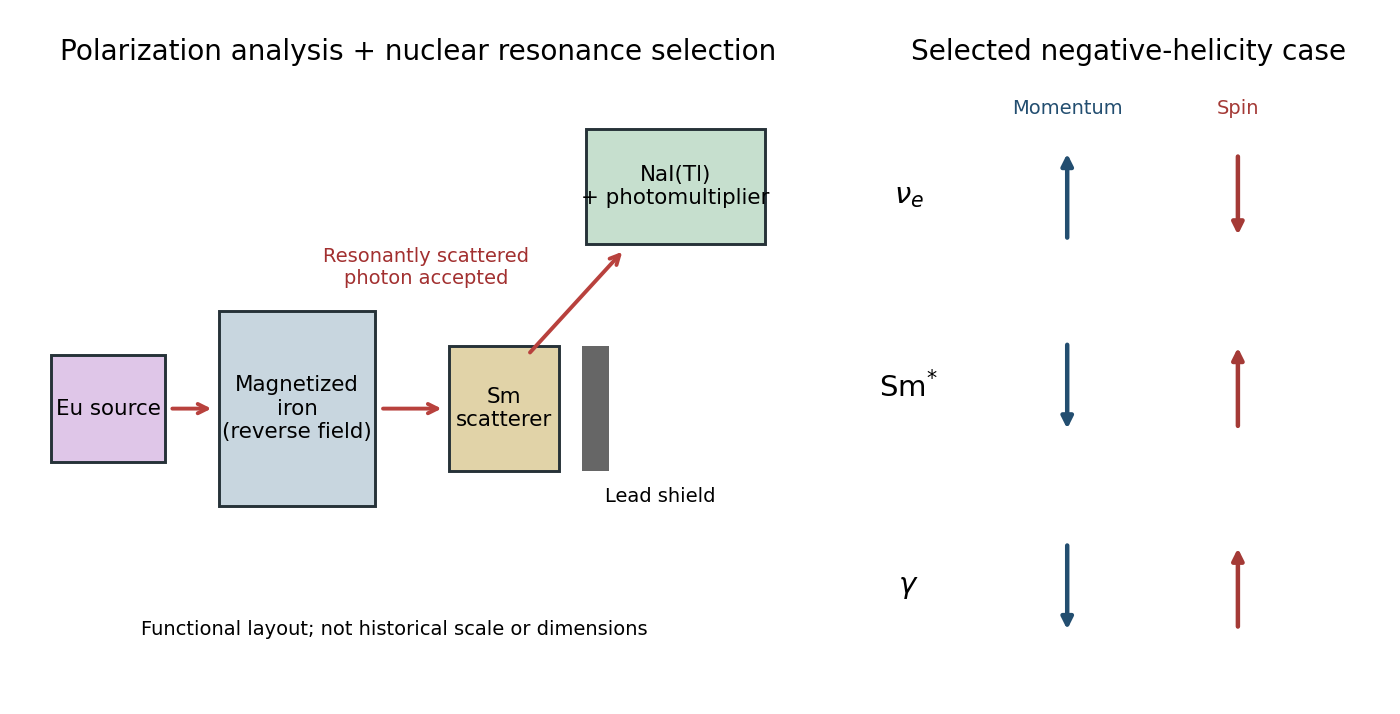
The europium source emits into magnetized iron, whose magnetization is alternated. A samarium scatterer selects nuclear nuclear resonance fluorescence, favouring photons emitted along the daughter recoil. A shielded NaI(Tl) scintillation counter records the scattered nuclear line. Compare the background-subtracted line rates for the two iron magnetizations, and use the calibrated sign of the analysing power to identify the photon helicity.
The measured circular polarization was negative, compatible after angular acceptance corrections with negative neutrino helicity. By the angular momentum conservation argument, the selected photon helicity and neutrino helicity have the same sign. Thus the experiment concludesfor the emitted relativistic electron neutrino. Finite acceptance dilutes the measured polarization; it does not justify equating the raw count asymmetry to .[ref]
Helicity of Neutrinos by Maurice Goldhaber and others. Pages 1016–1017, apparatus, reversal calibration and negative circular polarization
Strictly, it is the infinitesimal generators, not every unitary matrix with unit determinant, that are traceless. For a continuous one-parameter family , unitarity requires the generator to be Hermitian. The determinant condition givesDifferentiating at yields . A Hermitian matrix has real diagonal parameters and real off-diagonal parameters; one real trace constraint leaves independent generators. ThusThe identity matrix supplies a concrete counterexample to interpreting the claim as one about arbitrary group elements: but . Also, at a single parameter value only fixes the trace modulo ; the continuous neighbourhood is essential.
Embed the two off-diagonal Pauli matrices in each of the , and two-dimensional subspaces. Together with two independent embedded diagonal Pauli matrices, this produces the Gell-Mann matrices:To construct the last matrix explicitly, the diagonal embedding is and the embedding is . Their difference is , and their sum divided by is . There are only two independent diagonal generators.
Each matrix is Hermitian and traceless. Their inner products satisfy , proving linear independence. With , arbitrary transformations near the identity have . The eight matrices span the generators; they are not a vector-space basis of group elements themselves.
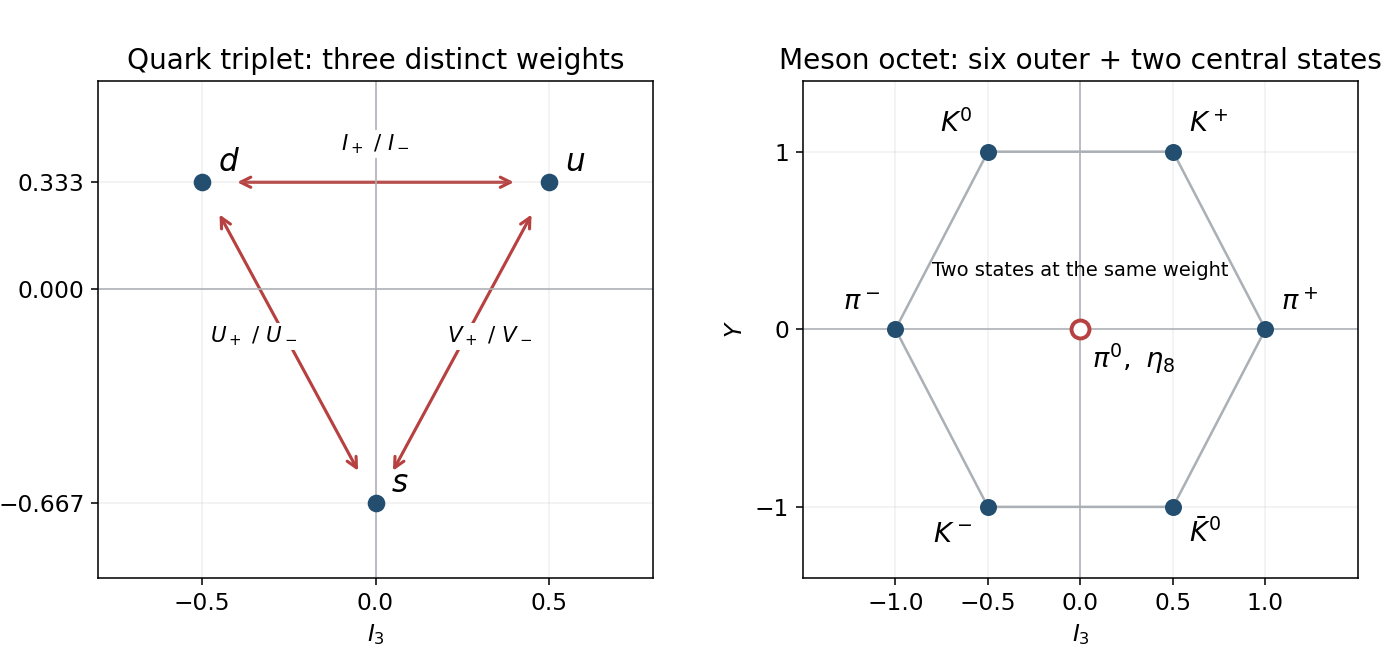
Writing , the ladder operators areThe ordered pair on each right-hand side gives the plus and minus operators respectively. Thus , and , with reverse actions for the minus operators; their other actions on the fundamental triplet vanish.
The remaining Flavor SU(3) Cartan generators can be chosen as and . Their eigenvalues label isospin and flavor hypercharge:These diagonal operators multiply a flavor eigenstate by an eigenvalue; exponentiating them changes relative phases rather than converting one quark flavour into another. The weight diagram makes the distinction visible: the ladder operators connect different points, while the diagonal eigenvalues supply the axes.
Represent a quark-antiquark state by a matrix with . Under flavor symmetry, , so an infinitesimal generator acts by . The minus sign in this commutator is the antiquark transformation law; acting on the quark alone would miss states.
Start from . Three useful first steps areFurther actions give , and . Overall phases are conventional. FinallyThus the second neutral octet state is obtained by removing the known component. Equivalently it is the normalized diagonal state orthogonal to both and the singlet. The full meson octet isTheir flavour matrices are traceless; the independent singlet is . The source uses for this ideal singlet. That notation is a basis convention here: the physical eta and eta prime mesons is not an exactly pure singlet because physical neutral pseudoscalar mesons mix.[ref]
Quark Model in the 2024 Review of Particle Physics. Section 15.3, singlet-octet wave functions and physical pseudoscalar mixing
The neutral vector mesons with isospin zero have the same conserved quantum numbers, so an off-diagonal mass matrix can mix the singlet and octet . Choose phases such thatAt the ideal mixing angle , or , these becomeThe overall sign of is unobservable. The omega meson near decays predominantly to three pions, whereas the phi meson near strongly favours kaon-antikaon channels when they are open. Suppression of its nonstrange channels agrees with the OZI rule and a predominantly strange state. The omega meson is below the two-kaon threshold, so its absence of that channel alone would not establish the mixing angle; masses and the broader decay pattern provide the evidence together.[ref]
In neutral meson mixing, the mass eigenstates and flavor eigenstates differ. A state prepared as develops a component because the effective Hamiltonian operator has off-diagonal mass and decay width entries. In the CP symmetry limit implicit in the source, the propagating states are equal superpositions, with average mass and average decay width .
To retain the source's positive convention for , take and , with , where . Then and reproduce the given functions. Reversing an eigenstate label changes signs in intermediate formulae; it must also change the phase conventions consistently.
For equal widths, the mixed probability is proportional to . Thus the angular angular frequency is in natural units, or with units restored; the period is . A nonzero difference of decay widths adds hyperbolic time dependence.
The ordinary neutral flavour-carrying mesons that mix are , , and with their antiparticles. A self-conjugate has no distinct antiparticle flavour to oscillate into. There are no long-lived top-flavoured mesons, since the top quark decays before hadronization.
Put , and . Two indistinguishable paths reach the wrong-sign kaon-pion final state: a direct doubly Cabibbo suppressed decay amplitude and a neutral meson mixing amplitude followed by the favoured decay, . They must be added before taking the absolute square:Direct complex-trigonometric multiplication givesThereforeThe three terms are direct decay, quantum interference and decay after mixing. In particular, the minus sign multiplying follows from the source's convention and its definition ; importing another convention without transforming would change a physical prediction incorrectly. The common exponential accounts for survival before decay. The expression is a decay-rate density up to an overall normalization, rather than a normalized cumulative probability.
The right-sign denominator has its own small mixing contribution. In the same CP symmetry convention its decay amplitude is . After cancelling , the exact numerator and denominator areDefine and . Their Taylor expansions are and . Dividing the series gives the strict second-order answerThe usually quoted approximation additionally drops terms suppressed by powers of in the right-sign denominator:For and , this is for , and for . The first increases; the second initially decreases, reaches approximately at , then rises. The strict series instead has and . At the exact ratios are approximately and ; the leading approximations give and .
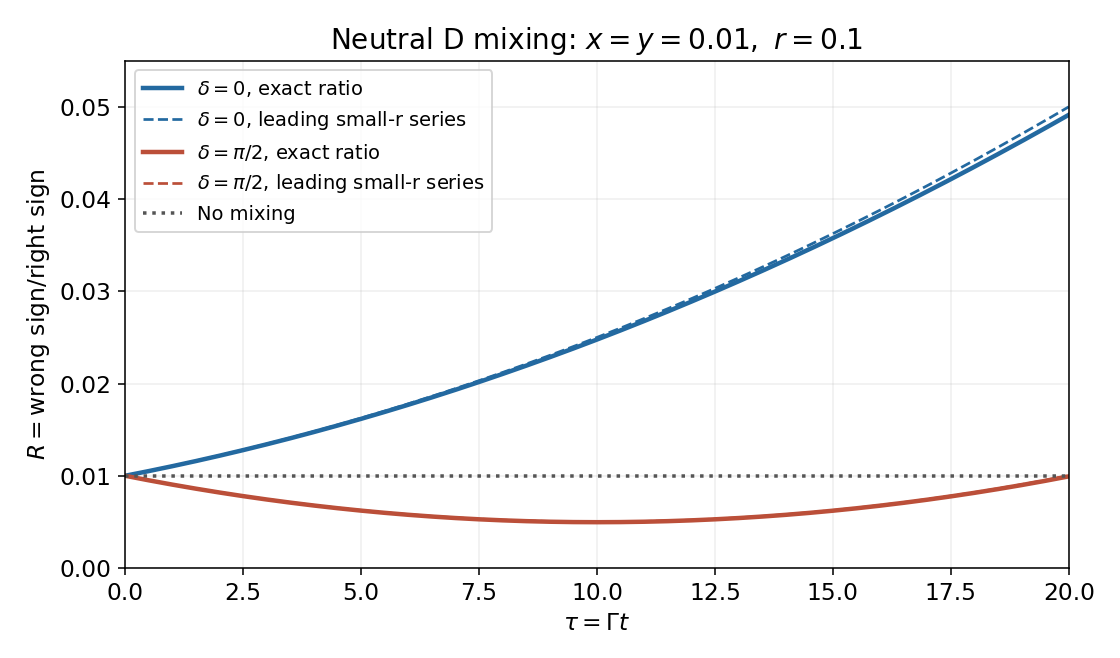
With no neutral meson mixing, and , so at all decay times. The wrong-sign signal then remains through direct doubly Cabibbo suppressed decay.
A charged lepton in a semileptonic decay directly identifies the decaying charm quark flavour: ordinarily and . With an independently tagged initial quark flavour, the wrong-sign charged lepton requires neutral meson mixing, rather than a competing doubly Cabibbo suppressed amplitude. Its leading time dependence is , which looks theoretically cleaner.
That method measures only the quadratic combination at leading order, with no direct access to their signs. The missing neutrino also worsens kinematic and decay-time reconstruction. The fully reconstructed channel has substantial yield, a clear invariant-mass peak and a well-measured decay interaction vertex. Most significantly, quantum interference with the small direct amplitude produces a term linear in and , enhancing sensitivity to small mixing. Its cost is the unknown strong phase , so separating and needs further channels or an independent strong-phase measurement. Neither one unqualified rate measurement determines both parameters by itself.
The local Fermi interaction gives a three-body leptonic decay width of the format tree level with negligible neutrino masses and universal weak coupling constant values. The fifth power follows from the dimension of and the three-body phase space; results from integrating the V-A interaction matrix element over the reduced phase space when the charged daughter has nonzero mass. It is more than a purely geometric volume correction because the spin-dependent matrix element is included.
As , ; increasing daughter mass reduces the available energy and suppresses the rate. The largest ratio is , so the correction is visibly below one. The electron is extremely light relative to either parent. Using the lepton masses givesThese reproduce the supplied factors to their stated accuracy. Radiative and finite-W boson corrections are separate small corrections when a precision lepton universality test is performed.
At the Z boson resonance, a tau lepton pair produces two approximately opposite narrow hemispheres, usually with one or three charged tracks per decay, and missing energy from neutrinos. Multihadronic Z boson decays have much higher track multiplicity. Direct and events have two tracks but almost the full beam energy in an electromagnetic calorimeter or muon detector; the tau lepton daughters typically have smaller visible energy. Track directions, calorimetric energy, missing transverse momentum and particle identification together control these backgrounds.
Use a tag-and-probe method: select one hemisphere with an independently understood tau lepton tag, then classify the opposite hemisphere into mutually exclusive decay categories. Correct the category counts for efficiency, migration and background, including an explicit remainder for modes absent from the displayed table. Conditional on a genuine tag, the opposite-hemisphere probabilities sum to one. This avoids assuming that a raw event count equals the number of decaying tau leptons.
An absolute cross-check uses single and double tags. If counts tagged hemispheres and counts events with both hemispheres in mode , thenThe double-tag efficiency need not factorize. Fit all categories with their efficiencies and correlations, imposing the inclusive normalization. The nine displayed entries sum to , not . Renormalizing those entries alone to would bias every quoted branching fraction.
Lepton universality means that the weak charged current couples equally to the three charged lepton families after accounting for masses and known radiative corrections. In the ratio of two tau lepton leptonic decay widths, the parent coupling constant, mean lifetime and cancel:The universal prediction is . The measured ratio is , givingif the quoted errors are treated as independent. This is consistent with unity at about standard deviations. An actual precision fit must retain the measured covariance and the small radiative corrections; the rounded table alone does not supply those correlations.
The Cabibbo-Kobayashi-Maskawa matrix is the unitary change of basis between down-type quark mass eigenstates and the combinations appearing in the weak charged current. In particular, and production carry and . Exclusive tau lepton decays into a charged pseudoscalar meson giveup to small radiative corrections. The pseudoscalar decay constants specify the vacuum-to-meson axial-current matrix elements, .
The observed branching fraction ratio is , and the kinematic factor is approximately . Hence the directly determined combination isWith an independent, representative lattice input , this becomes , close to the source's rounded expectation . Conversely that expectation and the hadronic input predict a branching fraction ratio near . Without the decay-constant input the table does not isolate a pure Cabibbo-Kobayashi-Maskawa matrix ratio. Setting would give approximately , demonstrating the importance of flavor symmetry breaking.[ref]
Leptonic Decays of Charged Pseudoscalar Mesons in the 2024 Review of Particle Physics. Sections 72.1–72.2, axial-current definition, radiative corrections and lattice decay-constant ratios
Assuming that the two listed leptonic decay categories exhaust the leptonic modes, the inclusive hadronic branching fraction is . ThusAt the simplest massless quark level, the W boson couples to and in three color charge states, so equal quark and lepton weak coupling constant values predictThis is a rough check of color multiplicity in a decay width and universal weak-current normalization. It is much less precise than the two-lepton ratio because hadronic Quantum chromodynamics and electroweak interaction corrections are sizeable: the data require a net correction factor near . They must be included before extracting a quark-to-lepton coupling constant ratio. It would be incorrect to interpret the excess over three directly as a failure of weak universality. The displayed exclusive hadronic modes alone would underestimate the inclusive sum.
The isospin coupling , with third component , has the normalized stateThe two Clebsch-Gordan coefficients have equal squared magnitude. Neglecting electromagnetic effects and charged-neutral mass differences, the two rho meson charge channels have equal rates. Their subsequent strong decays are and , with nearly unit probabilities. Consequentlyin the ideal isospin model.
Each final state contains one pair of identical pions. Summing the alternative resonant-pair assignments coherently, with the corresponding identical-particle phase space factors, does not generate an extra factor of two for just one channel. In the narrow-rho meson approximation the equality is already evident from equal rates; the consistent isospin amplitudes extend it to the integrated three-body distributions.
The tabulated ratio is close to this expectation but is not exactly one. Treating the printed errors as independent gives an uncertainty about , so a percent-level comparison requires isospin breaking, radiative corrections, realistic resonant dynamics and experimental correlations. The idealized argument predicts the leading pattern rather than an exact identity for the rounded measurements.
A projection operator satisfies ; an orthogonal projection operator also has . It extracts a subspace while leaving already projected states unchanged. Since and , the chiral projectors areThey separate the Dirac spinor into opposite fermion chirality components. The Standard Model weak charged current contains , selecting left-chiral particle fields and the corresponding right-helicity massless antiparticles; right-chiral charged fermions are weak-isospin singlets. The weak neutral current can couple to both fermion chirality components with different strengths. Chirality and helicity should not be equated for a massive fermion: a Lorentz boost can reverse its helicity, while the field representation defining chirality is a different notion.
The Dirac adjoint is . Because is Hermitian and anticommutes with ,Anticommutation with then givesThus the left-chiral charged current can be written with its chiral projector acting on either external Dirac spinor. More precisely, , since the opposite projection vanishes. The Dirac adjoint reverses the matrix projector, ; overlooking this reversal would give a wrong zero. The source uses , so no additional factor of two is introduced when moving that entire factor.
Use the Dirac representation of the gamma matrices and commuting external-wavefunction components, rather than anticommuting quantum fields. Let , , and . Since and ,Transpose this scalar and use , and :Here and . The supplied identity therefore yieldsHenceThe external labels and momenta are exchanged; the scalar constants are transposed, not complex-conjugated. At the level of these numerical fermion bilinears, charge conjugation reverses the relative sign of the vector and axial terms, relating particle and antiparticle weak amplitudes. For , the two displayed spinor chains have opposite chiral projectors. A physical charge-conjugation transformation of an operator current also includes the minus sign from reordering Dirac fields. In particular this numerical identity does not imply equal electric charges for a particle and its antiparticle.
Cherenkov radiation is coherent electromagnetic emission by a charged particle moving through a dielectric faster than the phase velocity of light in that medium. The particle polarizes the material along its path. Wavelets interfere constructively on a cone whenA simple wavefront construction compares a particle displacement with the light-wave displacement , giving the cone relation. The particle still travels slower than the vacuum speed of light; no violation of special relativity occurs. Dispersion makes the angle and threshold wavelength-dependent. The radiation has a continuous spectrum rather than the discrete line spectrum of an atomic transition.
At , the velocities are , giving approximately , and for electrons, muons and protons. The glass threshold is . Thus the first two produce Cherenkov radiation, with internal angleswhereas a primary proton at this momentum is below threshold.
If an optical arrangement transports those cone angles without changing them, a plane downstream would intersect rings of radiusThese are conditional geometric estimates, not the ray trace for a flat slab in air. The emission depth alone spreads the radius by order , already larger than the approximately separation. The slab is one radiation length: electrons lose appreciable energy by bremsstrahlung and begin an electromagnetic shower, producing a broader and less clean pattern. Muons mainly ionize and retain a comparatively clean cone, with some Multiple Coulomb scattering. A below-threshold primary proton gives no direct cone, although energetic delta electrons and other secondary interactions can produce light.
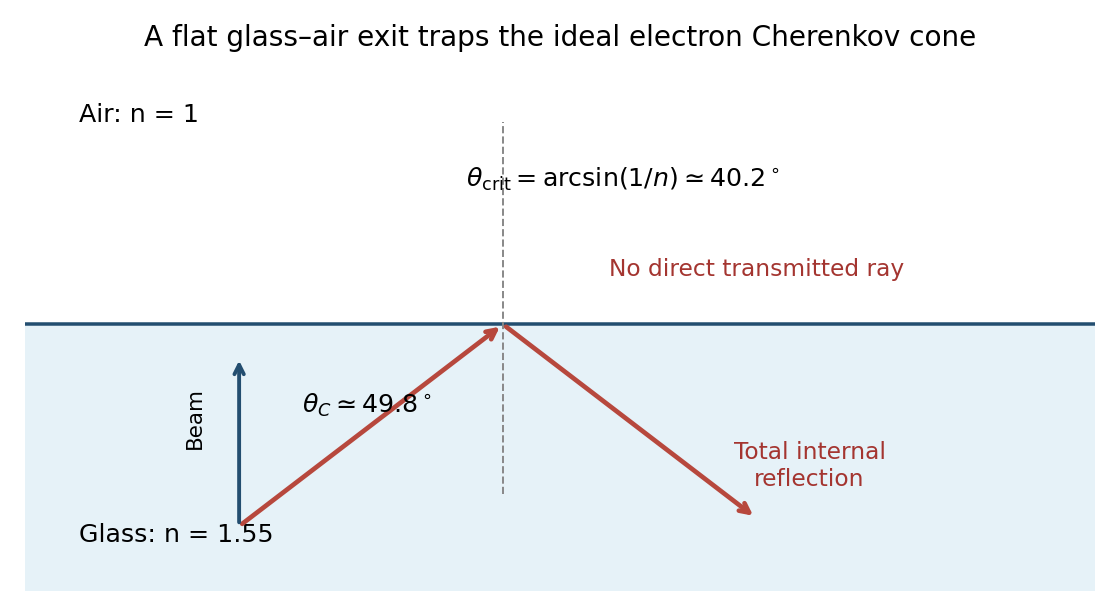
There is an essential optical qualification. For a normal beam through a parallel-faced glass slab followed by air, the internal critical angle is . Both emission angles exceed it. Snell's law would require , so the ideal photons undergo total internal reflection at the downstream face and do not form those direct downstream rings. Optical coupling, a prism or different surface geometry must be specified to extract them. The stated material parameters alone do not define a unique detected pattern; this flat-slab geometry is a concrete counterexample to silently assuming straight transmitted rays.
For protons, exposure and efficiency , the expected count in this channel is . A partial decay rate at the quoted upper bound gives one event per year whenMore generally, at the limiting rate. This is an estimate of the required proton inventory, not necessarily the whole detector mass. For water, each molecule contains ten protons and has mass approximately atomic mass units; the corresponding ideal inventory is about of water. Finite efficiency and a useful sample larger than one event increase the required exposure.
An upper limit is not a measured nonzero rate. The true rate could be much smaller, including zero, so no finite target guarantees a measurable signal. The estimate describes sensitivity to a rate near the existing limit.
A large, optically clean water Cherenkov detector provides many protons, a transparent radiator and a relatively inexpensive homogeneous target. A surrounding array of inward-facing photomultipliers records hit times and charge. Reconstructing the vertex and cone intersections identifies track directions and visible energies; an outer active veto rejects entering particles. Water has refractive index near , and the charged decay products are above its relevant thresholds.
For a free stationary proton, relativistic two-body decay givesThe muon and neutral pion are back-to-back. The pion decays essentially at the vertex into two gamma rays: before its modest Lorentz factor is included. Each gamma ray converts and initiates an electromagnetic shower, producing a diffuse ring. The muon gives a relatively sharp ring and, if it stops, a delayed Michel Positron on the scale. The ideal topology therefore has one muon-like and two electron-like rings, although overlaps or a weak photon may merge or hide a ring.
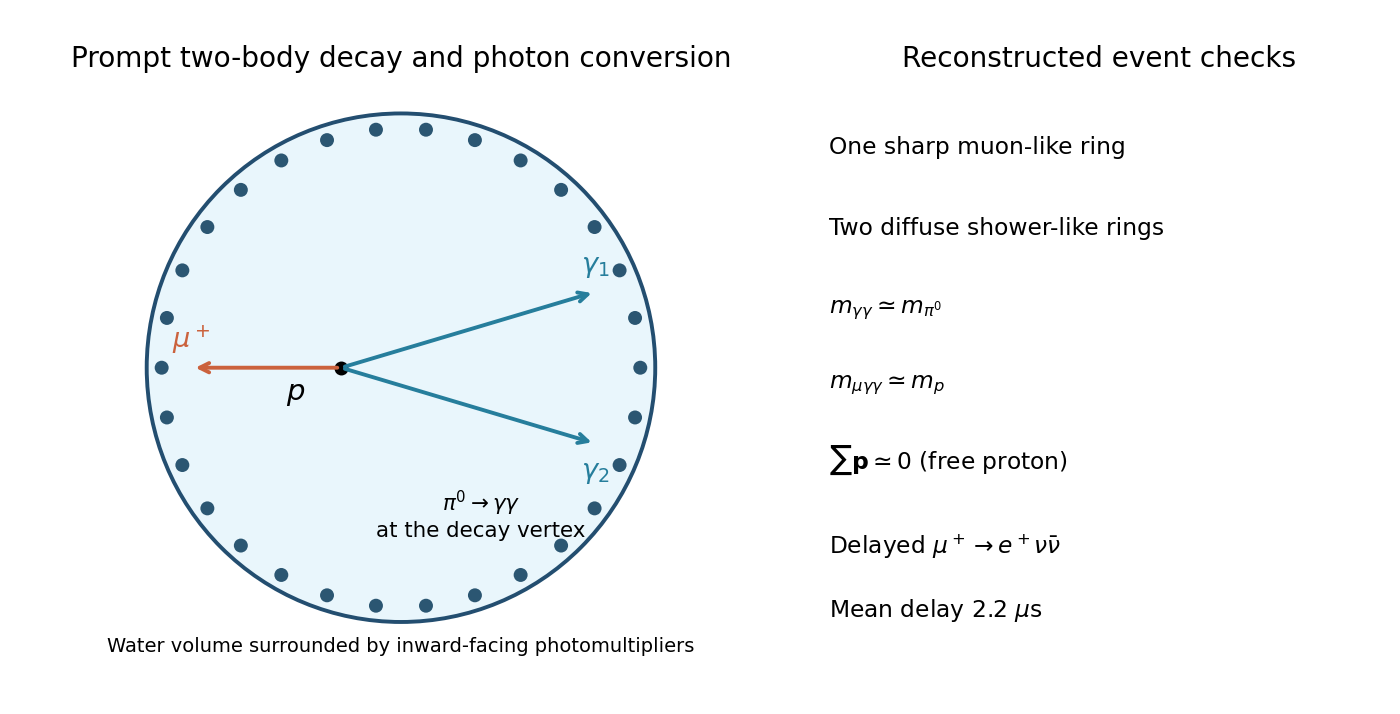


Require the two-photon invariant mass to match , the total reconstructed mass to match , and small total momentum. Bound oxygen protons have Fermi motion and their hadronic products can rescatter, so those cuts need realistic nuclear corrections; the water target also contains free hydrogen protons. Install the detector deep underground to suppress cosmic-ray muons, with shielding and an active veto. Important irreducible backgrounds are atmospheric-neutrino interactions producing a muon and neutral pion, potentially with an undetected recoil nucleon.
Collider luminosity is the proportionality factor between a process cross section and its interaction rate: before efficiency corrections. It has units of inverse area per time. Integrated collider luminosity is , with inverse-area units, and gives for a constant cross section and unit efficiency.
At an collider, count small-angle Bhabha scattering in a dedicated forward detector. Its calculable quantum electrodynamics cross section in a precisely defined angular acceptance provides , after background and radiative corrections. The inner angular boundary is especially important because the rate is sharply forward-peaked.
At a collider with two proton beams, a van der Meer scan calibrates a visible interaction monitor by separating the beams horizontally and vertically while recording the overlap-dependent rate. Known bunch populations and the measured overlap give an absolute collider luminosity and hence the monitor's visible cross section. Its rate then tracks collider luminosity during normal running. Correlations between transverse coordinates require a nonfactorizing scan analysis rather than blindly multiplying two one-dimensional profiles.
For two identical, head-on beams with Gaussian distributions, integrating the product of their normalized transverse densities gives an overlap . Each of the colliding bunch pairs crosses once per revolution, with . ThusThereforeThe factor accounts for the convolution of two beams, rather than the normalization of just one beam. The result assumes all stated bunch pairs collide at the chosen interaction point, speeds approximately , zero crossing angle and negligible hourglass reduction. Additional interaction points do not multiply the local collider luminosity at a single detector.
The geometric rms beam emittance measures transverse phase space area. In one plane,The betatron amplitude function describes how the beam envelope varies around the lattice. At a waist, and . This betatron amplitude function is unrelated to either the relativistic velocity ratio or a renormalization-group beta function.
With the beam emittances and bunch populations held fixed, reducing each interaction-point amplitude function to one third makes both transverse rms widths smaller by . Hence their product is smaller by three, andThe change is not a factor of nine: widths are proportional to the square root of the amplitude function. The transverse angular spread increases by . In a real machine, stronger final focusing, finite bunch length, crossing angle, aperture and beam-beam limits can reduce the nominal gain; the question's ideal symmetric head-on approximation neglects these effects.
For an electron-positron collider of fixed bending radius , synchrotron radiation rapidly becomes the principal obstacle. Multiplying the supplied radiated power by the revolution period givesA bending radius of gives losses of about per turn at per beam, but per turn at . At , a beam already radiates about . The radiofrequency system must replace this energy, and the vacuum chamber must absorb the radiation. The centre-of-mass energy is twice the beam energy for equal opposite beams.
For a collider with two proton beams, the same energy gives a much smaller Lorentz factor. At fixed energy and radius the radiated power scales as , so the suppression relative to electrons is . The main practical limit is the dipole magnetic field through magnetic rigidity:With and , the beam energy is about , or in the centre of mass. Fields near would give approximately per beam at that radius. These are realistic superconducting-magnet scales; a circumference includes straight sections, so its bending radius is less than . The proton radiation loss near is only a few keV per turn, though high beam currents still create substantial cryogenic heat loads. Magnet technology, aperture, protection and stored beam energy therefore dominate before the electron-like radiation limit.
Articles by others on the same topic
There are currently no matching articles.