At leading order in QED, the electron exchanges one spacelike virtual photon with a charged parton inside the proton.
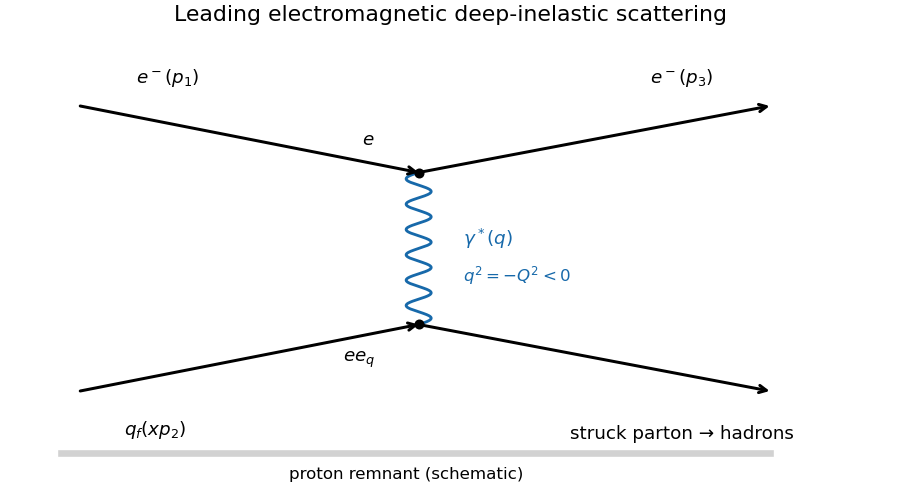

The two Feynman vertices contribute and , while the photon propagator contributes . Hence the scattering amplitude scales as and its squared absolute value as . Since the fine-structure constant is , the electromagnetic coupling dependence is . The numerical in the stated differential scattering cross-section additionally uses the flux, Lorentz-invariant phase space, azimuthal integration and the convention defining the deep-inelastic structure function; it cannot be deduced from the propagator alone.
For each measured bin form the reduced quantityPlot this against at several fixed values, normally using a logarithmic axis. Bjorken scaling predicts an approximately horizontal curve at each , or equivalently collapse of different- data onto one curve. Raw cross sections do not collapse because their explicit kinematic factors vary. QCD predicts logarithmic scaling violations, so exact independence is only the ideal parton model limit. The stated extraction also assumes negligible longitudinal deep-inelastic structure function, as in the leading massless spin-half parton approximation.
Articles by others on the same topic
There are currently no matching articles.