Use the Minkowski metric and choose the incoming electron along , with the scattered electron in the plane. In natural units, neglecting the electron mass, the four-momenta areThe momentum transfer entering the proton is thereforeThe outgoing hadronic system carries . The energy transfer is , while need not point along the original beam.
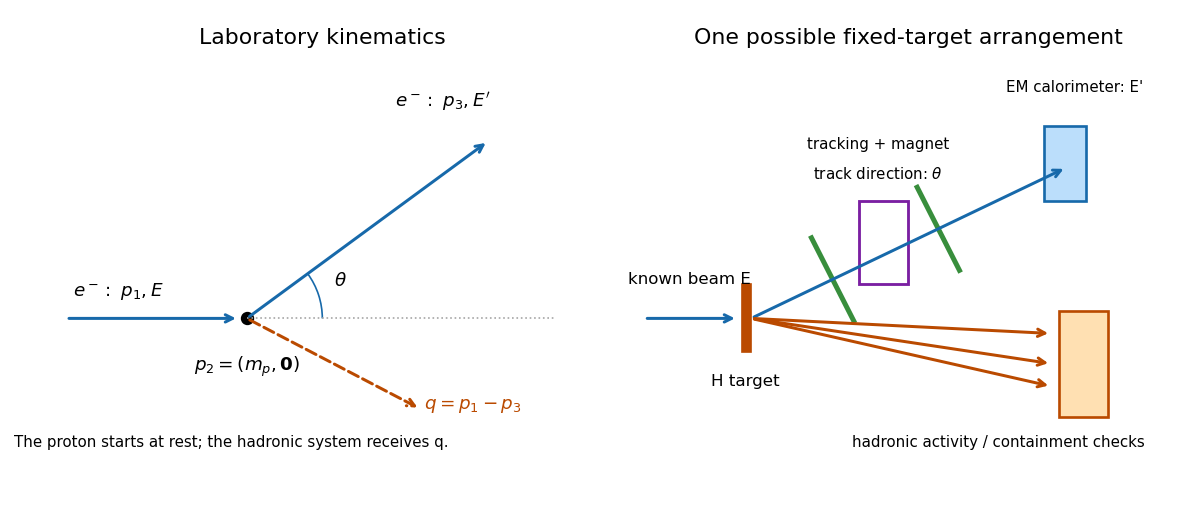
With the four-momenta in a, , , and . Thus the measured beam energy , scattered electron energy and scattering angle determineHere measures the spacelike momentum transfer, is the fractional energy transfer, and the Bjorken scaling variable is the struck parton's longitudinal momentum fraction in the leading collinear description. The hadronic invariant mass satisfies ; large and select deep inelastic scattering.
A beam spectrometer measures before a thin stationary hydrogen target. Tracking layers on both sides of a magnetic spectrometer measure the outgoing electron direction, charge and curvature; an electromagnetic calorimeter measures its energy. Matching the track to its particle shower, with downstream muon rejection where useful, separates the scattered electron from hadronic tracks. A downstream hadronic detector measures the hadronic activity and supports event-quality checks. The sketch in a shows these separate measurements.
The scattered electron provides a clean, single-particle reconstruction. Reconstructing the entire hadronic system requires summing many charged and neutral fragments, correcting unequal particle calorimeter response and losses through beam holes, and sometimes accounting for escaping neutrinos. Thus the leptonic definition is experimentally convenient. It is not a fundamental requirement of Lorentz invariance: exact reconstruction of gives the same , and hadronic or combined reconstructions can be preferable in some kinematic regions.
At leading order in QED, the electron exchanges one spacelike virtual photon with a charged parton inside the proton.
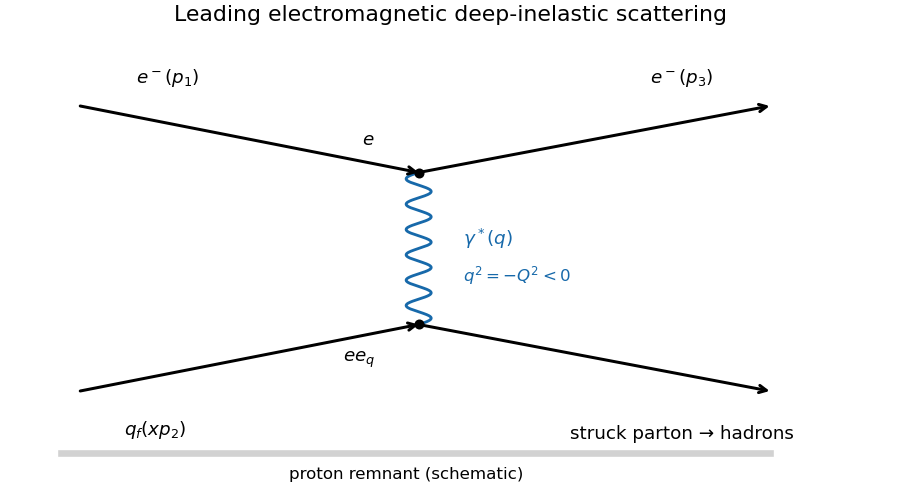


The two Feynman vertices contribute and , while the photon propagator contributes . Hence the scattering amplitude scales as and its squared absolute value as . Since the fine-structure constant is , the electromagnetic coupling dependence is . The numerical in the stated differential scattering cross-section additionally uses the flux, Lorentz-invariant phase space, azimuthal integration and the convention defining the deep-inelastic structure function; it cannot be deduced from the propagator alone.
For each measured bin form the reduced quantityPlot this against at several fixed values, normally using a logarithmic axis. Bjorken scaling predicts an approximately horizontal curve at each , or equivalently collapse of different- data onto one curve. Raw cross sections do not collapse because their explicit kinematic factors vary. QCD predicts logarithmic scaling violations, so exact independence is only the ideal parton model limit. The stated extraction also assumes negligible longitudinal deep-inelastic structure function, as in the leading massless spin-half parton approximation.
This labelled part supplies a definition rather than a separate task. Its notation is interpreted as an incoherent charge-squared sum: the photon couples to a quark with electric charge , and the squared scattering amplitude weights its contribution by . To make the antiquark convention explicit, letThen, restricting the displayed example to three active light quark flavors, the deep-inelastic structure function isThus the source's sum must either include antiquarks as separate partons or define each to include its antiquark distribution. It must not silently omit the sea quarks, especially in the small- limit used below.
Assume approximate charge symmetry of nucleon parton distributions, the interchange of up quarks and down quarks under the isospin rotation carrying the proton into the neutron:Corrections from the up quark-down quark mass difference and the electromagnetic interaction are neglected. With the proton-only shorthand in d,If charm is active, add the same to each; heavier flavors are treated similarly. These formulae use the same and factorization convention for all parton distribution functions.
Subtracting the deep-inelastic structure functions in e givesThus at moderate and large , the charge-weighted up quark content of the proton exceeds its down quark content. In the valence quark dominated regime this is consistent with the valence structure, compared with for the neutron. The larger up quark electric charge makes the proton scatter more strongly. This observation alone does not establish pointwise: the valence-number sum rules constrain integrals, not every bin.
If the small- observation means equality to good relative accuracy, it supports dominance by approximately charge-symmetric sea quarks, with and negligible relative valence excess. Gluon splitting creates quark-antiquark pairs, and the leading strong interaction treats light quark flavors similarly. It does not follow that every sea quark flavor has exactly the same distribution at every .
Logical qualification. Equality of the limiting values alone is weaker than equality of their ratio. For example , , near gives and : both tend to zero, although and . The usual inference about a symmetric sea needs or equivalent information about relative differences, rather than merely coincident zero limits.
Articles by others on the same topic
There are currently no matching articles.