An incoming fermion contributes a Dirac spinor and an outgoing fermion contributes its Dirac adjoint . The label specifies a spin state; is the on-shell four-momentum. Incoming and outgoing antifermions instead contribute and .
The exchanged boson is a virtual photon, represented in the Feynman rules by the photon propagator in Feynman gauge. Its momentum transfer is ; unlike an external real photon, it need not satisfy . Each Feynman vertex contracts a gamma matrix with this propagator and contributes in a conventional QED sign convention. The coupling constant sets the interaction strength, with fine-structure constant . One may reverse the sign of the photon field and both vertex signs without changing the result. The gamma matrices obey , with Minkowski metric .
There is one tree-level Feynman diagram: the distinguishable electron and muon exchange a photon in the channel. There is no identical-particle exchange diagram.
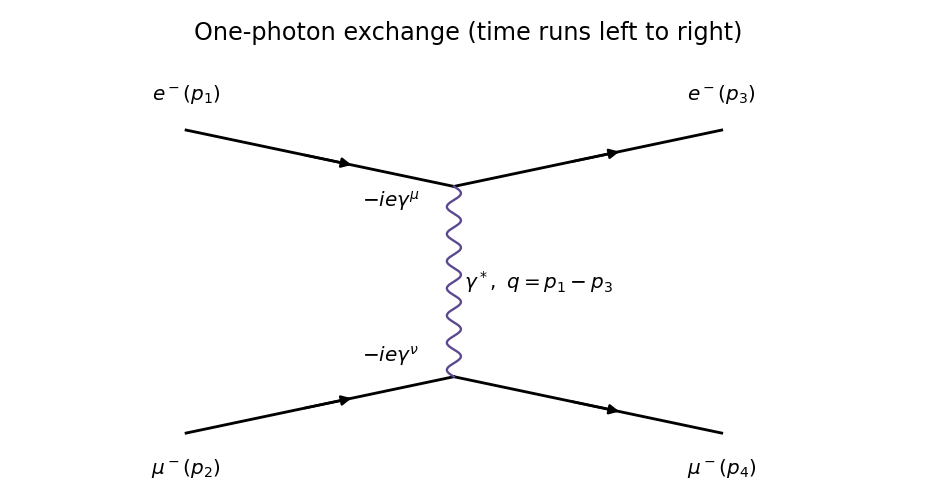

Multiplying the external Dirac spinors, the two Feynman vertices and the photon propagator givesThe overall phase of this scattering amplitude is convention dependent. Four external spin labels with two choices each give possible configurations before taking a limit. For , the vector QED interaction preserves fermion chirality, which becomes helicity for each external particle. Thus the surviving configurations, written as , areHere specify helicity along each particle's own momentum. The other configurations require at least one mass-suppressed flip and vanish in the strictly massless limit.
Define the Mandelstam variables for the scattering labels by , and . Dropping the electron and muon masses givesThese identities follow by expanding the corresponding squared four-momenta, using and four-momentum conservation. Substitution into the supplied spin-averaged matrix element yieldsThe initial spin average is already included in the given expression; no further averaging factor belongs here.
To implement crossing symmetry with the annihilation labels, replace the old scattering four-momenta by . The scattering Mandelstam variables then become , where now , and . ConsequentlyIn the centre-of-momentum frame, take between the incoming electron and outgoing positive muon, . For negligible masses, and . ThereforeDefining using the outgoing negative muon interchanges and and leaves the result unchanged.
The intermediate photon carries spin . In the massless limit, a back-to-back fermion-antifermion pair coupled to its vector current has opposite helicities, so the initial and final projections along their respective axes are . A rotation between these axes contributes the Wigner D-matrix elements . The relevant elements have magnitudes and . Summing the four squared helicity amplitudes gives the angular factorThe common coupling and normalization factors recover the result in d. The terms do not contribute: the massless external vector currents eliminate the corresponding helicity configurations.
Articles by others on the same topic
There are currently no matching articles.