The favoured weak charged current transition is followed by . The spectator quark combines with to form the component of the neutral pion, while forms . The product of CKM matrix factors is . The doubly Cabibbo suppressed transition is followed by , with factors ; the final is the neutral antikaon. Both are colour-suppressed internal-emission Feynman diagrams, with the same spectator routing.
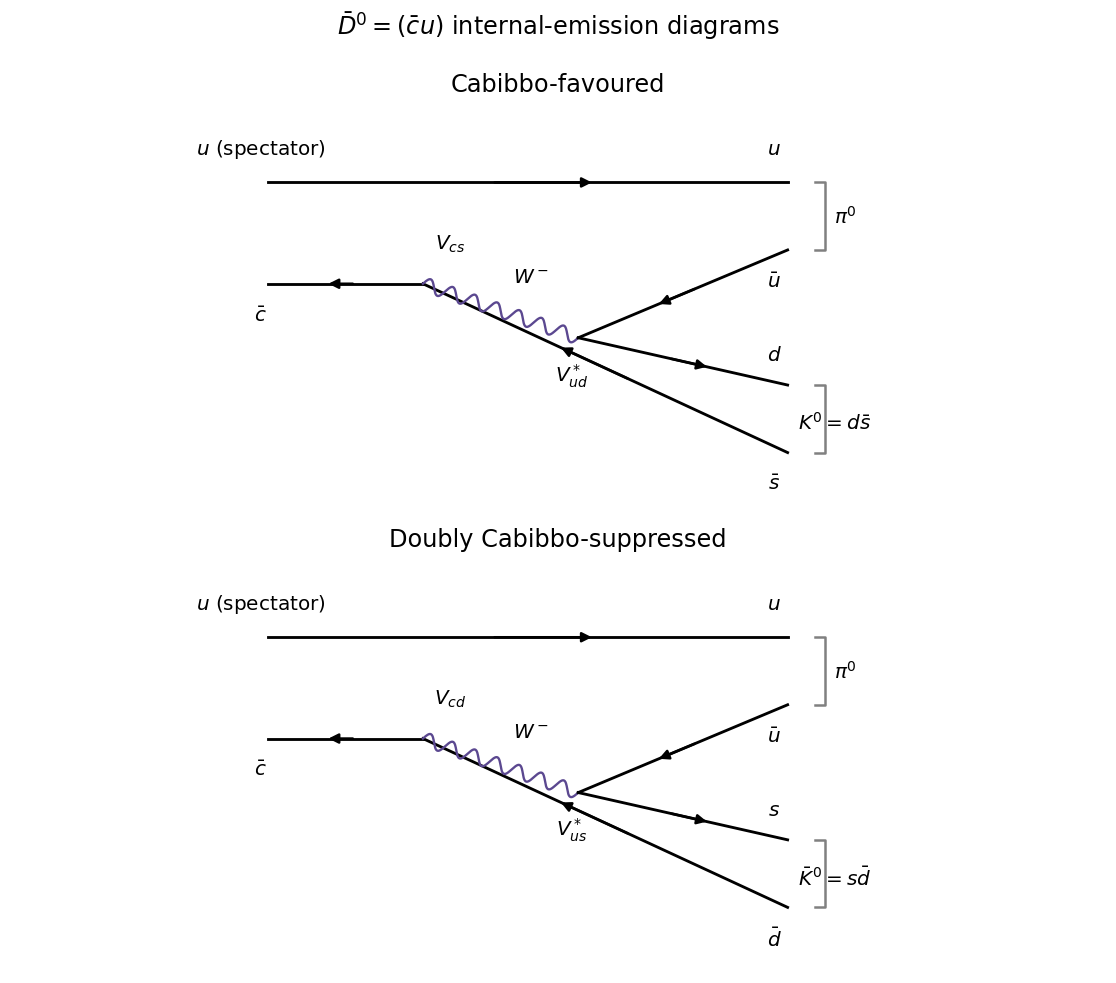

In the two-generation approximation to the CKM matrix, , and . For equal magnitudes of the hadronic matrix elements,The rate ratio is about with the supplied CKM matrix magnitudes. The minus sign of a particular product of CKM matrix elements must be combined with the phases of the hadronic matrix elements and kaon basis states; it is not by itself the observable interference sign.
Choose the exchange-positive CP convention for neutral kaon mixing, . Neglecting CP violation, the kaon CP eigenstates can then be writtenWriting and , projection on these coherent final states givesThis is the convention implicit in the printed sum. Changing the sign convention for the neutral antikaon changes both its coefficient in the kaon CP eigenstates and ; it cannot change either physical decay rate. The extremely small – mass difference can be ignored in the two-body phase space.
Put . Equal two-body phase space gives , so the decay-rate asymmetry is exactlyThe stated magnitude assumption fixes . Retaining the relative strong phase in the convention of b therefore givesA magnitude assumption alone does not determine . For example, has the stipulated magnitude but gives , whereas a real positive gives a positive asymmetry. With the additional aligned-amplitude assumption , conventionally used for this idealised extraction, the intended leading result is . The sign of here refers to the complete amplitude after choosing the kaon phase convention, not to a bare CKM matrix product. A flavour-symmetry relation can supply further information, but is stronger than the printed magnitude assumption.
The long-lived, electrically neutral kaon often traverses the particle detector without decaying into a reconstructable charged final state. Identifying it through a hadronic interaction or missing four-momentum is much less efficient than reconstructing the short-lived kaon through its nearby two-pion decay vertex. The efficiencies must be applied to the observed counts before taking their asymmetry:Using the leading aligned-amplitude approximation from c,The exact aligned formula instead gives , an immaterial correction here. Treating the observed counts as independent Poisson random variables and the efficiencies as known, propagation of uncertainty givesThe separate contributions to are and ; the small sample dominates. Linear propagation of uncertainty yields , although the nonlinear extraction and physical boundary make a symmetric confidence interval a rough summary. Unknown efficiency uncertainties, especially that of , would be additional systematic contributions.
The supplied CKM matrix gives , hence and . The asymmetry difference is only about statistical standard deviations, so the measurement is compatible. Without the phase assumption, these data measure to leading order and do not uniquely measure the Cabibbo angle.
Articles by others on the same topic
There are currently no matching articles.