Let and introduceDeform the contour upward to the steepest descent contour from zero and the endpoint path from . More precisely the original integral is the first path traversed forward minus the endpoint path traversed forward. Connect the truncated paths where and let . That connector has exponentially small factor , and no pole of is crossed: all its poles are real and outside the original segment.
On the endpoint path , and . Its negative orientation gives the leading endpoint termTaking real parts and inserting givesThe oscillatory first coefficient can vanish at particular values of ; the stated remainder still holds as an additive asymptotic expansion.
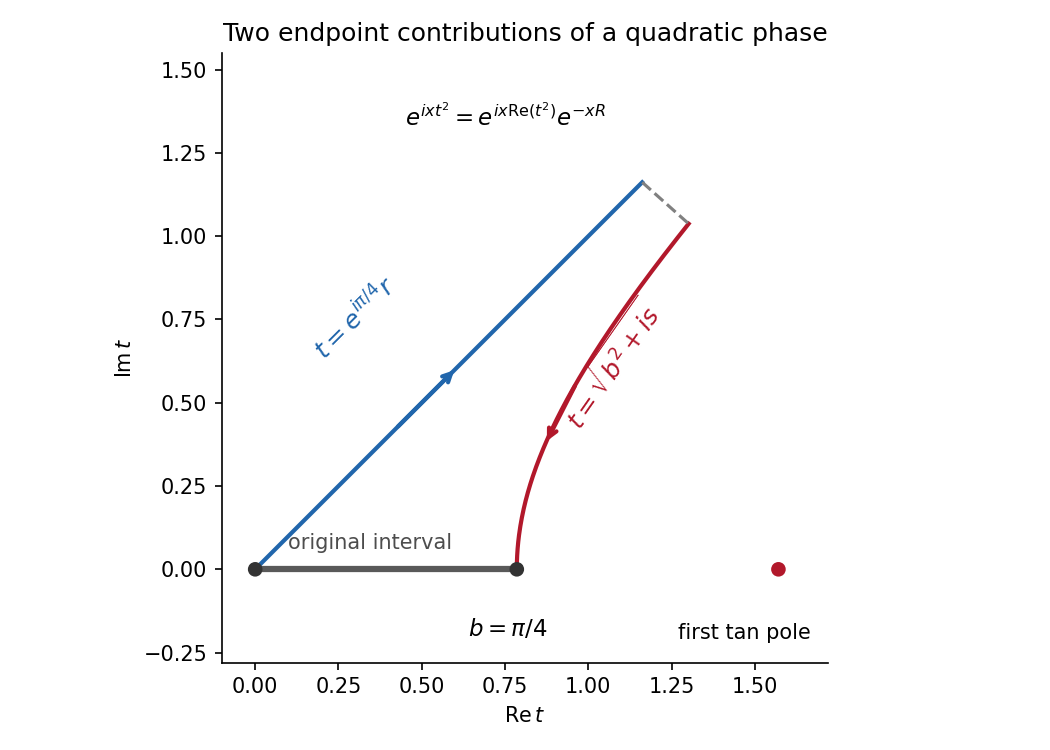
The quadratic phase descends from the stationary endpoint and from the nonstationary upper endpoint
. Details. 
The only nondegenerate stationary point of a phase of the phase is the endpoint zero. Its usual leading stationary phase method term is proportional to the amplitude there, but . Thus the nominal stationary contribution vanishes.
Expand one order further in the local amplitude: . The rescaling then gives a first nonzero stationary contribution of order , with coefficient in the real integral, as in part (i). Meanwhile the upper endpoint is nonstationary and has nonzero amplitude; its integration by parts contribution is , of order .
Consequently the nonstationary endpoint dominates the first nonzero saddle contribution. A stationary phase method formula retaining only the usual leading saddle term would miss the answer. The full stationary phase method, with the vanishing-amplitude correction and the endpoint term, agrees with method of steepest descent. This is quadratic stationary endpoint with quadratically vanishing amplitude.
Articles by others on the same topic
There are currently no matching articles.