The compact phase sectors arise because the angle is compact, . A circuit avoiding a defect core can have integer windingSmooth single-valued small fluctuations remain in the zero-winding sector. Vortices with cannot be unwound without a core or a boundary crossing; the smooth Gaussian theory misses those sectors. For outside a core of radius ,The positional entropy of a freely placed defect is approximately . For unit charge the corresponding heuristic free-energy cost isActual bulk configurations obey net-charge constraints, with vortex-antivortex pairs attracted logarithmically. At low temperature they remain bound; they renormalize the phase stiffness but do not screen away the algebraic correlations. Heating can unbind the pairs into a screening vortex plasma with short-range correlations: this is the Berezinskii–Kosterlitz–Thouless transition.
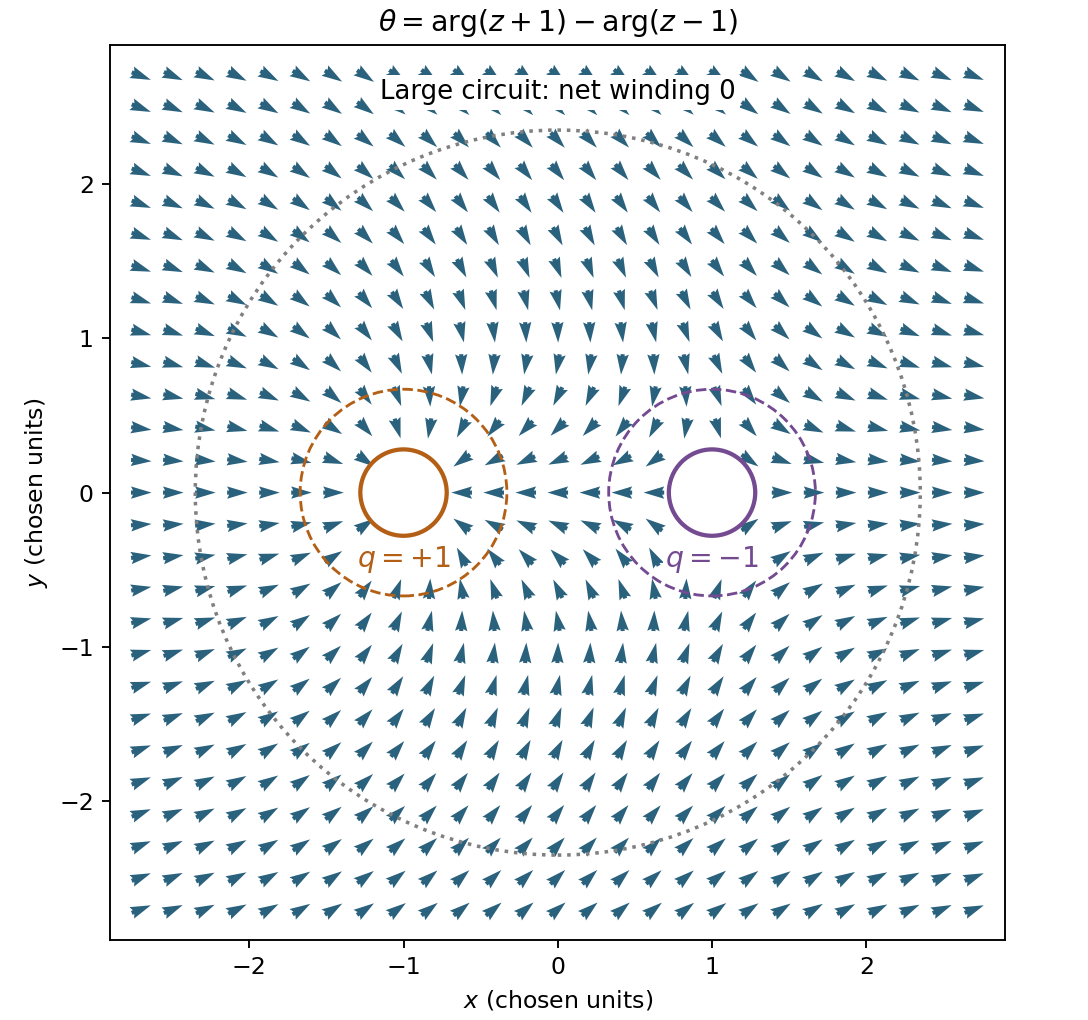
Compact phase with opposite winding
. Original constructed XY orientation field theta=arg(z+1)-arg(z-1), with unit positive and negative winding about the two excluded cores. Arrows show magnetization orientation, not fluid velocity; a circuit around both cores has zero net winding. Details.
The sharp criterion uses the long-distance renormalized stiffness , not a bare coefficient: , giving algebraic exponent . Both phases have zero conventional spontaneous magnetization at positive temperature; they differ in vortex binding, correlations and stiffness.[ref]
Articles by others on the same topic
There are currently no matching articles.