Spontaneous symmetry breaking means that a pure thermodynamic phase is less symmetric than the Hamiltonian even when the selecting external field is removed. For example,The direction of the infinitesimal field is held fixed in this limit. Reversing the limits in a finite symmetric sample normally gives zero. For the XY model, an ordered state chooses one direction from a circle of energetically equivalent directions.
A Goldstone mode is a long-wavelength fluctuation along this continuously degenerate family. A uniform angle rotation costs no energy; a slowly varying one costs only gradient energy. In the stated static phase-only model the quadratic kernel is , tending to zero as . There is one independent soft order-parameter phase coordinate for broken rotation. The static Hamiltonian does not specify a dynamical dispersion ; that requires a dynamical law. Magnitude fluctuations instead have a restoring local curvature and have been excluded from this low-energy model.
For an infrared-regulated phase covariance, fix the uniform order-parameter phase zero mode and introduce ultraviolet and infrared cutoffs before taking limits. With the Fourier conventionthe dimensionless quadratic Hamiltonian diagonalizes asCompleting the square with a source gives , with inverse kernelThere is no additional factor: it is already included in because the supplied Hamiltonian is .
It is simplest to evaluate the real-space dependence by its defining Green equation, . Rotational invariance gives constant for . Integrating over a small sphere fixes , where . Integrating once more,In two dimensions, take the limit after absorbing the divergent -independent piece into :For , itself has an infrared-divergent constant in the infinite system; it is not a finite thermodynamic covariance without a regulator. The physical phase-difference variance is finite at fixed separation and cancels that constant. These are smooth spin wave correlations; compact-field vortex sectors are considered separately below.
The magnetization correlator is an average of a phase difference, not merely its lowest Taylor expansion. Gaussian phase averaging giveswhereThe coincident value is ultraviolet-regularized at a microscopic scale . At large :
- For , the infrared integral for converges. Choosing , , so within the low-temperature spin wave thermodynamic phase.
- For , , hence .
- For , the leading growth is , hence . In particular , , gives .
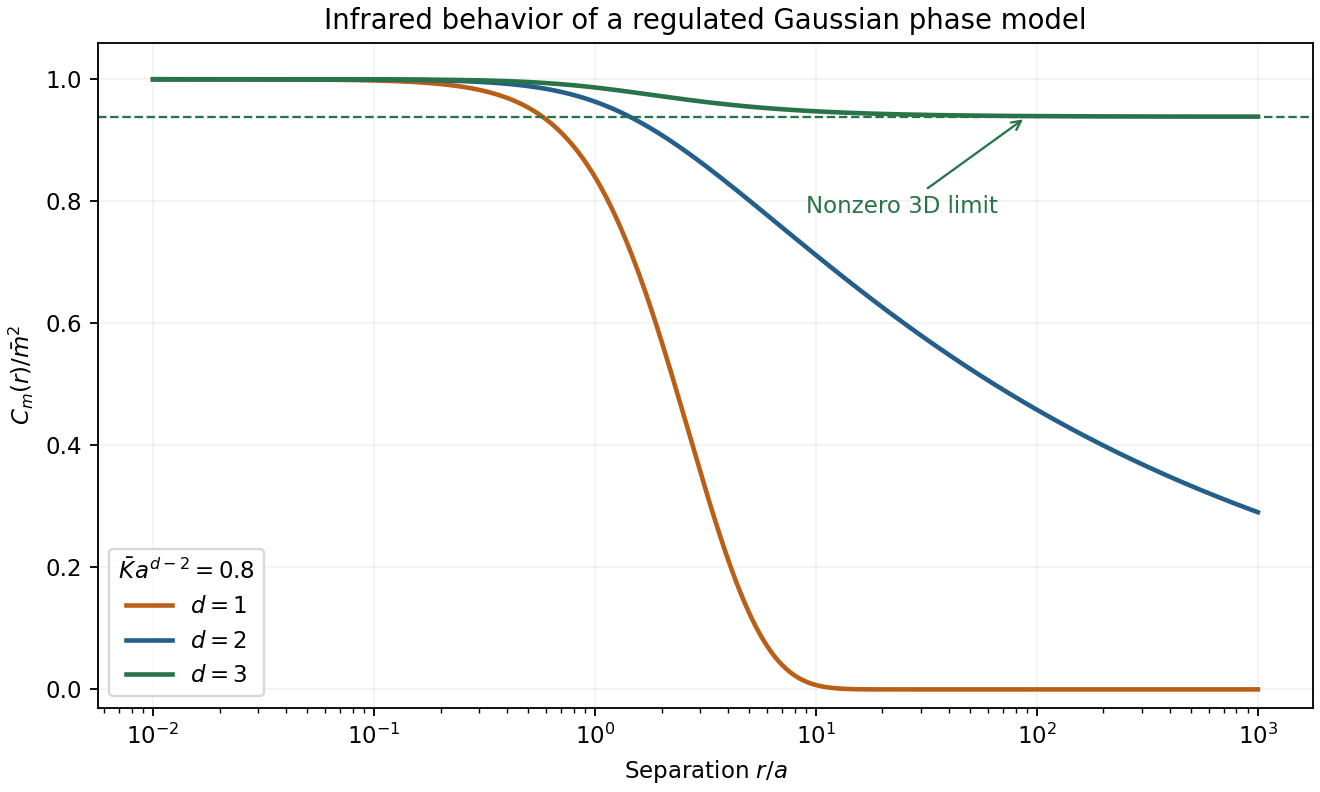

Thus two is the lower critical dimension for conventional positive-temperature continuous-symmetry order under the short-range assumptions. Two dimensions can still have quasi-long-range order and a thermodynamic transition; zero limiting magnetization does not forbid them. The spin wave result describes an admissible low-temperature ordered thermodynamic phase, not order at arbitrarily high temperature. The Mermin-Wagner theorem supplies the more general no-order statement below or at two dimensions.[ref]
Statistical Field Theory by David Tong. §4.2.3: infrared phase fluctuations and continuous-symmetry order
The compact phase sectors arise because the angle is compact, . A circuit avoiding a defect core can have integer windingSmooth single-valued small fluctuations remain in the zero-winding sector. Vortices with cannot be unwound without a core or a boundary crossing; the smooth Gaussian theory misses those sectors. For outside a core of radius ,The positional entropy of a freely placed defect is approximately . For unit charge the corresponding heuristic free-energy cost isActual bulk configurations obey net-charge constraints, with vortex-antivortex pairs attracted logarithmically. At low temperature they remain bound; they renormalize the phase stiffness but do not screen away the algebraic correlations. Heating can unbind the pairs into a screening vortex plasma with short-range correlations: this is the Berezinskii–Kosterlitz–Thouless transition.
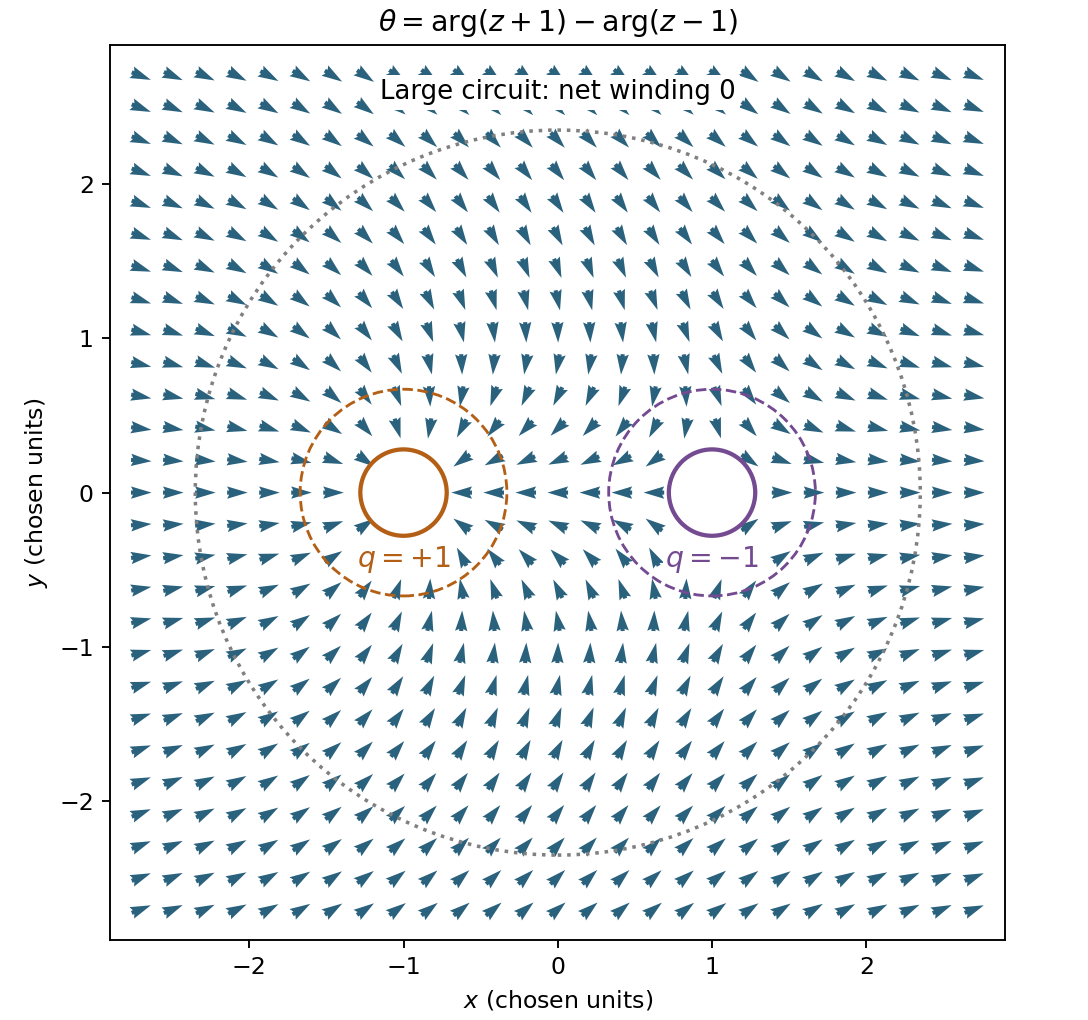
Compact phase with opposite winding
. Original constructed XY orientation field theta=arg(z+1)-arg(z-1), with unit positive and negative winding about the two excluded cores. Arrows show magnetization orientation, not fluid velocity; a circuit around both cores has zero net winding. Details.
The sharp criterion uses the long-distance renormalized stiffness , not a bare coefficient: , giving algebraic exponent . Both phases have zero conventional spontaneous magnetization at positive temperature; they differ in vortex binding, correlations and stiffness.[ref]
Articles by others on the same topic
There are currently no matching articles.