Bayes' theorem solves a precise part of the scientific confirmation problem: it gives a coherent relation between prior commitments, evidential likelihoods and updated probabilities. It does not select those commitments from no premises, and it should not be identified with every meaning of confirmation.
For background information , a hypothesis and newly considered evidence , let , and . With a positive denominator,The first formula requires a positive denominator; the odds formula additionally assumes and . The second equation separates prior odds from the Bayes factor. For , the evidence raises the probability of exactly when . It is not enough that is likely under ; it must be more likely than under the relevant alternative mixture. This guards against an inverse-probability error in evaluating scientific tests.
For example, let the prior be 0.01 and the two likelihoods be 0.8 and 0.08. The Bayes factor is ten, but the posterior probability is only . The evidence strongly favours relative to its previous odds without making probable in an absolute sense. Evidence can therefore confirm a hypothesis while leaving a rational investigator doubtful. The comparison also depends on which alternatives are included in and how their probabilities are distributed.
The raven paradox shows another benefit. Logically equivalent claims receive identical probabilities in the same probabilistic model, but this does not force every investigation of a white object to provide the same evidence about ravens. If an object is selected because it is already known to be a shoe, observing that it is not a raven may have equal likelihood under the rival hypotheses and provide a Bayes factor of one. Random selection from a specified population can give different likelihoods. The sampling procedure and background information must be represented, rather than letting a grammatical positive-instance rule determine evidential support.[ref]
Studies in the Logic of Confirmation I by Carl Hempel. Section 5: equivalence and the paradox of positive-instance confirmation
[ref]How Bayesian Confirmation Theory Handles the Paradox of the Ravens by Branden Fitelson and James Hawthorne. Analysis of dependence on background knowledge, sampling assumptions and alternative hypotheses
The problem of old evidence is a genuine limit of the simplest updating account. If already belongs to , conditioning on it again produces no increase. Yet an old measurement can be important support for a newly formulated theory. One may assess support relative to a specified earlier or counterfactual background, or model learning a previously unrecognized connection between theory and evidence. These are substantive additions. Simply applying the same conditioning rule to an already certain fact does not represent the new intellectual achievement.[ref]
Why I Am Not a Bayesian by Clark Glymour. Chapter 3 of Theory and Evidence: old evidence and newly considered theory
Other limitations concern model construction and priors. A hypothesis assigned zero prior probability remains at zero after ordinary conditioning on evidence of positive total probability. A badly specified likelihood can generate confident but unreliable results. Different reasonable priors need not disappear under finite or non-discriminating evidence. Nor does the theorem supply a noncircular solution to the problem of induction: the model's connection to future physical events remains an empirical commitment.
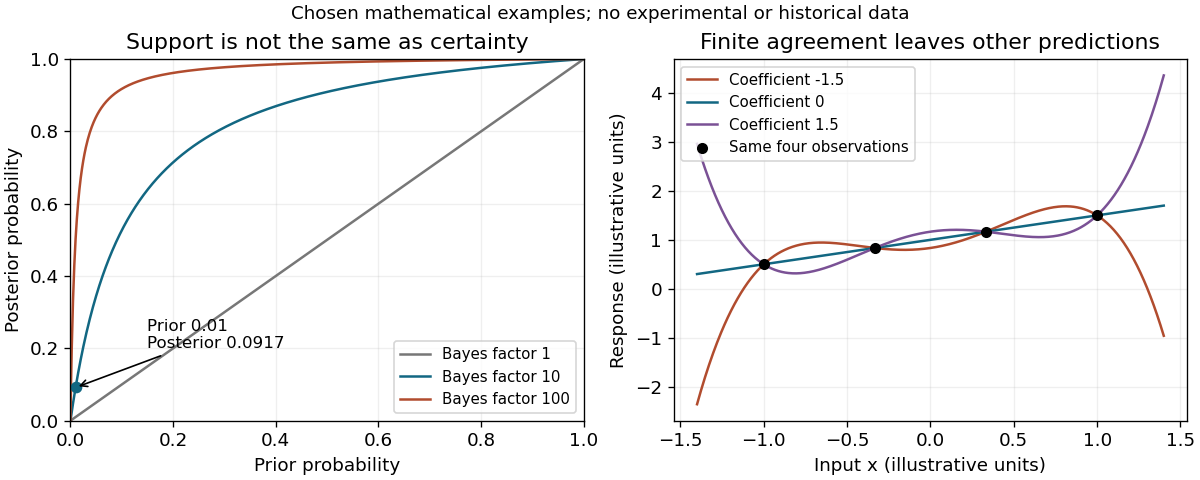
Posterior probability depends on prior odds, while finite observations leave alternative continuations
. Original mathematical illustrations with explicitly chosen probabilities and functions, not historical or experimental data. Details.
Thus the Bayesian framework gives a rigorous account of probability change, comparison of alternatives and some apparent paradoxes. These are real achievements. It is incomplete as a general recipe for scientific judgment unless the hypotheses, backgrounds, likelihoods and forms of learning are also defended. A mathematical rule of coherent updating can organize evidential reasoning without establishing that every coherent input represents nature correctly.
Articles by others on the same topic
There are currently no matching articles.