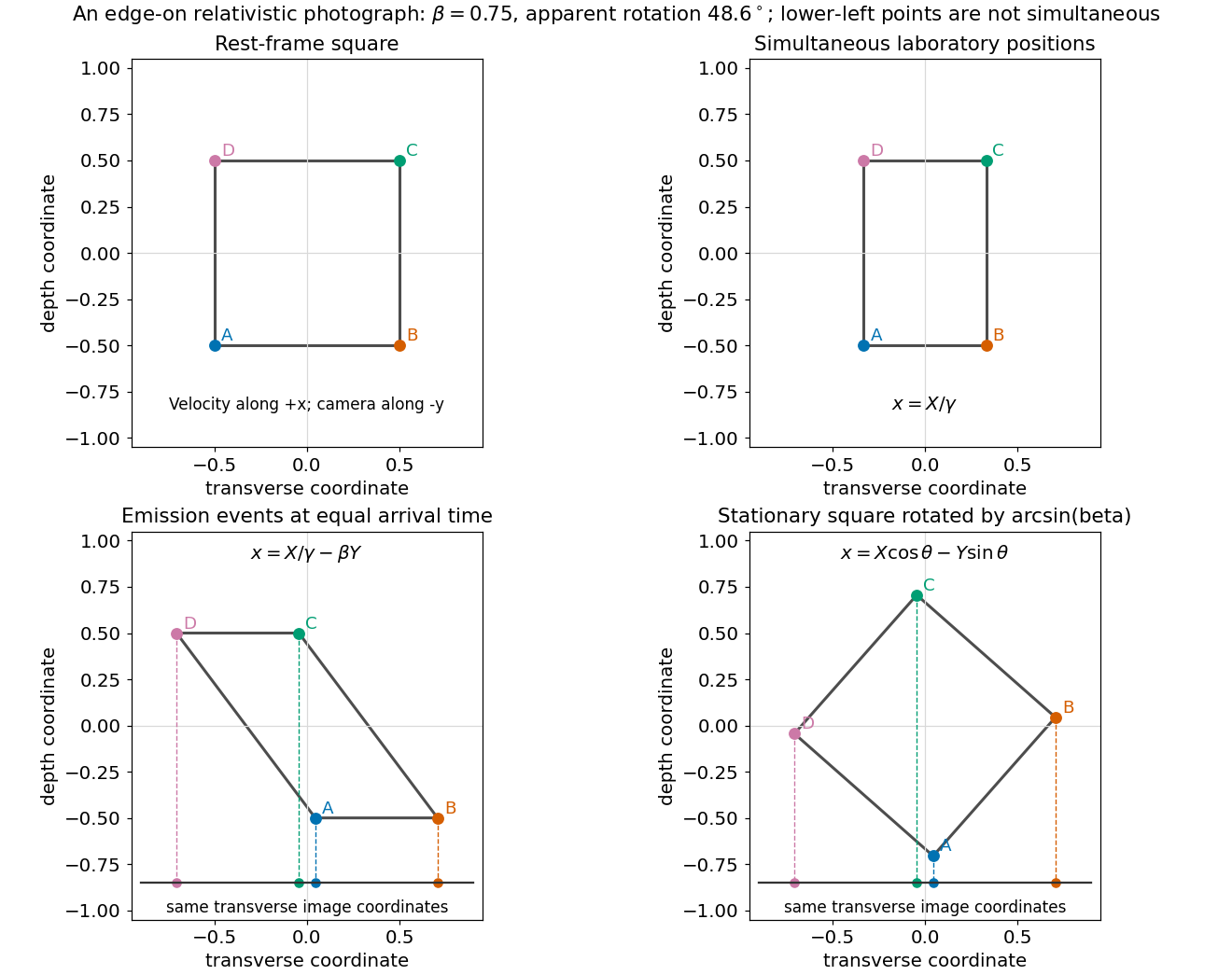
For a Lorentz boost along , the Lorentz transformation isTo calculate a photograph, compare photons that arrive together, which were generally emitted at different times. Put the lamina in the plane, moving along , and take the distant camera to lie along negative . Let be a material point's coordinates in the lamina's rest frame. At a laboratory time , its position satisfies , .
The distant-camera approximation makes the variable part of the light travel time . Equal arrival time therefore requires . Choose that constant to be zero. The point's photographed transverse coordinate becomesA stationary lamina rotated in its plane by would instead have the projected coordinate . The two projections agree whenThis is Terrell rotation. The shape defined by simultaneous laboratory positions still has length contraction; the photographic rotation comes from combining that contraction with unequal emission times. Reversing the viewing or motion direction reverses the apparent rotation's sign.

Articles by others on the same topic
There are currently no matching articles.