Take horizontal motion towards the second projectile as positive. In projectile motion, both bodies have the same downward gravitational acceleration, so it cancels from their relative motion. Their coordinates areFor a collision at , equality of the horizontal coordinates requires . Equality of the heights then requires . HenceThe upward solution requires . A collision strictly above the ground further requires , or . The horizontal target distance does not independently affect the interception geometry. If the first shot is also required to hit that ground target, its parameters satisfy .
The centre-of-momentum frame is an inertial frame in which the system's total momentum is zero. For nonrelativistic particles with total mass and total momentum , it moves with velocity relative to the original frame.
Under a Galilean boost by a constant velocity , the total kinetic energy transforms asFor an isolated collision, momentum conservation gives , and nonrelativistic mass conservation gives . ThereforeAn elastic collision with in one inertial frame has in every inertial frame. Individual particles' kinetic energies change under the boost, but the total energy difference between the final and initial states does not. This is the Galilean invariance of collision elasticity.
In the frame following the turn, the outward inertial force acts at height and tends to unload the inner rail. The two upward normal forces satisfyThe second equation is moment balance about the midpoint between the rails. ThusFull contact requires a nonnegative inner normal force. Its limiting value is zero, giving the toppling speed on level railsFor strictly positive contact force on both rails, . This ideal result assumes level rails, negligible suspension motion and enough lateral contact force to follow the curve; lateral sliding could impose a different limit.
Let be the constant rearward rocket exhaust speed, and let denote the rocket's instantaneous mass. Apply momentum conservation over a short ejection interval: the remaining rocket gains , while the expelled positive mass carries backward relative momentum . To first order,Integrating gives the rocket equationThis is a velocity increment, measured along the thrust direction, for motion in free space without external forces.
For the two-stage vehicle, take and to be the initial masses of the respective stages, each including its fuel . The first burn changes the total mass from to . Discarding the empty first-stage shell of mass leaves mass ; ideal jettison without a relative impulse does not change the velocity. The second burn then changes to . Adding the two rocket equation increments givesHere and leave positive dry masses. Different stage exhaust speeds would multiply their respective logarithms. A multistage rocket gains its advantage by avoiding acceleration of the spent first-stage shell during the second burn.
Choose the cylinder's velocity to be , and the ball's laboratory velocity to be . By Galilean velocity addition, the ball's velocity relative to the cylinder isFor a suitably centred entry without hitting a wall, the cylinder's axis must be parallel to this relative velocity. Its oriented angle to the cylinder's direction of travel is thereforeEquivalently, , with the quadrant chosen from the two components. For ,Thus the extra tilt relative to the ball's original direction is approximately . The use of also covers nearly transverse incidence, where taking an unqualified inverse tangent could select the wrong axis direction.
Let describe the direction towards the star, measured from the Earth's positive direction of motion. The arriving photon propagates in the opposite direction, so in the stellar frame its four-momentum hasA Lorentz transformation into the Earth's frame, moving at along , givesThe observed stellar bearing is opposite to the transformed photon momentum. Since a photon satisfies ,This is relativistic aberration. For small , : stellar directions shift towards the direction of the observer's motion. Keeping the distinction between stellar bearing and photon propagation direction explains the plus signs.
For a Lorentz boost along , the Lorentz transformation isTo calculate a photograph, compare photons that arrive together, which were generally emitted at different times. Put the lamina in the plane, moving along , and take the distant camera to lie along negative . Let be a material point's coordinates in the lamina's rest frame. At a laboratory time , its position satisfies , .
The distant-camera approximation makes the variable part of the light travel time . Equal arrival time therefore requires . Choose that constant to be zero. The point's photographed transverse coordinate becomesA stationary lamina rotated in its plane by would instead have the projected coordinate . The two projections agree whenThis is Terrell rotation. The shape defined by simultaneous laboratory positions still has length contraction; the photographic rotation comes from combining that contraction with unequal emission times. Reversing the viewing or motion direction reverses the apparent rotation's sign.
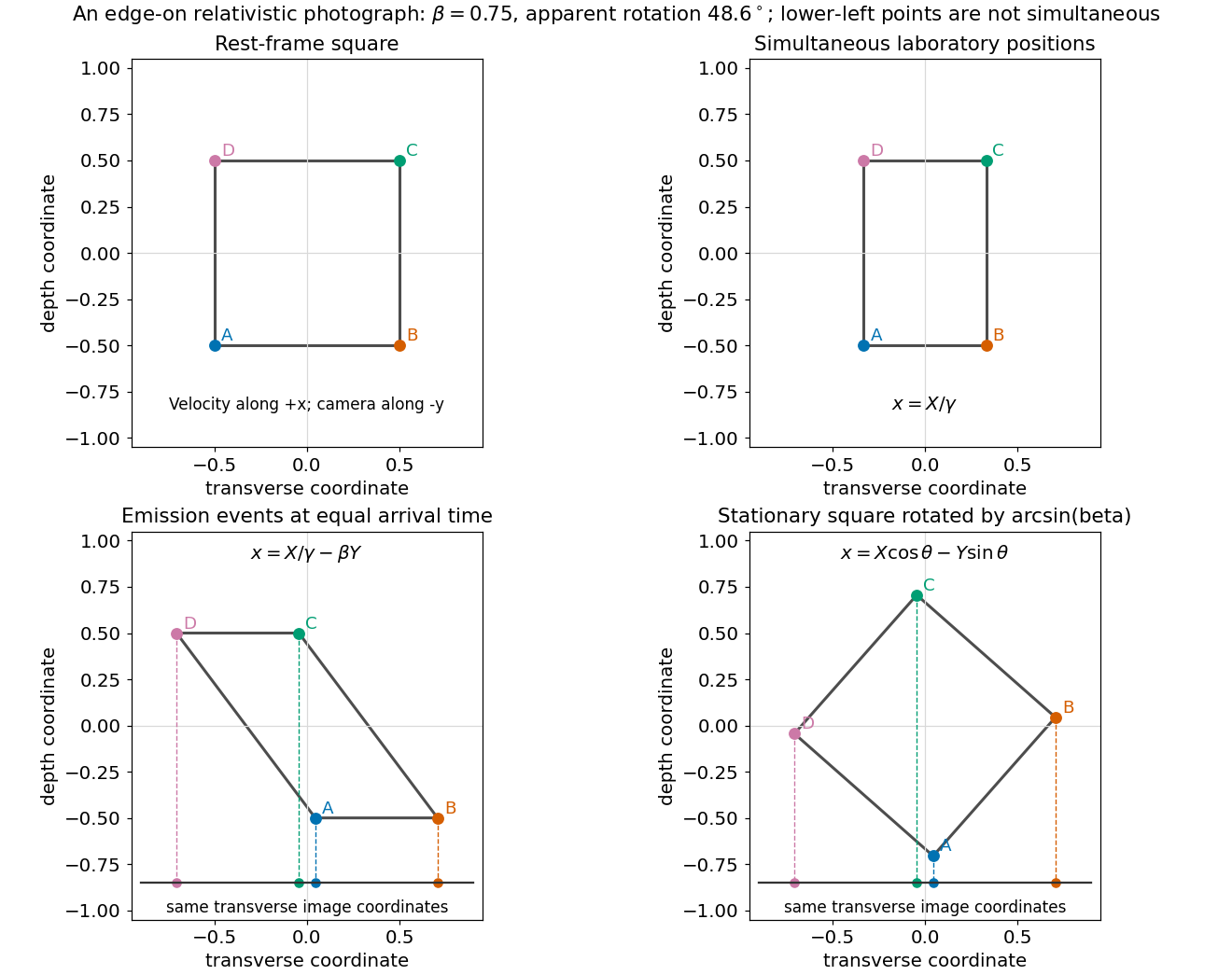
Equal-arrival-time projection of an edge-on lamina agrees with a rotated square, rather than the simultaneous contracted square
. Details. 
The parallel axis theorem gives for parallel axes separated by , with the reference axis through the centre of mass. For a plane lamina, the perpendicular axis theorem gives for mutually perpendicular axes meeting at one point, with in the plane.
Treat the removed material as negative mass. With the hole's centre at , its moment of inertia about is . The remaining moment of inertia and centre of mass areFor a uniform original disk, . Write and measure from the downward equilibrium direction of its centre of mass. The physical pendulum then has LagrangianThe Euler-Lagrange equation is . For small oscillations, , givingNow add the removed small disk on the opposite side, with its centre a distance from so that it is internally tangent to the large disk. The total mass returns to , while its first moment about is . ThusReplacing both the inertia and gravitational restoring moment givesThe same first-moment method applies to a general perforated-disc pendulum. The added disk is attached to the lamina and shares its rotation; treating it as a massless patch or updating only the inertia would omit its restoring torque.
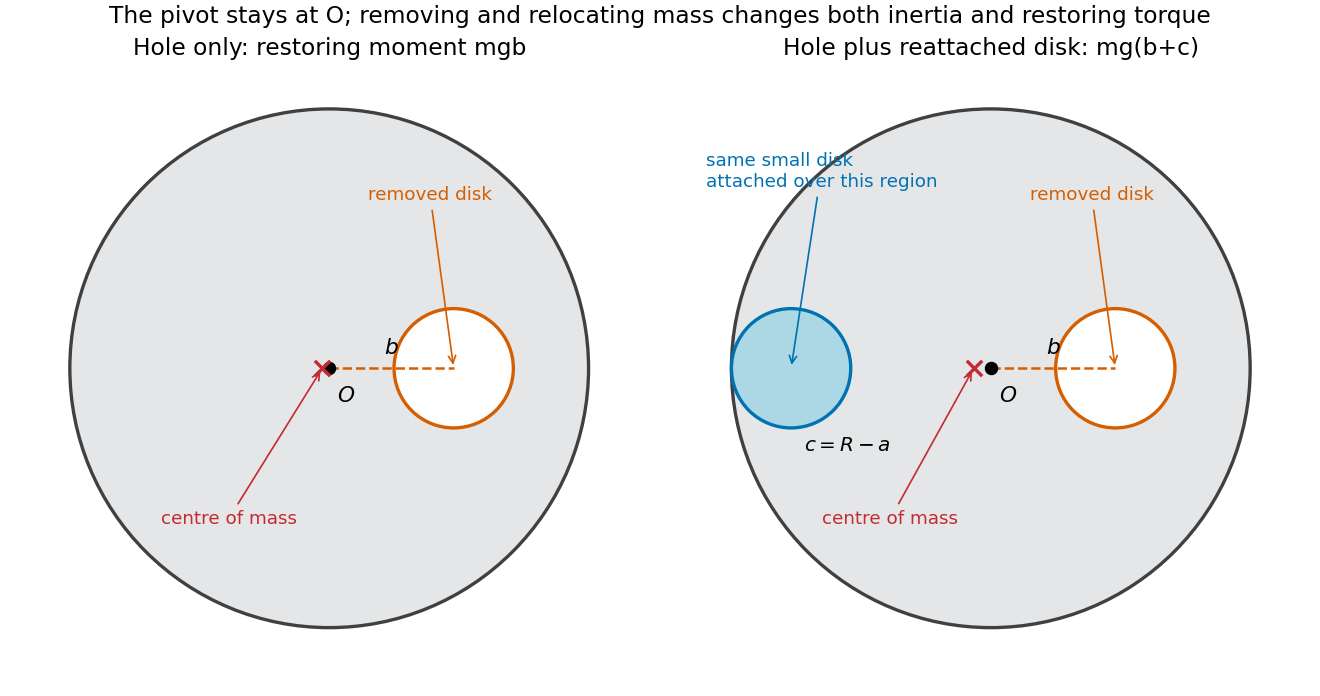
Removing an off-centre disk and reattaching it on the opposite side changes both the pendulum inertia and its centre of mass
. Details. 
Let be the downward displacement of from its initial position just beyond the table edge. The smaller mass moves towards the edge by the same distance, and the hanging chain length is . All the chain and both endpoint masses move at speed , so their total moving mass is . The hanging chain's gravitational potential energy, relative to the initial configuration, is . Thus the Lagrangian for the chain sliding over a table edge isThe Euler-Lagrange equation gives . Put . With , the solution isThese are also the smaller mass's displacement and speed towards the edge. The formula applies until reaches the floor, at . Since , the smaller mass has not yet reached the edge during this interval. As , the result tends to , as expected for a massless connector.
Let the spring's spring constant be , and write its extension as , allowing for an initial extension . The new Lagrangian isThe specified equilibrium is , with . Put ; the equation becomesThe spring-stabilized chain over a table edge oscillates only when . More hanging chain increases its own gravitational pull, reducing the effective restoring stiffness. The equilibrium height alone does not determine without information about the spring's natural length or preload.
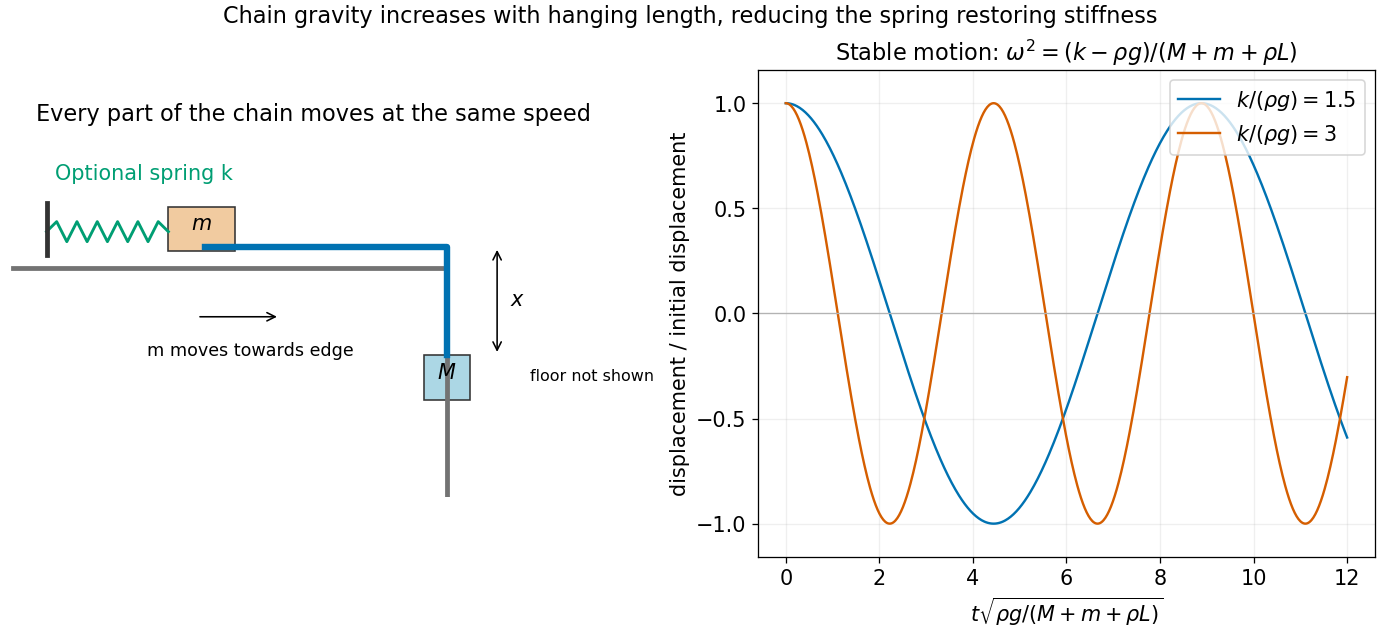
Chain gravity accelerates sliding and subtracts from a spring's restoring stiffness; stable oscillations require k greater than rho g
. Details. 
Put . Balancing Newton's law of universal gravitation with the required centripetal force gives , henceThe circular Kepler orbit is stable against small radial perturbations: its effective radial potential is , and at the circular value , . Here is the conserved angular momentum.
The assumed orbital energy is . At a point a distance from the planet,This is the vis-viva equation. The semi-major axis and radius are measured from the gravitational focus where the planet lies.
For the Hohmann transfer orbit, the inner and outer circular radii are the ellipse's pericentre and apocentre distances, so . The vis-viva equation gives the transfer speed at the inner tangent point,Both old and new velocities are tangential there, so the required first impulse is prograde, with
At the outer tangent point, the vis-viva equation gives . This is below the outer circular Kepler orbit's speed . The second impulse is therefore also prograde:It raises the pericentre to the outer radius, completing the circularization.
In a quasi-circular spiral transfer, a small tangential thrust supplies power while the orbit stays approximately circular. Differentiating and using givesThis is the integrated thrust magnitude per unit constant mass, not the net vector change of orbital velocity.
For comparison, write . Adding the two Hohmann transfer impulses and subtracting the slow-transfer result yieldsThe bracket is negative because for . Thus the Hohmann transfer uses less total impulse than the slow circular spiral for these ideal coplanar transfers. The Hohmann transfer compared with a slow spiral does not establish a global optimum over every possible transfer family or propulsion constraint.
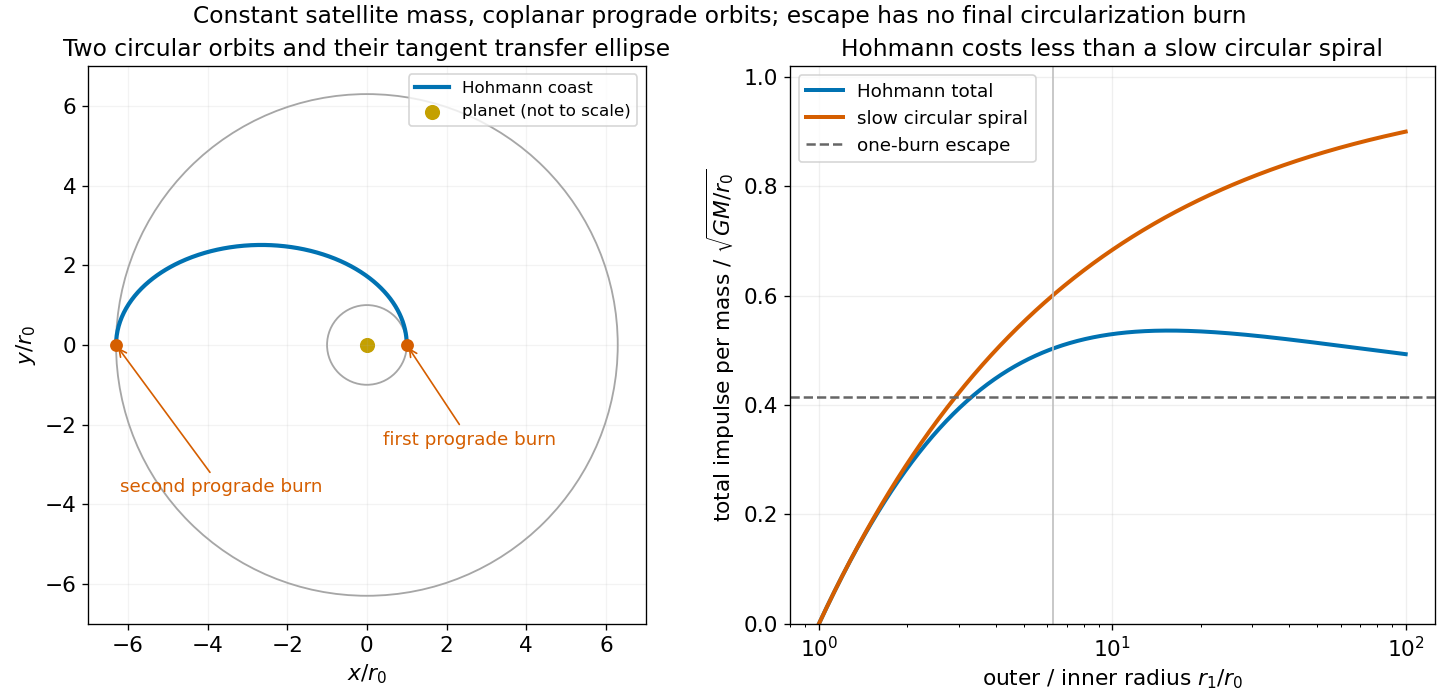
Two tangential Hohmann burns versus an adiabatically slow circular spiral; total impulse is lower for the Hohmann transfer
. Details. 
Use the supplied planet mass , , and adopt mean Earth radius . For a geostationary orbit, use one sidereal day, . The adopted radius and rotation period follow NASA's fact sheet.[ref]
Earth Fact Sheet by National Aeronautics and Space Administration. Bulk parameters: volumetric mean radius6371.000km; orbital parameters: sidereal rotation period23.9345hours
The slightly smaller radius than the usual terrestrial value follows from using the question's smaller Earth mass. For coplanar prograde orbits, the preceding formulas giveThe escape transfer has , so its first tangential burn reaches the local escape speed . No final circularization at infinity is needed:Thus the geostationary transfer requires about more total impulse, or about 22 percent more, despite leaving the spacecraft gravitationally bound. Reaching the outer radius and circularizing there are separate requirements. Changing the starting orbit's inclination would add a plane-change cost absent from this calculation.Write for the electron rest mass and . The incident positron has total energy and satisfies . Adding the target electron's four-momentum, the squared total centre-of-momentum energy isAt the fixed-target production threshold, all three final particles are at rest relative to one another, so . ConsequentlyThis is the positron's total energy, not its kinetic energy. It assumes and addresses kinematic allowance; other selection rules could still forbid a proposed reaction. For and , .
At threshold the three products share the centre-of-momentum frame's laboratory velocity. Their common Lorentz factor and speed areFor the subsequent two-photon decay, each photon has rest-frame energy . A Lorentz transformation of a photon emitted at rest-frame angle to the boost gives . Therefore the kinematically allowed laboratory range isor numericallyThe two photon energies in a single event are correlated: their sum is the parent's laboratory energy . When one attains the upper endpoint, the other attains the lower endpoint. Angular distributions and detector acceptance can affect which part of this range is observed.
Articles by others on the same topic
There are currently no matching articles.