Ignoring edge fields, Gauss's law gives between the parallel plates. Their voltage is , and their charge magnitude is . Therefore
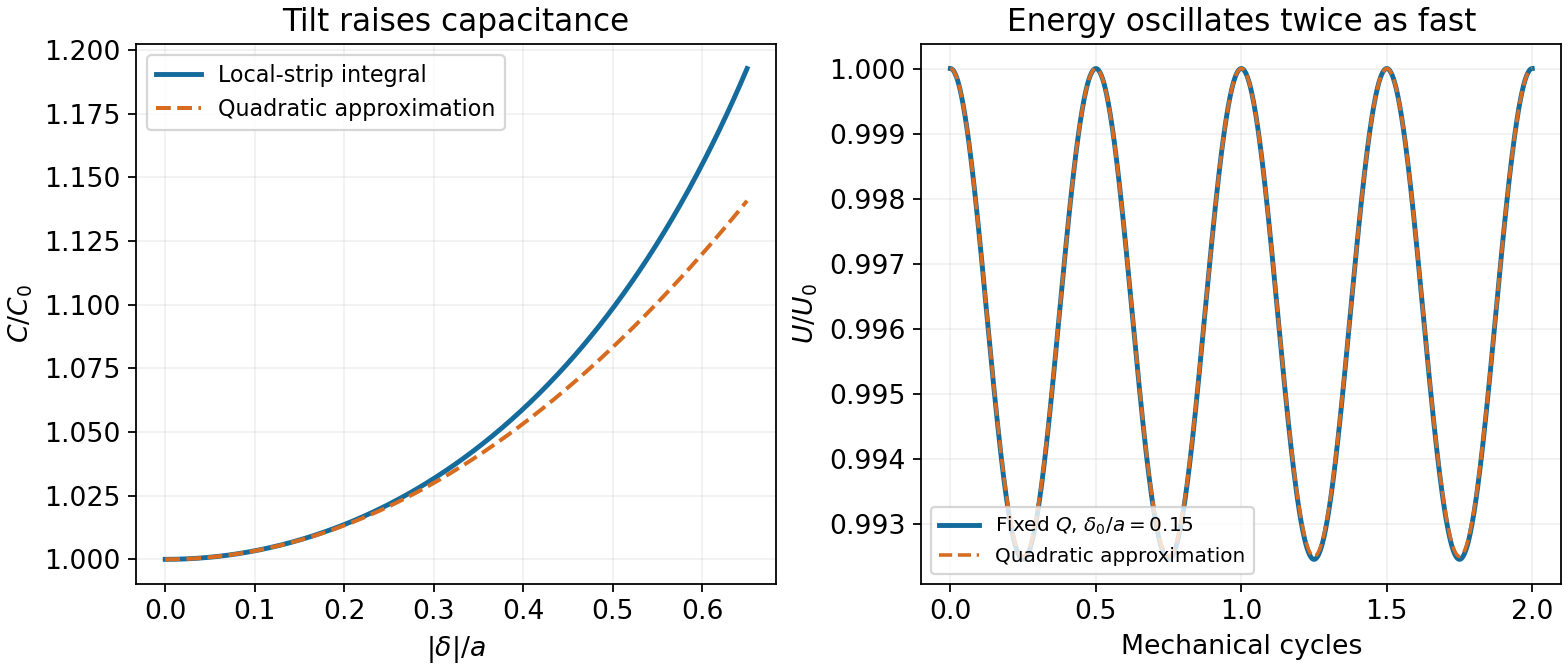
Take along the tilt, with local separation . Since and the tilt is small, each narrow strip is a local parallel-plate capacitor at the same voltage . Its surface charge densities are approximatelyParallel strip capacitances add, so for ,Using givesThe denser charge at the smaller gap explains why tilting increases the capacitance. The local-strip approximation neglects fringing and slope corrections of order , smaller than the retained term.
Isolation fixes charge, not voltage: . The electrostatic energy is therefore . Inverting the small-tilt capacitance givesThe leading variation has frequency , since tilts of opposite sign give the same capacitance. With , the result is to this order. Energy decreases as the gap becomes less uniform at fixed charge; the difference is exchanged mechanically with the oscillator.

Articles by others on the same topic
There are currently no matching articles.