Ground the non-inverting input and take the ideal operational amplifier in stable, unsaturated negative feedback. Its inverting input is a virtual ground and draws no current. Kirchhoff's current law there givesThe minus sign is the phase inversion of the inverting amplifier.
The input source supplies into the virtual ground, so the complete circuit's input resistance is . The ideal output is a zero-resistance controlled voltage source:These are properties of the closed-loop circuit, distinct from the infinite input resistance of the amplifier terminals themselves.
With , the output and input voltage magnitudes are equal. The signal power supplied at the input is , while the load receives . HenceThis is dB of power gain into the specified load. Output energy comes from the amplifier's supply rails; unity voltage-gain magnitude does not imply unity power gain. Dissipation in the feedback resistor is additional to the specified load power.
Replace the feedback resistor by a capacitor , retaining the input resistor . The virtual ground makes the input charge flow onto the feedback capacitor rather than into the ideal amplifier. Integrating its current givesIf the calorimeter delivers for deposited energy , then . A reset establishes the initial output; a practical large resistor across limits long-time drift, but is omitted from the ideal integration interval.
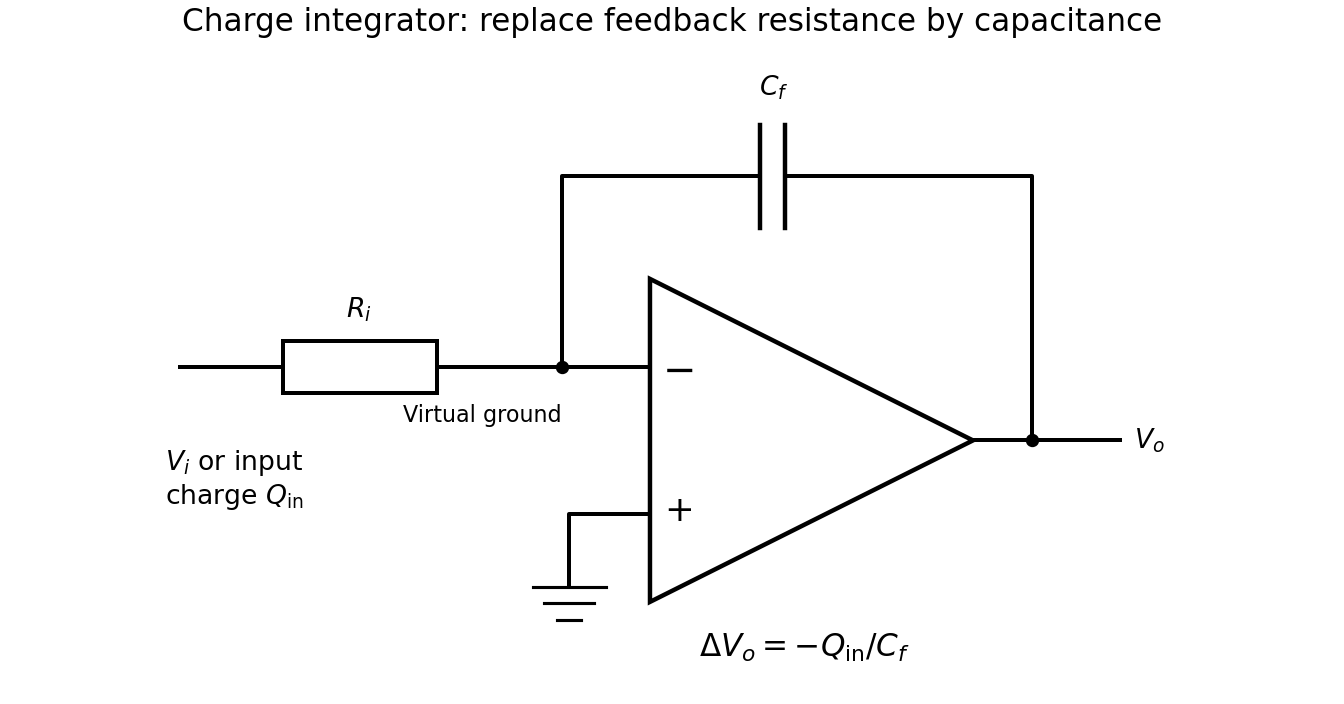

For the modified circuit, and . With ,The sinusoidal component has amplitude and leads the cosine input by ; the constant is set by the initial capacitor charge. This assumes the output remains within the amplifier's linear range.
Articles by others on the same topic
There are currently no matching articles.