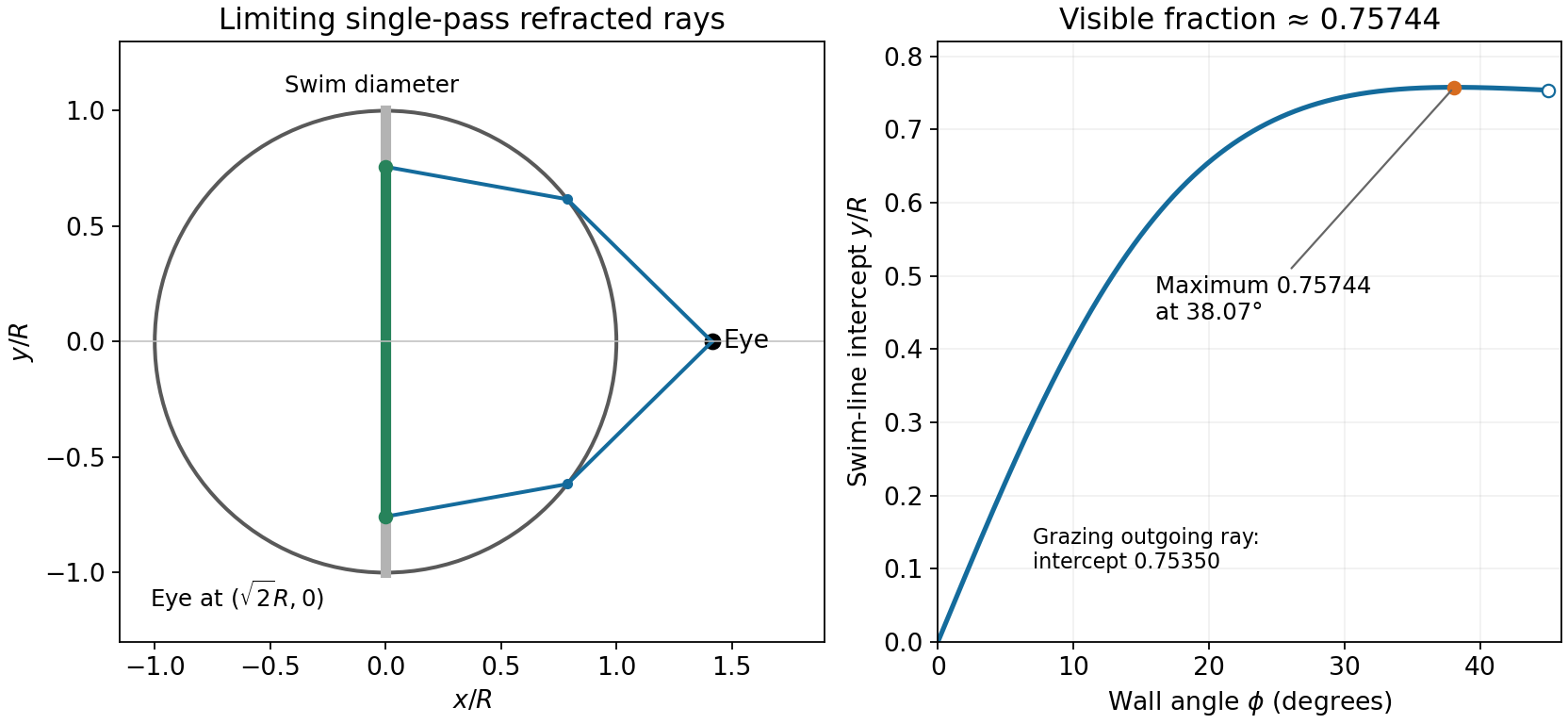
Take a horizontal cross-section in units of . The eye is at , and the tadpole swims along the perpendicular diameter shown in the source. Since glass and water have the same red-light index, their internal interface causes no red-light refraction. Write an exit point on the circular wall as . An unobstructed outward ray to the eye has .
For , let be the magnitude of the emerging ray's angle to the outward normal and its internal angle. Geometry and Snell's law giveThe outgoing internal ray makes angle to . Its backward continuation intersects the swim diameter atThe directly visible positive endpoint is the largest such intercept, including all single-pass refracted rays. Maximizing this one-variable expression gives and . By symmetry the visible length is , soChecking only the grazing exit at gives , a close estimate but a slightly smaller fraction. The exact limiting ray occurs before that grazing ray, where two refracted paths merge at a caustic. This is a geometrical, single-pass visibility boundary; finite pupil size and detection thresholds would smooth the transition.

Articles by others on the same topic
There are currently no matching articles.