Let be the intensity that either narrow slit would produce alone, and let measure screen displacement from the perpendicular bisector. The optical path difference is approximately . Equal coherent field amplitudes then giveThe maxima are at ; the minima are halfway between them. HereThe expression uses the paraxial approximation and neglects the slowly varying single-slit diffraction envelope because the slit widths are unspecified.
The slide adds an optical path length in the covered path. If the covered slit is at positive transverse position, its geometric path to is shorter, giving total path difference . The zero-difference fringe therefore moves toward that slit:This is about fringe periods. The leading grating-angle correction, and , gives mm, consistent with the paraxial result. In a strictly monochromatic periodic pattern, identifying the continuously tracked central order is essential: the final intensity pattern determines displacement only modulo one fringe spacing.
The band has mean wavelength and width . At order , the positions of the extreme-wavelength maxima differ by about . Comparing this spread with a fringe spacing givesEquivalently, the coherence length scale is . Thus the usual bandwidth estimate isThis is a washout scale, not a sharp definition of “clearly”. For a spectrum uniform in inverse wavelength , the interference visibility is , with ; its first zero occurs near order . Fringes well inside that limit have stronger contrast. A half-fringe-smear criterion would instead retain about orders each side. The precise visible number needs the spectral distribution and a contrast threshold, neither supplied. If the slide remains in place and dispersion is neglected, the envelope is centred on the shifted zero-path-difference position and this order-count scale is unchanged.
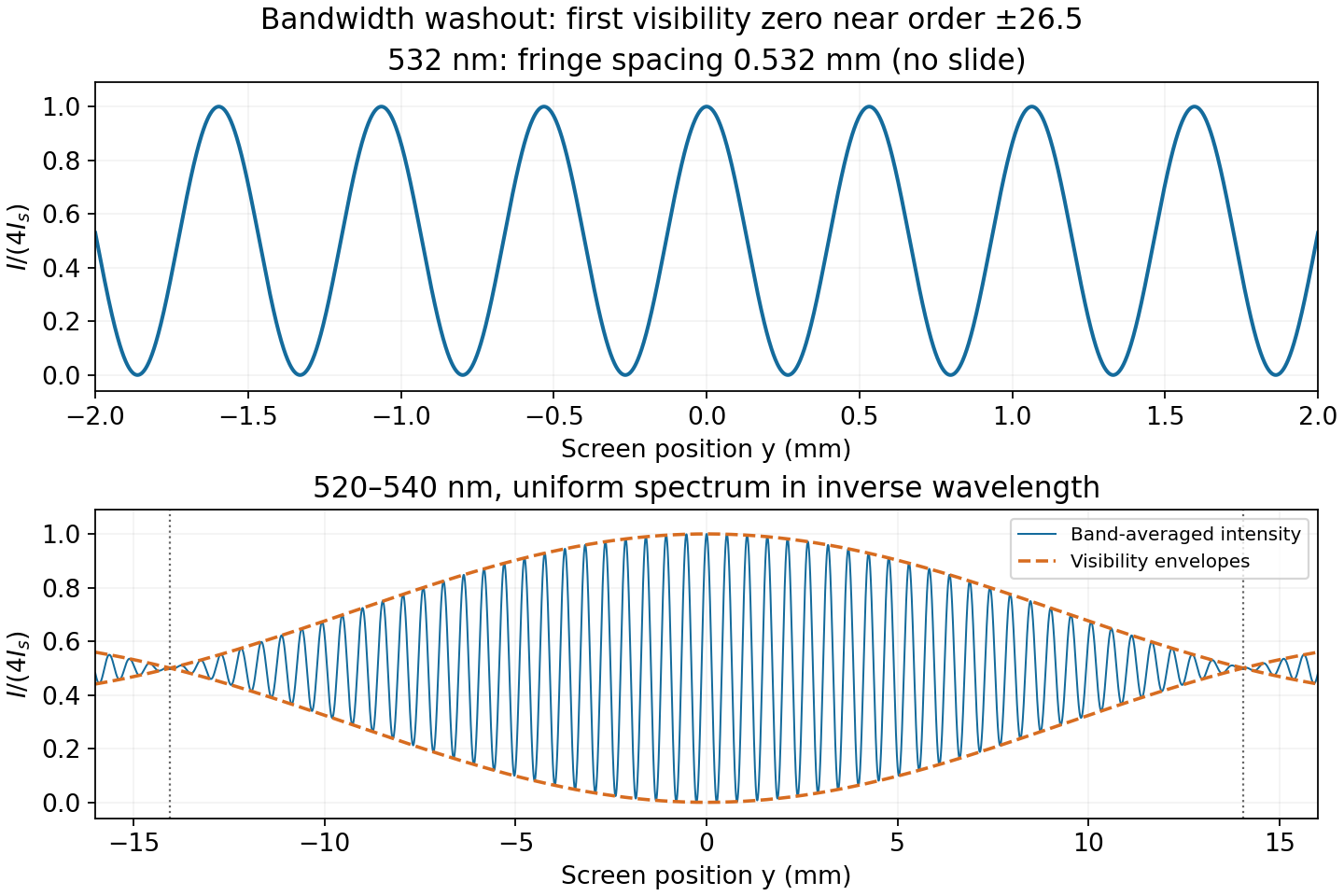
Double-slit fringes and bandwidth-induced loss of contrast
. The band example assumes equal spectral intensity per unit inverse wavelength from 520 to 540 nm. Dashed envelopes show the visibility decline and its first zero near 26.5 central-wavelength orders. Details.
Articles by others on the same topic
There are currently no matching articles.