Source paper: Oxford source archive, member
2014/CP2_June_2014.pdf. The dated cover establishes the 10 June 2014 ordinary sitting. All ten questions are treated. Unlettered marked blocks use ordinal subparts; printed letters and Roman numerals are retained.Take the conducting plane as , with the real point charges at and at . The method of images replaces the plane by image charges at and at . This makes the plane an equipotential; the physical field above it is the sum of the real- and image-charge fields. No factor of enters the force on a real charge.
Set and , and use positive from toward , positive upward. The horizontal forces combine the mutual attraction and the force from the other charge's image:For the vertical components, the own-image attractions act downward; each cross-image term acts upward. ThusThese are the electrostatic forces; the external forces holding the charges fixed are their negatives. The smaller positive charge's vertical force need not always point downward, because the other charge's induced surface charge also contributes. The construction assumes the usual ideal large-plane limit with no imposed background field.
Faraday's law states that the induced electromotive force equals minus the rate of change of linked magnetic flux:The minus sign expresses Lenz's law: the induced electric current acts to oppose the change in magnetic flux. For a fixed contour this is equivalent to .
The loop area is . Integrating Ohm's law and Faraday's law through the whole decay givesThereforeThe switching time cancels: a faster linear flux decay produces a larger electric current for a proportionally shorter interval. If the coil's self-inductance is retained, integrating gives zero provided the initial and final currents vanish and the stated total charge includes the decay tail.
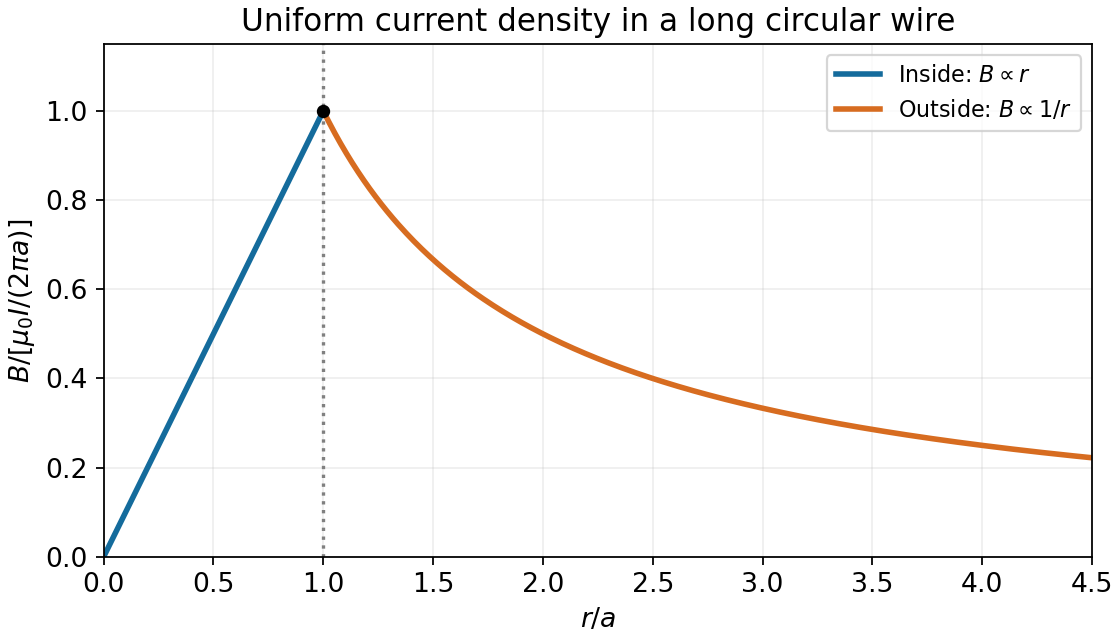
Let the wire radius be , and take its electric current along . Cylindrical symmetry makes the magnetic flux density azimuthal. For a circular Amperian loop of radius , Ampère's law gives . Uniform current density means inside and outside. ConsequentlyIts direction follows the right-hand rule. The magnitude rises linearly from zero to at the surface, is continuous there, and then falls as .

For the intended force-balanced straight-line motion, the Lorentz force vanishes:For a nonzero uniform magnetic field, this implies andwhile a component parallel to is unrestricted. A straight trajectory by itself states only that the force has no transverse component, . For example, parallel electric field and motion can give straight but accelerated motion. The boxed cancellation is the usual constant-velocity interpretation of the source.
After the electric field is removed, the uniform magnetic field preserves the speed. Decompose the instantaneous initial velocity as , with and signed . Thenand, integrating,This is a helical motion in a uniform magnetic field of radius and angular frequency . It is a circle if , and a straight line if . The formula assumes a uniform, nonzero field and nonrelativistic motion.
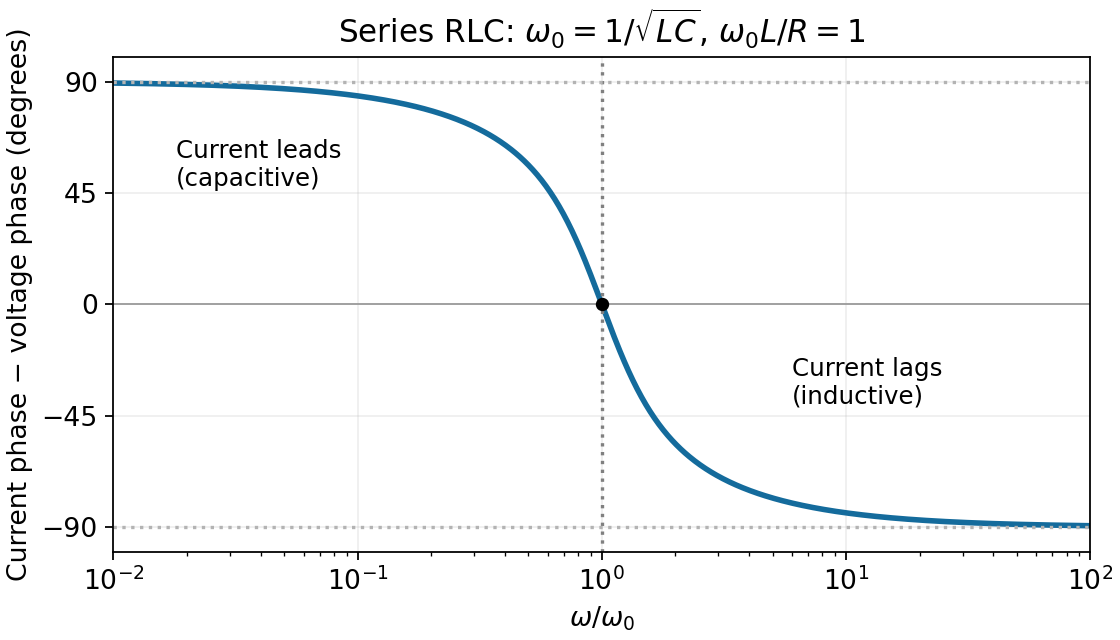
With phasors proportional to , the series RLC circuit hasFor fixed and frequency-independent positive , the maximum occurs when the reactances cancel. ThusThis is the driven current resonance; a damped free-oscillation frequency is a different quantity.
Define the phase difference as current phase minus voltage phase. Since ,It decreases continuously from at low frequency, through zero at , to at high frequency. Thus the current leads in the capacitive limit and lags in the inductive limit. Defining voltage phase minus current phase would reverse the graph's sign.

Huygens' principle treats each point of a wavefront as the source of a secondary wavelet. The later wavefront is the common forward envelope of those wavelets. Consider a plane front reaching a flat interface between media with speeds and . In the same interval , the incident front advances while the first transmitted wavelet grows to radius .
The two right triangles sharing the interface segment of length give and , where and are ray angles to the normal. HenceThis is Snell's law. The frequency is unchanged at a stationary interface, while wavelength changes with the propagation speed.
Let be the intensity that either narrow slit would produce alone, and let measure screen displacement from the perpendicular bisector. The optical path difference is approximately . Equal coherent field amplitudes then giveThe maxima are at ; the minima are halfway between them. HereThe expression uses the paraxial approximation and neglects the slowly varying single-slit diffraction envelope because the slit widths are unspecified.
The slide adds an optical path length in the covered path. If the covered slit is at positive transverse position, its geometric path to is shorter, giving total path difference . The zero-difference fringe therefore moves toward that slit:This is about fringe periods. The leading grating-angle correction, and , gives mm, consistent with the paraxial result. In a strictly monochromatic periodic pattern, identifying the continuously tracked central order is essential: the final intensity pattern determines displacement only modulo one fringe spacing.
The band has mean wavelength and width . At order , the positions of the extreme-wavelength maxima differ by about . Comparing this spread with a fringe spacing givesEquivalently, the coherence length scale is . Thus the usual bandwidth estimate isThis is a washout scale, not a sharp definition of “clearly”. For a spectrum uniform in inverse wavelength , the interference visibility is , with ; its first zero occurs near order . Fringes well inside that limit have stronger contrast. A half-fringe-smear criterion would instead retain about orders each side. The precise visible number needs the spectral distribution and a contrast threshold, neither supplied. If the slide remains in place and dispersion is neglected, the envelope is centred on the shifted zero-path-difference position and this order-count scale is unchanged.
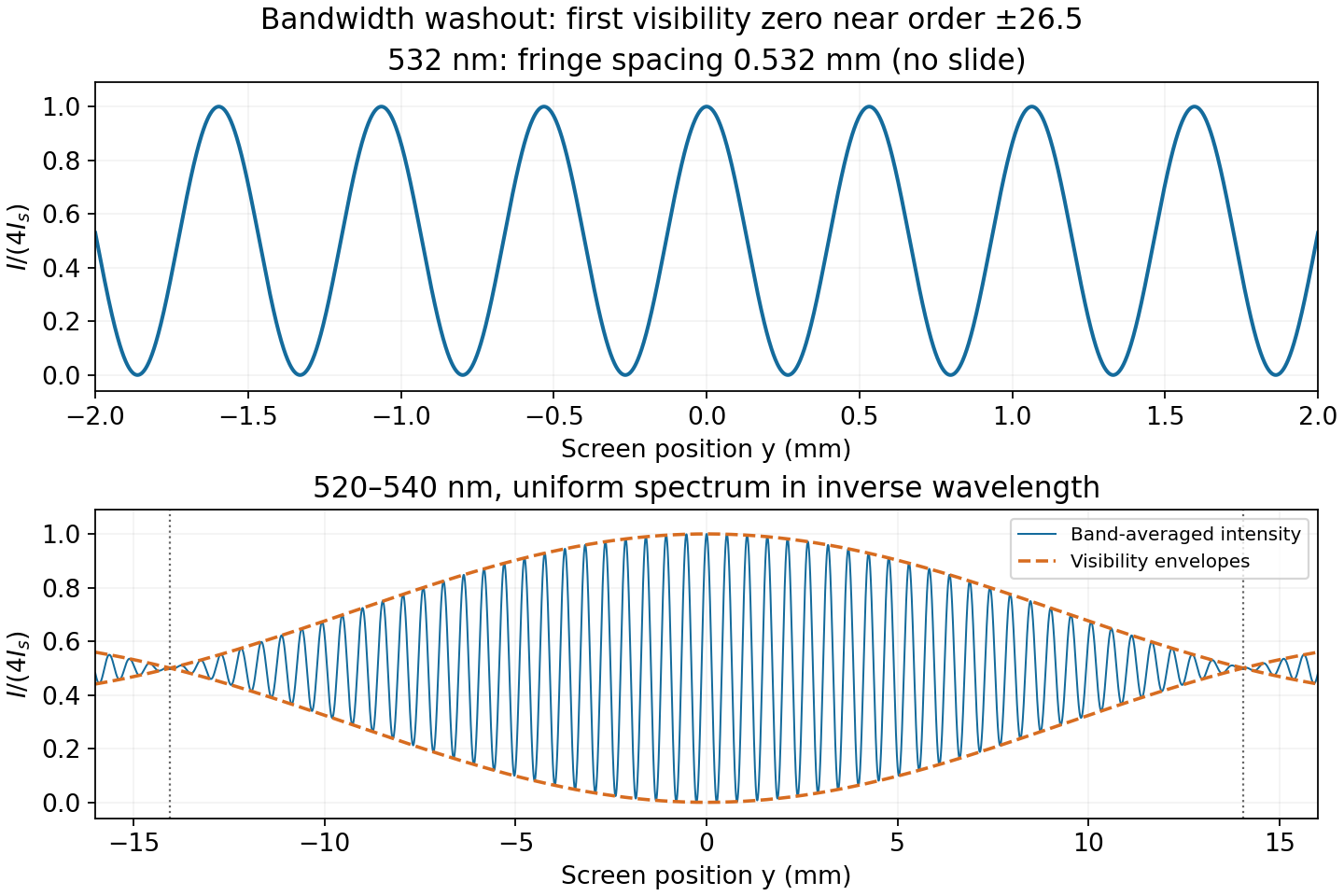
Double-slit fringes and bandwidth-induced loss of contrast
. The band example assumes equal spectral intensity per unit inverse wavelength from 520 to 540 nm. Dashed envelopes show the visibility decline and its first zero near 26.5 central-wavelength orders. Details.
In matter, Gauss's law for free electric charge isThe area normal points out of . In vacuum , so these become and .
Put charges and on the concentric conductors. Gauss's law gives between them, . The potential difference isThe capacitance of this vacuum spherical capacitor is thereforeThe conductors are equipotentials; a uniform dielectric filling would replace by its permittivity.
At the distances from the two centres are equal:By the electrostatic shell theorem, a uniformly charged spherical shell gives zero field inside and its point-charge field outside. For the point is inside both shells. For only the small, negatively charged shell contributes. For both contribute, soThe requested magnitude isIt jumps from zero to at , decreases to just before , jumps down to just after , and then falls as . The ideal surface charge makes the field discontinuous at each crossing, so the one-sided limits, rather than a unique value on the sheet, specify the graph. The far field is the equatorial field of an electric dipole with electric dipole moment .
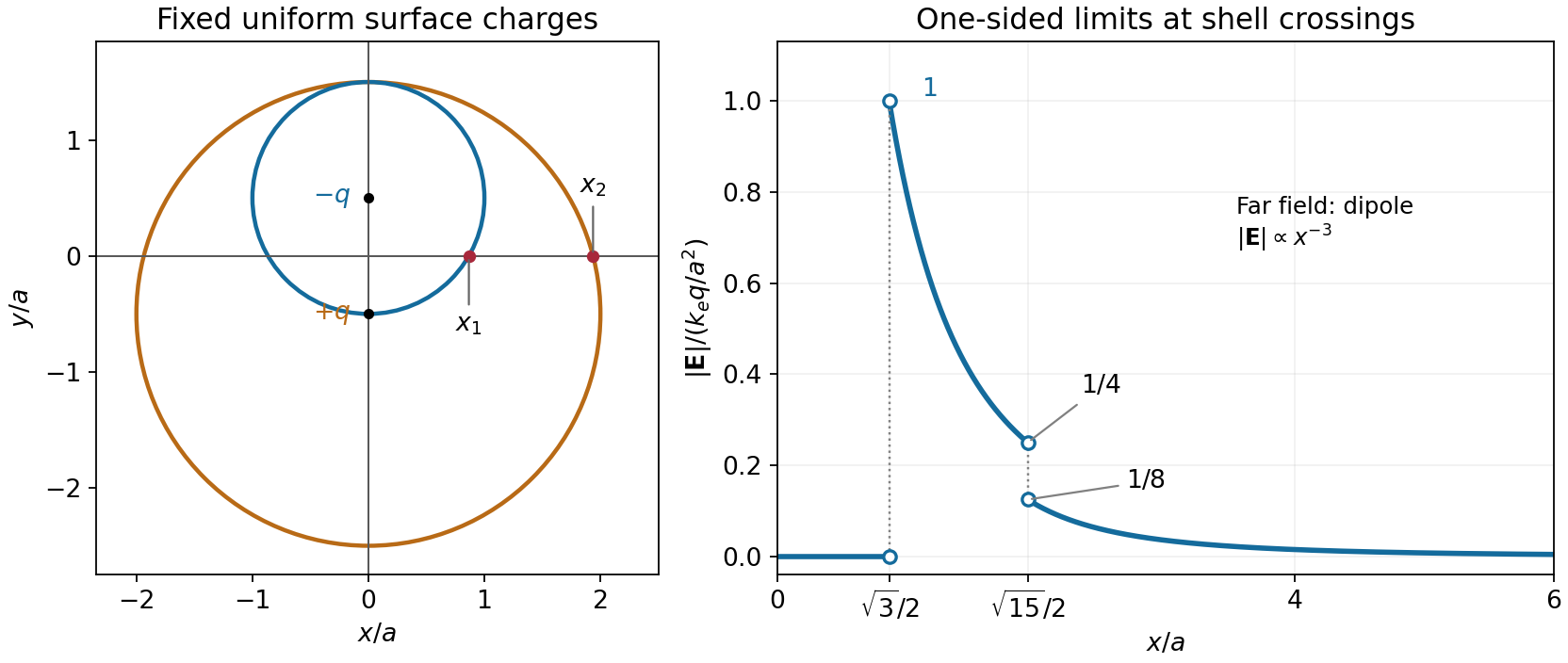
Geometry and electric-field magnitude for the two offset charged shells
. The open endpoints give the one-sided limits at the two surface crossings. The field is zero inside both shells and has a dipolar far-field tail. Details.
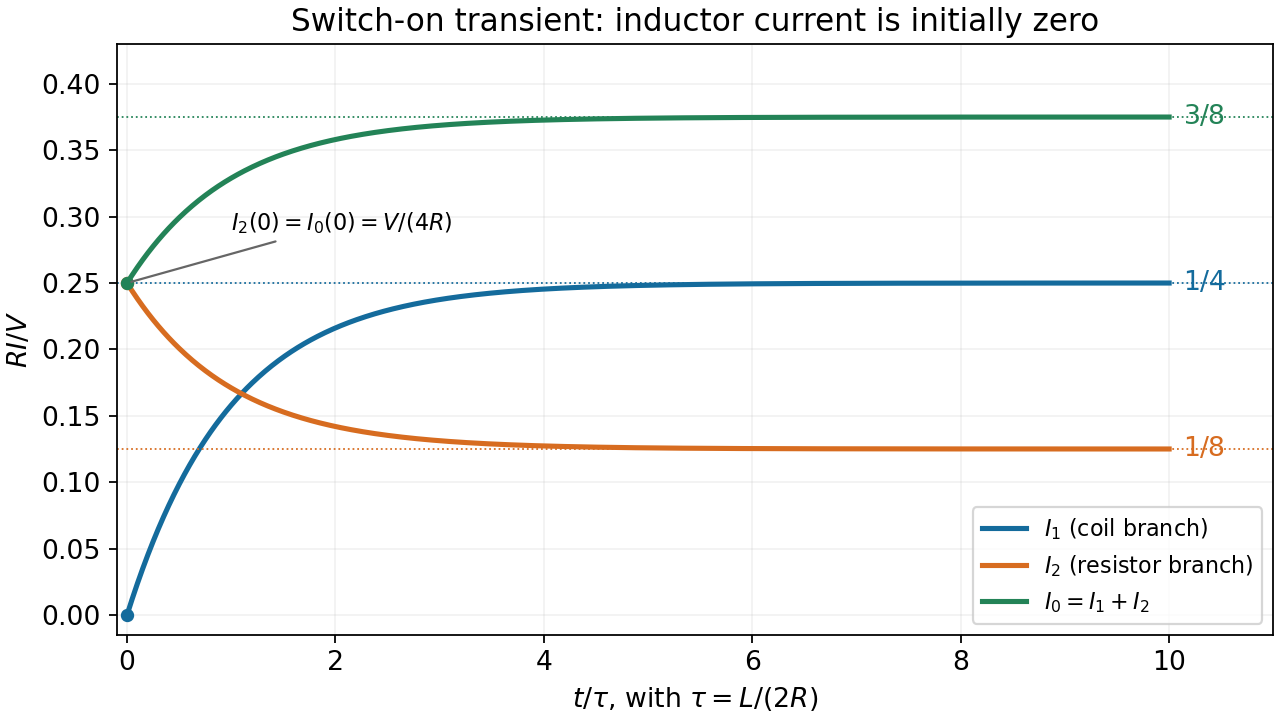
The source diagram has in series with two parallel branches: one containing then , and the other containing . Let their common voltage be , measured from the upper node to the lower return. Kirchhoff's current law and the branch laws giveUsing in the source equation yields . Substitution into the coil branch givesThe switch was open for a long time, so . Inductor current continuity gives for a finite applied voltage.
The constant particular solution is , and the homogeneous equation has decay rate . Imposing givesAs a separate check, the Thévenin equivalent seen by has open-circuit voltage and resistance , again giving .
Put . From and ,At the three values are and . At late times they are , , and . Thus and increase monotonically while decreases; every transient has the same time constant. By , the exponential correction is only of its initial amplitude.

Only the ideal inductor stores energy in this circuit; ideal resistors dissipate energy as heat. With ,The question excludes the battery's internal energy, and the continuously generated resistor heat is not stored electromagnetic energy.
Maxwell's equations in matter, with free charge and current densities, areFor vacuum, and , so the last equation is .
For a charging parallel-plate capacitor of area , neglect fringing. The field in the gap is , so the displacement current through the gap isAn Amperian loop around the feed wire can bound a surface cutting the wire, which has conduction current , or a bulging surface passing through the dielectric gap, which has no conduction current. Including displacement current makes both surfaces give the same magnetic circulation. It is also required by charge conservation: the divergence of the Ampère-Maxwell equation and Gauss's law yields , the continuity equation.
In charge- and current-free vacuum, . Taking the curl of Faraday's law and using the Ampère-Maxwell equation givesSince , it follows thatSubstituting a plane wave with phase gives and thereforeThe divergence equations make the waves transverse, and the curl equations fix .
The phase describes propagation along . With , the vacuum plane electromagnetic wave hasThus , , and . The field amplitudes are and , givingThe instantaneous magnitude ratio also equals wherever the fields are nonzero; at a node both vanish together. Their Poynting vector points along , checking the relative component signs.
Articles by others on the same topic
There are currently no matching articles.