Write for the vacuum wavelength. Initially the identical air-filled boxes add equal optical paths. When the refractive index in one box falls from to , the extra path in the box that remains full isIdentical fixed window contributions cancel. At the screen centre the geometric slit-path difference is zero, so, neglecting unequal transmission changes,Each extra optical path of one wavelength produces one full intensity period and one new maximum. Taking the stated count in the usual sense of 20 completed fringe periods during evacuation, excluding the initial maximum, and using for vacuum givesTaking , vacuum wavelength and ,If the quoted instead denotes the wavelength in ambient air, use and the exact relation . It gives , differing by less than from the vacuum-wavelength estimate, well below one-fringe counting resolution.
The count convention matters: 20 maxima including both the initial and final maxima span only 19 periods, giving approximately . If the final fractional fringe is not measured, an integer count alone has a resolution of order in refractive index. The standard 20-period estimate should therefore not be interpreted as an arbitrarily precise index measurement.
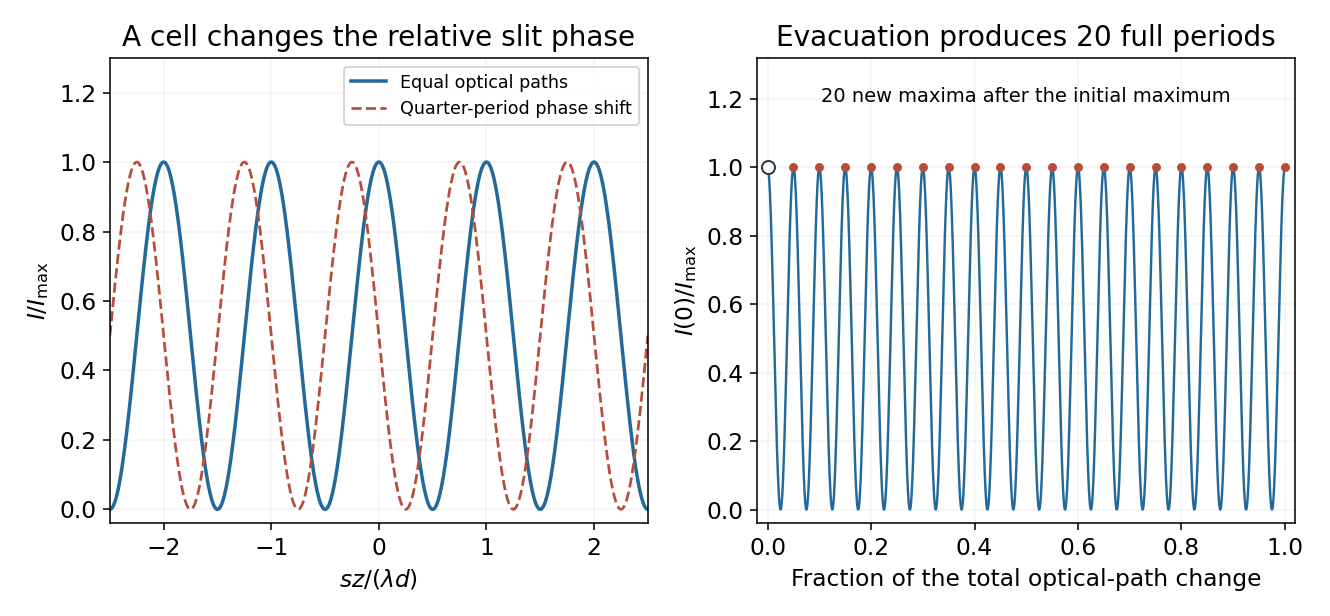
Optical-path phase shift and 20 completed centre-intensity fringe periods
. Details. 
Articles by others on the same topic
There are currently no matching articles.