Source paper: Oxford source archive, member
2015/CP2_Sept_2015.pdf. The dated cover establishes the 8 September 2015 resit. Unlettered marked blocks are indexed a, b and so on; all four Section B options are treated.Take the electric potential to vanish at infinity and work at . For a positive point charge in vacuum,The field is radial and outward. Since a radial scalar function has gradient ,Thus the two expressions have the required vector relationship. Adding an arbitrary constant to would leave the electric field unchanged; the chosen reference at infinity fixes that constant. The point-charge singularity itself is excluded from the ordinary derivative calculation.
Let and use bold for the magnetic flux density, to distinguish it from the scalar amplitude in . For a plane electromagnetic wave travelling along , Faraday's law gives the wave-associated fieldHenceFor an explicit component check, , while differentiating the displayed field gives equal to that vector. The field is transverse and also satisfies .
In vacuum, Ampère-Maxwell equation compatibility requires , so each factor is . More generally it is the inverse phase velocity on a suitable homogeneous-medium plane-wave branch. A time-independent background field could be added without changing the electric wave's Faraday equation; the requested propagating-wave field takes that independent background to be zero. Finally, confirms the propagation direction and the relative signs.
For a fixed number of identical bulbs, first approximate each as a resistor of electrical resistance connected to a fixed ideal battery electric potential difference . A series circuit has electrical resistance , while a parallel circuit has electrical resistance . ThusParallel connection therefore maximizes dissipation in this model: every bulb receives the full source electric potential difference instead of sharing it. For the two arrangements coincide.
An actual incandescent light bulb changes electrical resistance as its filament heats, so a single constant need not describe both operating points. The same qualitative conclusion holds for identical stable bulbs with increasing current-voltage function : parallel operation gives , whereas symmetric series operation gives . The former is larger for . This comparison assumes a fixed collection and an ideal source as specified; an unlimited number of parallel bulbs on a zero-internal-resistance ideal battery would have no finite total-power maximum.
The magnetostatic Ampère's law is , equivalently in vacuum. Let the wire radius be and take positive electric current along its axis. Cylindrical symmetry makes azimuthal and constant in magnitude on a radius- circular path, so .
Uniform electric current density gives . Inside the wire, ; outside, the full electric current is enclosed. ThereforeThe direction is set by the right-hand rule around the electric current. The magnitude starts at zero on the axis, rises linearly to at the surface and then falls as . The two expressions are continuous at . The long-wire approximation neglects end effects and any high-frequency redistribution of electric current.
Let and put charge per unit length on the inner shell and on the facing outer conductor. For a long coaxial Gaussian surface of radius in the gap, Gauss's law givesThe electric potential difference between the shells isWith total inner charge , the capacitance isThis assumes a vacuum or approximately air-filled gap and negligible fringing at the ends. A uniform linear dielectric replaces by its permittivity. The expression depends on the shell-to-shell potential difference, not on the arbitrary common potential reference.
For an ideal inductor of constant self-inductance , the passive-sign electric potential difference is . The supplied power is , so increasing the electric current quasistatically from zero storesAny electrical resistance would additionally dissipate energy as heat; it is not included in this stored magnetic energy.
For a long vacuum solenoid with turns, axial length and cross-sectional area , Ampère's law gives . Its flux linkage is , soThe nearly uniform field occupies volume , with negligible external-field energy in the long-solenoid approximation. Dividing its stored energy by this volume yieldsThe vacuum and linear-inductance assumptions matter; a nonlinear magnetic material requires the appropriate field-energy integral rather than simply substituting a varying inductance into .
Fermat principle states that the optical path length , equivalently the travel time in the nondispersive stationary isotropic ray model, is stationary for the actual light ray between fixed endpoints. It need not be a minimum in every optical system.
For two homogeneous media separated by , place the fixed endpoints at and , with positive heights. If the ray crosses at , its optical path isStationarity with respect to the crossing point givesThe two fractions are and , with angles measured from the interface normal. Thuswhich is Snell's law. Dividing by the vacuum light speed gives the corresponding travel time; minimizing geometric distance without refractive-index weighting would incorrectly predict a straight ray through unlike media.
Use nonrelativistic dynamics, take along , and neglect radiation. The Lorentz force initially points along . It does no work, so the speed stays and the trajectory inside the field is circular, withStarting from the entry point, the orbit can be parametrized as , , where . Its largest possible before turning back is . Therefore it enters the strict region exactly whenFor that case, the first boundary crossing satisfies . The velocity components are and , so the outgoing angle above the direction isThe zero-field limit is straight motion. At the particle only touches the far boundary tangentially and does not enter ; for it turns around before reaching that boundary and eventually returns through the entrance side. The equality case must therefore not be included in a crossing condition.
The electric field does work on the initially stationary particle. Thus the entry speed into the magnetic region isIn the source geometry the magnetic field is perpendicular to the page, and the particle enters perpendicular to the straight interface. Its return to that interface occurs after a semicircle. The separation between exit and return points is its orbit diameter, so the required separation gives . ConsequentlyFor the drawn field into the page and a positive charge entering upwards, the trajectory bends left. Its speed is constant while in the magnetic field, so the time there is the semicircle length divided by :The last form is half the cyclotron period and independently checks the geometric calculation.
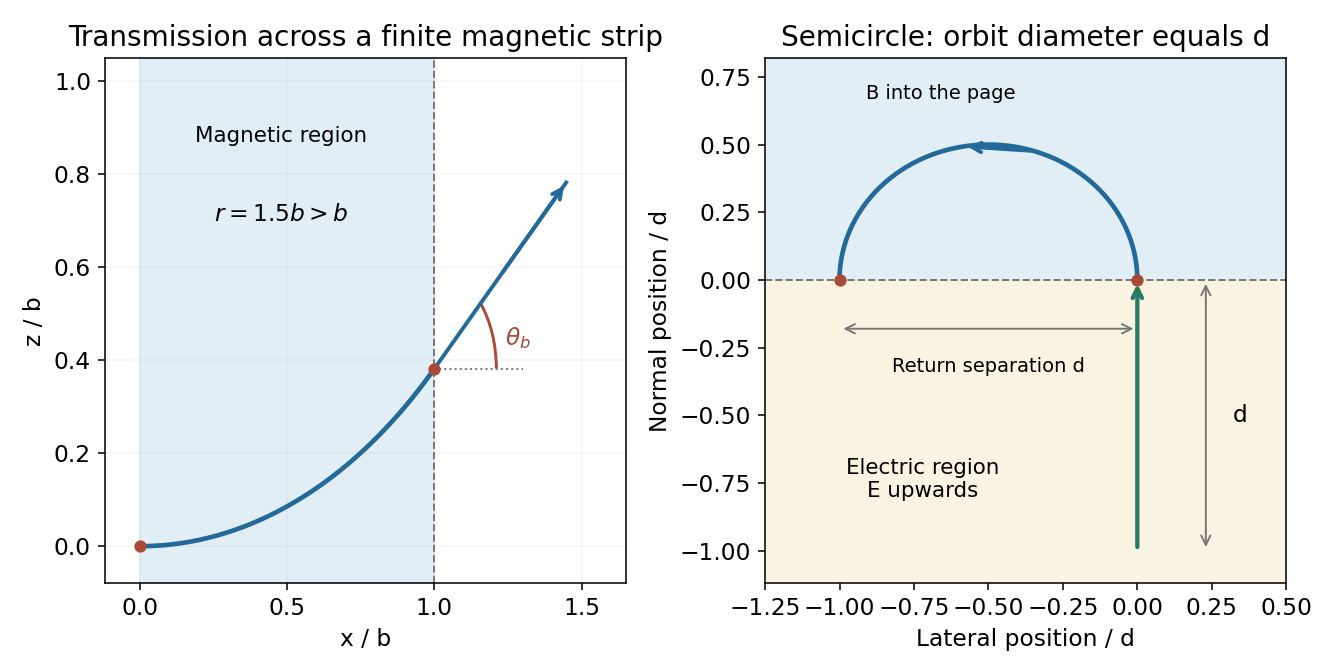
Finite magnetic-strip transmission and a semicircular return to the electric region
. Details. Label the capacitor's left terminal and right terminal , with the battery's negative node at zero. The source diagram has from to ground, from to ground, and a source-side resistor feeding from electric potential difference . The capacitor electric current flows from to ; flows through .
With the capacitor removed, and , so the Thévenin equivalent seen by the capacitor has . Suppress the ideal electric potential difference source to find its electrical resistance: the left terminal sees to ground and the right sees , giving between the terminals.
The initially uncharged capacitor electric potential difference therefore obeysSolving gives , with . The capacitor electric current is , henceAt , the short-like uncharged capacitor makes , so directly from the right resistor. At long times the capacitor carries no direct electric current. These endpoint checks agree with the exponential solution.
Kirchhoff's current law at the left capacitor terminal gives . Since ,Thus rises from to , whereas falls from to zero. Their derivatives have opposite signs, and both approach their limiting values on the same time scale . The graph uses electric currents in units of and time in units of .
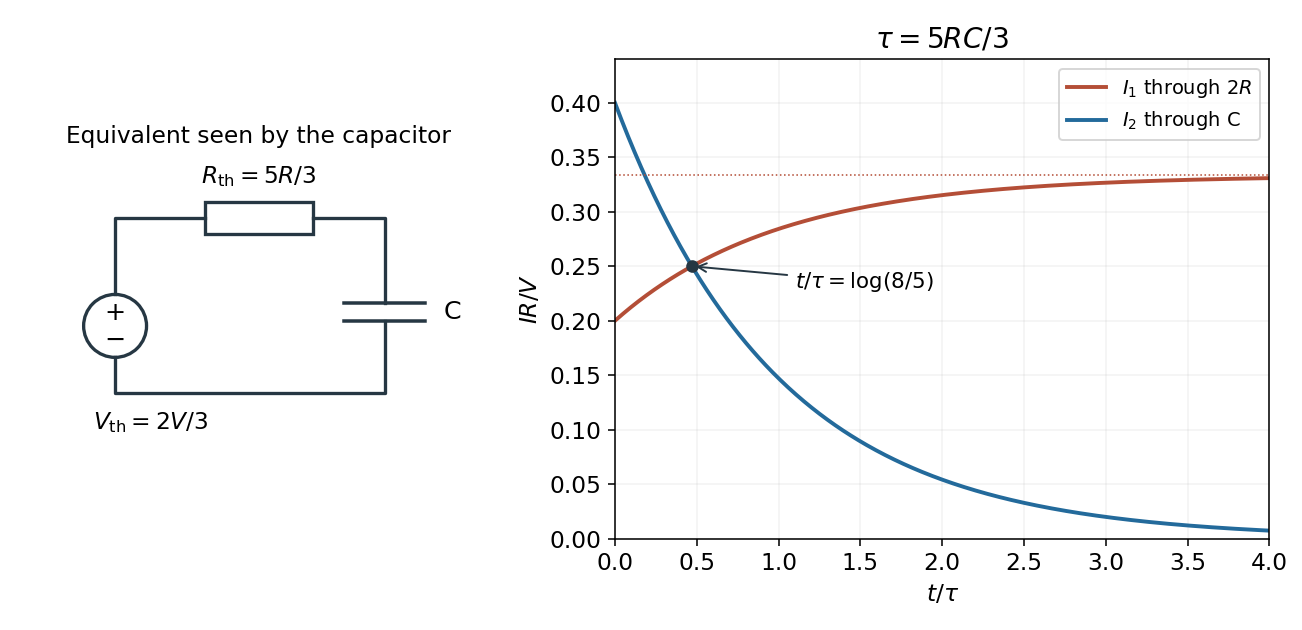
At equality, , so the common electric current is . Substituting the capacitor electric current givesThereforeFor and , and , giving . The battery electric potential difference cancels, as expected because every electric current scales linearly with it in this ideal linear circuit. The result assumes a nonzero source electric potential difference; with both electric currents vanish at all times.
The differential vacuum Gauss's law isIntegrate over a volume with closed boundary . The divergence theorem converts the left side into outward electric flux:This is the integral form. Surface charge can be treated by a thin-layer limit or by the corresponding jump in the normal field; the enclosed charge then includes the charged sheet. The surface orientation must be outward, and the field entering the integral is the total field, not merely the field of the enclosed charges alone.
Choose at the sheet, positive upwards, so the uniformly charged slab occupies . Use the usual isolated-plane superposition convention, with no imposed uniform background field. The slab alone produces above it, while the negatively charged sheet produces there. ConsequentlySince , the field is upward, away from the net positive charge distribution, with magnitude . The equal halves in the separate infinite-sheet fields follow from their reflection symmetry before superposition.
Below the slab, its own field is downward, . The negative sheet attracts a positive test charge upwards and contributes . Adding the fields givesThe magnitude equals the above-sheet value, but the direction is downward. This equality of outside magnitudes describes the zero-background solution for the given infinite charge planes; adding an externally imposed uniform field would constitute extra boundary data not specified here.
Inside the uniformly charged slab, its own electric field is : it vanishes at the slab's midplane and has derivative . Everywhere below the negative sheet, that sheet adds . ThereforeIts magnitude is the absolute value of this scalar coefficient. The field changes direction atFor it points downward; for it points upward, towards the negative sheet. Thus it is neither uniform nor directed upwards throughout the slab. The derivative and the field at the lower slab boundary also agree with Gauss's law and the previously found outside field.
The signed normal-field profile is constant and negative below , rises linearly through the slab, jumps down at the negative sheet, then remains constant and positive above. More explicitly,There is no surface charge at the slab's lower face, so the field is continuous there; only its slope changes. At the ideal sheet, the field jump isexactly the negative-sheet boundary condition. The ideal sheet itself has distinct one-sided fields rather than one common field value.
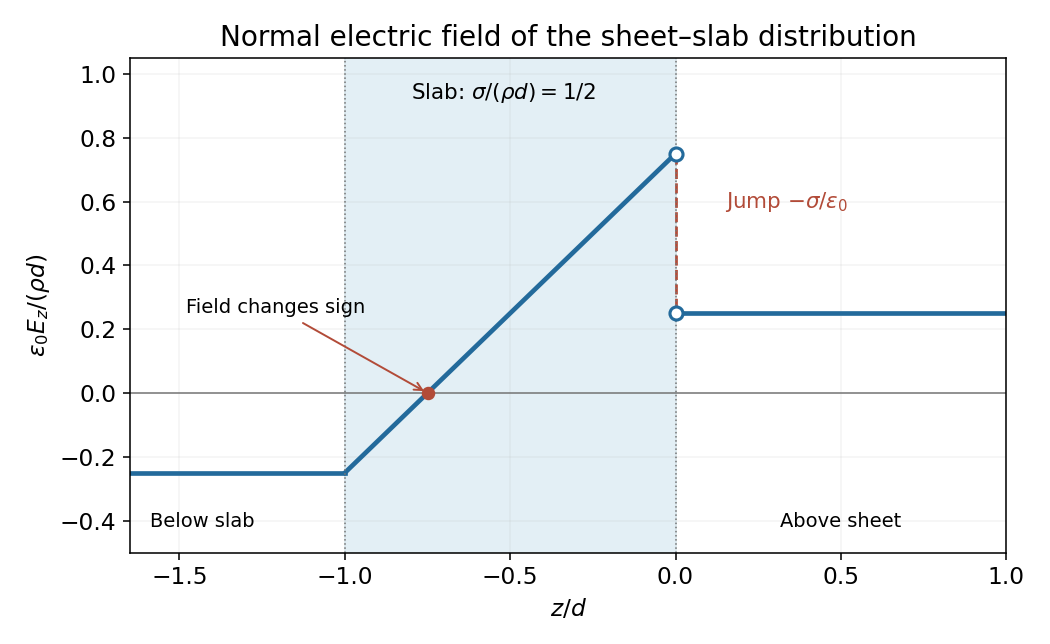


The graph uses the illustrative ratio , clearly separated from the symbolic general result. The zero occurs inside the lower half of the slab, and the two outside fields have equal magnitude and opposite sign.
For two identical narrow slits under coherent normal illumination, with the wavelength in the propagation medium, let be the intensity contributed by either slit alone in the relevant angular range. At far-field angle , the path difference is and the phase difference is . Adding the two complex amplitudes givesFor a screen perpendicular to the optical axis, . Thus the angular fringe factor uses ; in the paraxial region it reduces toThe supplied large-distance condition gives the Fraunhofer diffraction regime for the slit separation; the further replacement is a separate small-angle approximation. An unspecified finite slit width would add a single-slit envelope, and can then vary with angle. The formula above gives the interference factor in the ideal narrow-slit, equal-amplitude model; no absolute source intensity is supplied.
An ideal focusing lens maps propagation angle to position in its back focal plane, with for paraxial light rays. The two-slit relative phase remains , so the focal-plane interference pattern has the same form with propagation distance replaced by focal length:The new peak intensity accounts for focusing and need not equal the earlier screen peak. The lens forms the angular Fraunhofer pattern at a finite focal-plane distance, so a long free propagation distance is no longer needed to obtain that angular pattern. The displayed position formula assumes the same narrow-slit and paraxial approximations.
Write for the vacuum wavelength. Initially the identical air-filled boxes add equal optical paths. When the refractive index in one box falls from to , the extra path in the box that remains full isIdentical fixed window contributions cancel. At the screen centre the geometric slit-path difference is zero, so, neglecting unequal transmission changes,Each extra optical path of one wavelength produces one full intensity period and one new maximum. Taking the stated count in the usual sense of 20 completed fringe periods during evacuation, excluding the initial maximum, and using for vacuum givesTaking , vacuum wavelength and ,If the quoted instead denotes the wavelength in ambient air, use and the exact relation . It gives , differing by less than from the vacuum-wavelength estimate, well below one-fringe counting resolution.
The count convention matters: 20 maxima including both the initial and final maxima span only 19 periods, giving approximately . If the final fractional fringe is not measured, an integer count alone has a resolution of order in refractive index. The standard 20-period estimate should therefore not be interpreted as an arbitrarily precise index measurement.
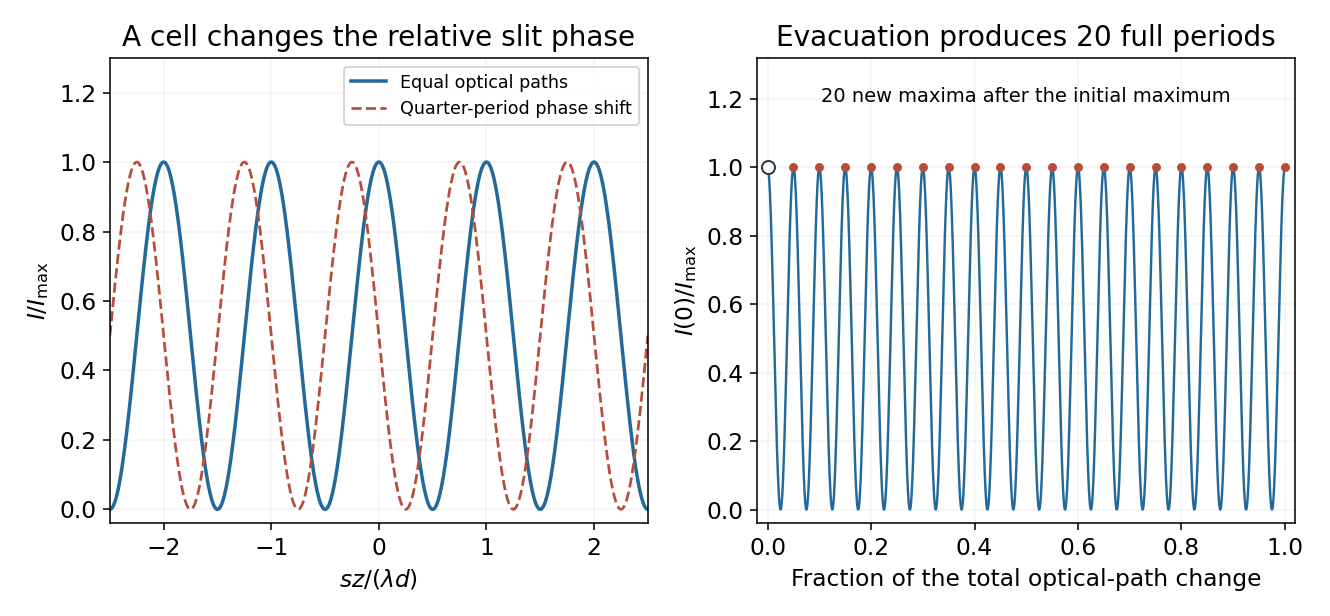
Optical-path phase shift and 20 completed centre-intensity fringe periods
. Details. 
Articles by others on the same topic
There are currently no matching articles.