For two identical narrow slits under coherent normal illumination, with the wavelength in the propagation medium, let be the intensity contributed by either slit alone in the relevant angular range. At far-field angle , the path difference is and the phase difference is . Adding the two complex amplitudes givesFor a screen perpendicular to the optical axis, . Thus the angular fringe factor uses ; in the paraxial region it reduces toThe supplied large-distance condition gives the Fraunhofer diffraction regime for the slit separation; the further replacement is a separate small-angle approximation. An unspecified finite slit width would add a single-slit envelope, and can then vary with angle. The formula above gives the interference factor in the ideal narrow-slit, equal-amplitude model; no absolute source intensity is supplied.
An ideal focusing lens maps propagation angle to position in its back focal plane, with for paraxial light rays. The two-slit relative phase remains , so the focal-plane interference pattern has the same form with propagation distance replaced by focal length:The new peak intensity accounts for focusing and need not equal the earlier screen peak. The lens forms the angular Fraunhofer pattern at a finite focal-plane distance, so a long free propagation distance is no longer needed to obtain that angular pattern. The displayed position formula assumes the same narrow-slit and paraxial approximations.
Write for the vacuum wavelength. Initially the identical air-filled boxes add equal optical paths. When the refractive index in one box falls from to , the extra path in the box that remains full isIdentical fixed window contributions cancel. At the screen centre the geometric slit-path difference is zero, so, neglecting unequal transmission changes,Each extra optical path of one wavelength produces one full intensity period and one new maximum. Taking the stated count in the usual sense of 20 completed fringe periods during evacuation, excluding the initial maximum, and using for vacuum givesTaking , vacuum wavelength and ,If the quoted instead denotes the wavelength in ambient air, use and the exact relation . It gives , differing by less than from the vacuum-wavelength estimate, well below one-fringe counting resolution.
The count convention matters: 20 maxima including both the initial and final maxima span only 19 periods, giving approximately . If the final fractional fringe is not measured, an integer count alone has a resolution of order in refractive index. The standard 20-period estimate should therefore not be interpreted as an arbitrarily precise index measurement.
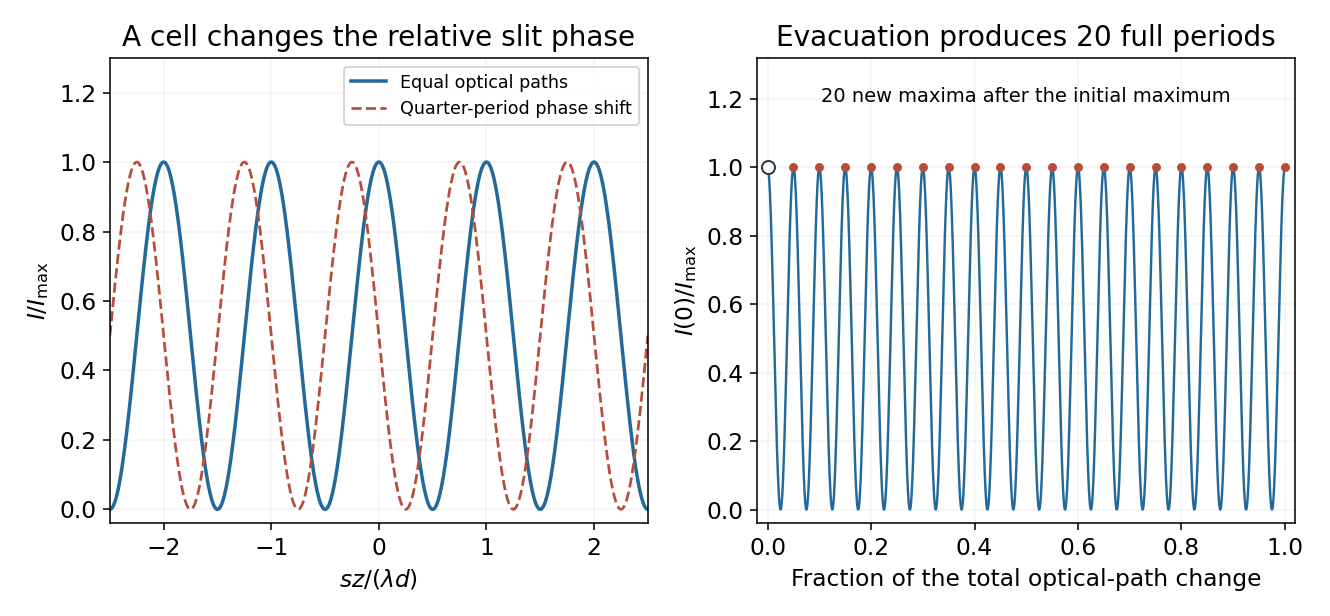
Optical-path phase shift and 20 completed centre-intensity fringe periods
. Details. 
Articles by others on the same topic
There are currently no matching articles.