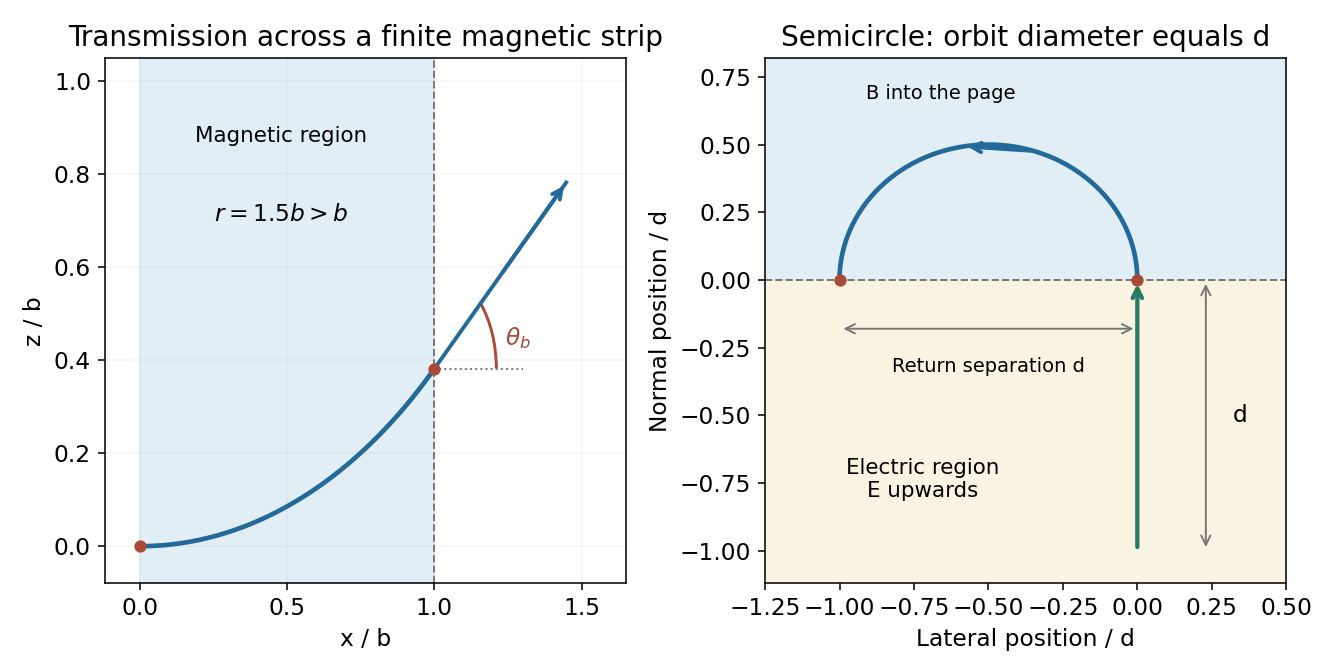
Use nonrelativistic dynamics, take along , and neglect radiation. The Lorentz force initially points along . It does no work, so the speed stays and the trajectory inside the field is circular, withStarting from the entry point, the orbit can be parametrized as , , where . Its largest possible before turning back is . Therefore it enters the strict region exactly whenFor that case, the first boundary crossing satisfies . The velocity components are and , so the outgoing angle above the direction isThe zero-field limit is straight motion. At the particle only touches the far boundary tangentially and does not enter ; for it turns around before reaching that boundary and eventually returns through the entrance side. The equality case must therefore not be included in a crossing condition.
The electric field does work on the initially stationary particle. Thus the entry speed into the magnetic region isIn the source geometry the magnetic field is perpendicular to the page, and the particle enters perpendicular to the straight interface. Its return to that interface occurs after a semicircle. The separation between exit and return points is its orbit diameter, so the required separation gives . ConsequentlyFor the drawn field into the page and a positive charge entering upwards, the trajectory bends left. Its speed is constant while in the magnetic field, so the time there is the semicircle length divided by :The last form is half the cyclotron period and independently checks the geometric calculation.

Articles by others on the same topic
There are currently no matching articles.